Are your conveyor wear parts failing prematurely under extreme mechanical loads, harsh chemicals, or scorching operating temperatures? Standard plastics like UHMW-PE are absolute workhorses for general sliding applications, but they rapidly lose dimensional stability and load-bearing capacity when operating limits get pushed.
Upgrading blindly to high-cost specialty polymers isn't the answer either. Knowing exactly when CF PEEK is the right choice for conveyor wear parts—and understanding how 30% carbon-fiber-reinforced PEEK (CF30 PEEK) fundamentally changes stiffness, creep resistance, and machining behavior compared to unfilled PEEK—is the key to solving severe wear problems without blowing your engineering budget.
Whether you are designing wear pads, bushings, or custom alignment components for high-demand processing environments, understanding the real-world performance trade-offs will help you specify the exact material system your application requires.
When Is CF PEEK the Right Choice for Conveyor Wear Parts?
Why Conveyor Wear Parts Need Application-Specific Material Selection
Conveyor systems operate under vastly different thermal, mechanical, and chemical environments. Using a generic wear plastic often leads to rapid deformation, accelerated wear, or sudden component failure. Selecting CF PEEK conveyor wear parts based on specific operating parameters prevents costly downtime and extends maintenance cycles.
- Mechanical Load: High static or dynamic weights require high creep resistance.
- Thermal Exposure: Elevated continuous temperatures degrade commodity and engineering plastics.
- Chemical Exposure: Aggressive washdown chemicals demand broad chemical inertness.
- Sliding Speed: High-speed motion generates frictional heat that softens standard polymers.
What 30% Carbon-Fiber-Reinforced PEEK Changes Compared With Unfilled PEEK
Integrating 30% short carbon fibers into the polymer matrix (CF30 PEEK) significantly upgrades the mechanical and thermal capabilities of standard unfilled PEEK.
| Property | Unfilled PEEK | 30% Carbon Fiber PEEK (CF30) |
|---|---|---|
| Flexural Modulus (Stiffness) | Standard (~3.8 GPa) | Ultra-High (~10–12 GPa) |
| Compressive Strength | Moderate | Maximum Load Bearing |
| Coefficient of Thermal Expansion (CTE) | Higher Thermal Drift | Ultra-Low Dimensional Change |
| Thermal Conductivity | Low Heat Dissipation | Enhanced Heat Transfer Away from Friction Surface |
Why CF30 PEEK Is a Specialized Rather Than Default Conveyor Material
While carbon fiber PEEK wear parts deliver unmatched performance, CF30 PEEK is an application-specific polymer rather than a default replacement for standard conveyor wear material. Because of its higher material cost and increased tool wear during CNC machined PEEK parts fabrication, it is specified when standard options like UHMW-PE, Acetyl, or unfilled PEEK reach their physical operating limits.
Operating Conditions That Can Justify CF30 PEEK
Standard engineering plastics often hit a wall in demanding industrial environments. We specify CF30 PEEK (30% carbon-fiber-reinforced PEEK) when line speeds, heavy loads, and aggressive thermal or chemical conditions push standard materials past their physical limits.
| Operating Condition | Standard Plastics (UHMW-PE / Acetal) | CF30 PEEK Capability |
|---|---|---|
| Max Continuous Temp | 80°C - 100°C | grade/datasheet dependent |
| Flexural Modulus | ~1.0 to 3.0 GPa | ~11.0 to 13.0 GPa |
| Thermal Expansion (CTE) | High (prone to warping) | Extremely Low |
| Chemical & Steam Exposure | Limited hot water/steam | Excellent chemical and CIP/SIP resistance |
Elevated Temperatures Beyond Common Conveyor Plastics
High-speed processing lines and heat-curing tunnels generate continuous friction and ambient heat that soften standard polymers. UHMW-PE and POM deform rapidly above 90°C, causing belt jams and unexpected wear. Carbon fiber PEEK wear parts maintain structural integrity at continuous operating temperatures up to 250°C (482°F) without losing mechanical strength. For high-temperature processing zones, choosing custom CF30 PEEK wear parts for food conveyors ensures smooth belt travel without thermal softening.
Higher Mechanical Loads and Stiffness Requirements
Standard conveyor plastics creep and flex under heavy point loads over time. Adding 30% carbon fiber to PEEK dramatically boosts flexural modulus and tensile strength, preventing deformation under sustained mechanical stress.
High compressive strength: Prevents permanent distortion under heavy container weight.
Superior fatigue resistance: Retains shape during continuous cyclic loading.
Reduced deflection: Ensures long conveyor spans don't sag or bind sliding chains.
Applications Requiring Greater Dimensional Stability
Thermal expansion causes standard plastic guide rails and wear pads to expand, buckle, or pinch moving components. Carbon-fiber reinforcement significantly lowers PEEK's coefficient of thermal expansion (CTE).
Tight tolerances: Maintains exact positioning in automated pick-and-place lines.
Reduced thermal distortion: Helps maintain wear-track geometry across temperature changes.
Consistent fit: Holds precision bore and bushing clearances during cold starts and high-heat operation.
Chemically Demanding Processing Environments
In processing lines requiring aggressive chemical washdowns, live steam sterilization, or exposure to harsh solvents, baseline materials degrade rapidly.
Chemical immunity: Resists harsh solvents, acids, and aggressive CIP (clean-in-place) chemicals.
Hydrolysis resistance: Withstands continuous exposure to hot water and steam without swelling or softening.
Material evaluation: To evaluate how CF30 PEEK compares against other options in processing lines, review our detailed UHMW-PE vs POM vs PEEK for food conveyors guide.
How Carbon-Fiber Reinforcement Changes PEEK Performance
Adding 30% carbon fiber to raw PEEK changes the structural capabilities completely. It shifts the material from a tough, high-temperature polymer to a rigid, high-modulus composite designed to tackle heavy mechanical stresses.
Higher Stiffness and Reduced Deformation Under Load
Short carbon fibers dramatically increase the material's flexural modulus. While unfilled PEEK can flex under high weight, 30% carbon fiber PEEK maintains structural integrity under severe mechanical forces.
- Increased Rigidity: Flexural modulus jumps significantly, keeping CF30 PEEK parts flat and dimensionally stable.
- Minimized Deflection: High-load sliding zones experience minimal bending, preventing belt mistracking and equipment jams.
- Compact Designs: Higher stiffness allows for thinner PEEK wear components without sacrificing load capacity.
Dimensional Stability Across Temperature Changes
Thermal expansion often compromises tight tolerances in high-heat production environments. Carbon fiber reinforcement lowers the Coefficient of Thermal Expansion (CTE), stabilizing part dimensions through thermal cycling.
- Reduced Thermal Growth: CF PEEK expands far less than standard conveyor plastics under extreme heat.
- Consistent Clearances: Precision bushings and alignment plates maintain critical tolerances without binding.
- Predictable Fit: Minimal dimensional drift ensures smooth operation from cold start-ups to peak operating temperatures.
Strength and Creep Considerations Under Sustained Loads
Unreinforced plastics gradually deform under long-term pressure—a condition known as creep. Carbon fiber PEEK wear parts eliminate this structural weakness under continuous load.
- Creep Resistance: Retains original geometry under prolonged static and dynamic compression.
- Higher Yield Strength: Handles high mechanical loads and sudden line shock without permanent deformation.
- Extended Fatigue Life: Resists micro-cracking over millions of operating cycles.
The Trade-Offs Introduced by Carbon-Fiber Reinforcement
Carbon fiber provides exceptional strength, but it introduces specific material trade-offs that must be evaluated during design.
- Counter-Surface Wear: Exposed carbon fibers can act as micro-abrasives against softer mating metals like unhardened steel or aluminum.
- Lower Impact Toughness: Increased rigidity reduces impact resistance compared to ductile, unreinforced polymers.
- Anisotropic Behavior: Mechanical properties and thermal expansion vary depending on fiber orientation during processing.
- Higher Investment: Increased material costs require clear functional justification over standard engineering plastics.
Wear and Friction: Is CF PEEK Always Better?
Upgrading to 30% carbon-fiber-reinforced PEEK does not automatically solve every friction and wear issue on a conveyor line. While carbon reinforcement excels in heavy-load scenarios, adding fibers alters how the material interacts with mating surfaces, meaning a higher price tag does not guarantee lower wear.
Why Carbon-Fiber Reinforcement Does Not Guarantee Lower Wear
Carbon fibers dramatically increase stiffness and load capacity, but exposed fiber ends at the contact interface can act as micro-abrasives. In light-load or high-speed sliding setups, unfilled PEEK or self-lubricating grades often deliver a lower coefficient of friction and cause far less counter-surface wear than CF30 PEEK.
How Load, Sliding Speed and Temperature Affect Wear Behavior
Wear rates depend heavily on your system's pressure and velocity parameters:
- High Mechanical Loads: CF PEEK prevents localized deformation, keeping the contact geometry stable under heavy pressure.
- High Sliding Speeds: Rapid sliding generates localized surface heat, where carbon fibers help maintain structural integrity.
- Elevated Temperatures: Higher ambient or friction-induced temperatures favor CF PEEK over standard engineering plastics that soften prematurely.
The Importance of Mating-Surface Material and Finish
The material sliding against your polymer dictates overall service life. Carbon-reinforced compounds perform best against hard, polished metals like hardened steel or ceramics. Running CF PEEK against soft aluminum or raw stainless steel can cause rapid abrasive wear on the metal side. For severe wear tracks, combining high-performance polymers with DLC-coated components provides the ultimate hard, low-friction mating surface.
Frictional Heat, Lubrication and Dry-Running Conditions
In dry-running conveyor applications, localized frictional heat builds up fast. Carbon fibers increase thermal conductivity, helping conduct heat away from the sliding interface better than unreinforced polymers. However, if washdown fluids or process lubricants are present, hydrodynamic films often form more effectively on smoother, unfilled polymers.
Why Critical Wear Interfaces May Require Application Testing
Because wear is a system-level property rather than a pure material constant, theoretical calculations only go so far. Before finalizing material selection for custom production lines or high-speed machinery, testing prototype parts—such as specialized pet food wear tracks—under real operating loads, speeds, and washdown environments is essential for validating long-term reliability.
CF PEEK vs. UHMW-PE for Conveyor Wear Parts
When UHMW-PE Is the More Practical Choice
UHMW-PE remains the industrial workhorse for general-purpose material handling. If your system operates under ambient temperatures, moderate mechanical loads, and routine sliding conditions, UHMW-PE delivers exceptional impact resistance and a very low coefficient of friction at a minimal cost. For standard packaging, bottling, and sorting lines, implementing food-grade UHMW-PE guide rails and wear strips provides reliable, low-wear performance without over-engineering the equipment.
When Temperature or Stiffness Can Favor CF PEEK
Standard UHMW-PE begins to soften and lose load-bearing capability above 80°C (176°F). In contrast, 30% carbon-fiber-reinforced PEEK (CF30 PEEK) maintains high mechanical strength and rigidity at continuous temperatures exceeding 200°C (392°F). The integrated carbon fibers dramatically increase structural stiffness, preventing sagging, deflection, and premature wear under high loads where commodity polymers quickly fail.
Comparing Dimensional Stability and Mechanical Load Requirements
High-temperature capability; verify the selected compound datasheet:
| Performance Metric | UHMW-PE | CF30 PEEK |
|---|---|---|
| Max Operating Temp | ~80°C (176°F) | grade/datasheet dependent |
| Flexural Modulus | Low (~1.0 GPa) | Extremely High (~11.5 GPa) |
| Thermal Expansion | High (Thermal drift under heat) | Very Low (Tight tolerance stability) |
| Creep Resistance | Prone to deformation under continuous load | High resistance to cold flow and creep |
| Cost Profile | Low cost, economical bulk material | Premium specialized material |
Why Higher Material Cost Must Solve a Real Engineering Problem
We always evaluate material performance against total operational value. CF PEEK carries a significant cost premium over standard thermoplastics. Upgrading to CF30 PEEK makes financial sense only when it resolves a severe engineering constraint—such as heat distortion, mechanical creep, or continuous line stoppage caused by component degradation. If UHMW-PE meets your operational temperature and load profiles, stick with it. If severe environment demands cause standard plastic failure, CF PEEK justifies the investment.
CF PEEK vs. Unfilled PEEK for Conveyor Components
While both options belong to the polyetheretherketone family, choosing between 30% carbon-fiber-reinforced PEEK (CF30 PEEK) and unfilled PEEK comes down to mechanical load, thermal stability, and mating surface compatibility. When evaluating high-performance polymers for demanding production lines, reviewing specialized machined PEEK materials provides a clear benchmark for mechanical and thermal performance.
Differences in Stiffness and Dimensional Behavior
Carbon-fiber reinforcement significantly improves creep resistance and helps reduce long-term deformation under sustained loads.
| Property | Unfilled PEEK | CF30 PEEK |
|---|---|---|
| Flexural Modulus | ~3.8 GPa | ~13 GPa (3x Higher Stiffness) |
| Thermal Expansion (CLTE) | Higher rate of growth | Significantly lower expansion |
| Creep Resistance | Moderate under heavy load | Superior under sustained loads |
| Impact Strength | Higher toughness/ductility | Stiffer, but more brittle |
Differences in Machining and Surface Interaction
- Cutting & Tool Wear: Unfilled PEEK machines cleanly with standard carbide tooling. CF30 PEEK contains highly abrasive short carbon fibers that require specialized diamond-coated (PCD) tooling during CNC machining to maintain tight tolerances.
- Mating Surface Wear: Unfilled PEEK features a smooth, ductile surface ideal for running against softer metals. CF30 PEEK is exceptionally rigid, but exposed carbon fibers can cause abrasive wear on soft aluminum or unhardened steel counter-faces over time.
When Unfilled PEEK May Be the Better Choice
- Soft Counter-Face Materials: Ideal when sliding directly against soft aluminum, brass, or standard 304 stainless steel without scoring the guide track.
- High Impact Conditions: Better shock absorption prevents brittle fractures under sudden mechanical impact or localized dropping loads.
- Cost Efficiency: Delivers top-tier chemical and thermal resistance at a lower material cost when extreme structural stiffness is unnecessary.
Why the OEM Material Specification Should Take Priority
Over-engineering a component by blindly swapping unfilled PEEK for CF30 PEEK can backfire. If an OEM engineered a conveyor wear component out of unfilled PEEK, they likely factored in counter-face hardness, thermal expansion gaps, and impact tolerance. We always recommend sticking strictly to the OEM material specification unless a clear structural failure, severe thermal deformation, or load-induced creep demands an upgrade to carbon-fiber-reinforced material.
Typical Conveyor Components That May Use CF30 PEEK
Not every section of a conveyor requires carbon-fiber-reinforced PEEK. We recommend reserving this material for localized, high-stress zones where lower-cost plastics deform, soften, or wear out prematurely under heavy mechanical loads and elevated thermal stress.
Wear Pads and Guide Blocks
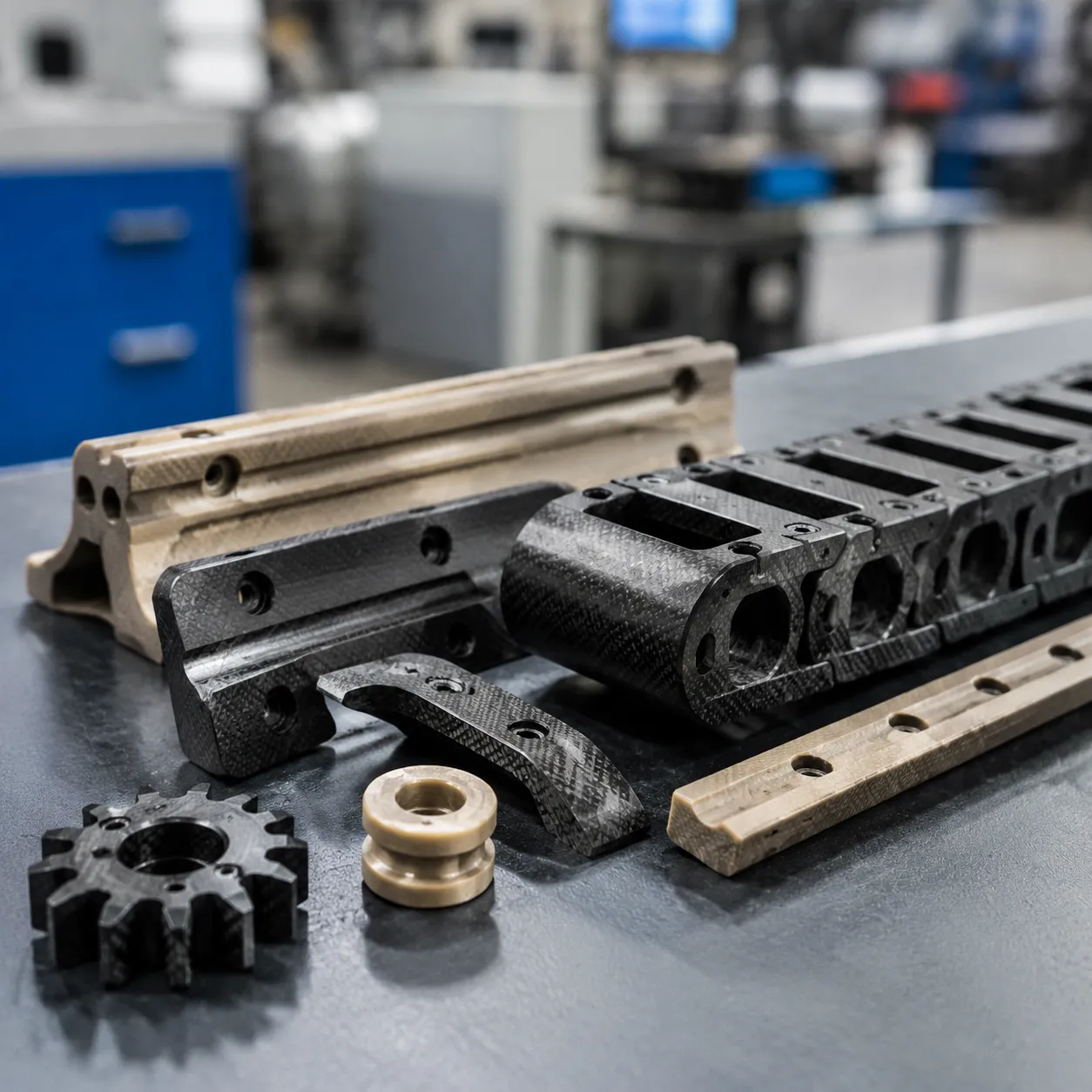
When high sliding speeds combine with heavy contact pressure and elevated heat, standard plastic guides expand or deform. CF30 PEEK wear pads maintain strict flatness and offer high creep resistance under continuous load. Integrating carbon-fiber-reinforced PEEK into high-wear zones provides long-term stability and keeps continuous processing lines operating smoothly. High-performance conveyor wear parts made from CF30 PEEK protect critical line sections from thermal deformation while extending maintenance intervals.
Bushings, Spacers and Support Components
In high-temperature process zones, traditional sleeve bushings often expand and bind against rotating shafts. CF30 PEEK offers low thermal expansion, high compressive strength, and reliable load-bearing performance under dry-running conditions.
- Sleeve Bushings: Prevent shaft binding at operating temperatures exceeding 150°C.
- Structural Spacers: Maintain precise axial clearances under sustained clamping forces without creeping.
- Support Rollers: Provide rigid rotational support in chemical wash or hot-air drying environments.
These elements fit directly into heavy-duty conveyor machine components to eliminate frequent wear-related shutdowns.
Precision Sliding and Alignment Components
Precision container handling and positioning systems require components that preserve exact tolerances during continuous temperature shifts. Carbon fiber PEEK wear parts provide high dimensional stability, eliminating slop and binding in precision sliding mechanisms.
- Linear Alignment Guides: Prevent deflection in high-speed precision indexing systems.
- Sensor & Actuator Mounts: Keep critical process sensors accurately positioned near heat sources.
- Sliding Shoes: Deliver rigid, predictable linear motion under high downward forces.
Custom Replacement Parts Specified in CF30 PEEK
When OEM plastic parts fail repeatedly due to unexpected load spikes or extreme ambient heat, custom-machined CF30 PEEK components offer a direct engineering upgrade. We machine high-precision replacement parts directly from CAD models to match original equipment dimensions while drastically improving structural stiffness, wear life, and thermal resistance across demanding production environments.
CNC Machining Considerations for CF30 PEEK Wear Parts
Machining CF30 PEEK requires a different operational approach than cutting unfilled polymers. The 30% carbon fiber reinforcement creates a stiff, abrasive composite that requires optimized tooling, strict thermal management, and specialized workholding to produce reliable CNC machined PEEK parts.
How Carbon Fiber Affects Cutting Tool Wear
The embedded carbon fibers act as an abrasive during cutting. Uncoated carbide tools dull rapidly, leading to dimensional drift, poor surface finishes, and fiber tear-out.
- Tooling Selection: Use solid carbide with diamond-like carbon (DLC) coatings or PCD (polycrystalline diamond) tooling for long production runs.
- Tool Geometry: Select sharp, positive rake geometries to shear the fibers cleanly rather than pushing them into the polymer matrix.
Managing Cutting Heat During Machining
CF PEEK has low thermal conductivity, meaning heat stays concentrated at the tool tip and work interface rather than dissipating into the chip.
- Coolant Strategy: Use clean water-soluble coolants or continuous high-pressure air blasts to control temperatures and remove fine composite dust.
- Tool Engagement: Maintain continuous chip loads with higher feed rates and moderate cutting speeds to prevent friction and localized melting.
Controlling Bores, Fits and Thin Features
Holding tight tolerances on internal bores and slender profiles requires careful process sequencing due to directional fiber alignment and residual stress.
- Two-Pass Machining: Rough-machine components to leave uniform stock, allow internal stresses to relax, and finish to final dimensions.
- Structural Deflection: When manufacturing complex geometries, understanding how thin-wall design affects CNC accuracy helps prevent tool pressure from deflecting thin sections on carbon fiber PEEK wear parts.
Workholding Without Distorting Precision Polymer Components
While CF PEEK conveyor wear parts offer far higher flexural modulus than standard plastics, localized clamping force can still introduce distortion.
- Custom Soft Jaws: Machined aluminum or plastic soft jaws wrap around the component profile to distribute clamping pressure evenly.
- Fixture Plates: Use vacuum chucks or dedicated modular fixtures for flat wear strips and guide plates to eliminate mechanical clamping distortion.
Maintaining Dimensional Consistency in Batch Production
Running consistent batches of high-precision components requires controlling environmental and mechanical variables throughout the shift.
| Process Parameter | CF30 PEEK Machining Protocol | Functional Benefit |
|---|---|---|
| Tooling Inspection | Scheduled offset checks and PCD tooling | Prevents tool wear from enlarging bore tolerances |
| Thermal Stabilization | Temperature-controlled coolant and shop environment | Eliminates thermal growth during long cycles |
| Chip Evacuation | High-flow flush at the cutting zone | Prevents recutting abrasive chips and scoring surfaces |
| Part Clamping | Torque-limiting wrenches on all workholding | Ensures repeatable part geometry across batches |
Food Conveyor Applications and Material Compliance
Why PEEK Does Not Automatically Mean Food-Contact Compliant
Many engineers assume all PEEK wear components are inherently food-safe because virgin PEEK polymer is widely approved for food processing. However, introducing 30% carbon fiber changes the material's regulatory status. The carbon fibers, binders, and sizing agents used during compounding often do not meet FDA or EU 10/2011 direct food contact requirements. Knowing when CF PEEK is the right choice for conveyor wear parts requires distinguishing between structural drive components and direct food-handling surfaces.
Checking the Exact PEEK Grade and Compound
We evaluate raw resin specifications before machining PEEK sliding components to ensure full compliance with regional regulations. Standard industrial CF30 PEEK handles extreme mechanical loads but belongs in non-contact zones unless a specialty certified grade is specified.
| Material Grade | Filler System | FDA / EU 10/2011 Compliance | Ideal Conveyor Function |
|---|---|---|---|
| Unfilled PEEK | None | Compliant (grade dependent) | Direct product guides, scrapers, pushers |
| Standard CF30 PEEK | 30% Industrial Carbon | Non-compliant (Industrial use) | High-load wear strips, drive bushings, guide rails |
| Food-Grade CF PEEK | FDA-compliant Carbon & Sizing | Compliant (specialty compound) | High-temp, high-load food handling components |
Material Documentation and Customer-Specified Compliance Requirements
Sanitary processing lines require complete lot traceability from raw polymer stock to finished components.
- Certificates of Conformance: We secure full material test reports (MTRs) and lot traceability documents before machining begins.
- Hygienic Line Integration: Heavy-load carbon fiber PEEK wear parts in washdown zones often pair with corrosion-resistant metal hardware, such as custom 316L washdown bearing housings for food conveyors, to ensure the entire assembly passes inspection.
- Regulatory Alignment: Always verify whether your line requires FDA 21 CFR 177.2415, EU 10/2011, or 3-A Sanitary Standards prior to finalizing component drawings.
When CF30 PEEK Is Not the Right Choice
Over-engineering conveyor wear parts adds unnecessary expense without providing extra reliability. While 30% carbon-fiber-reinforced PEEK offers exceptional rigidity and heat tolerance, it is simply not needed for every application.
When UHMW-PE Already Meets the Operating Requirements
If your operating environment features ambient temperatures, continuous washdowns, and high impact, standard polymers are usually superior. For everyday low-friction wear strips and guide rails, choosing versatile UHMW-PE material solutions delivers outstanding impact strength and self-lubrication at a fraction of the cost.
When Higher Stiffness or Temperature Capability Is Unnecessary
CF30 PEEK shines above 300°F (150°C) and under intense mechanical loads. If your conveyor operates at normal room temperatures with light-to-medium loads, the extreme thermal resistance and flexural modulus of carbon-fiber reinforcement offer zero operational gain.
When Sliding Conditions Favor a Different Material System
The microscopic carbon fibers in CF30 PEEK make the material exceptionally stiff, but they can also cause wear on softer mating surfaces.
- Soft Mating Metals: Aluminum, brass, or soft stainless steel can experience micro-abrasion from carbon fibers over long duty cycles.
- Low-Friction Dry Running: Materials like PTFE-filled or lubricated polymers often yield lower friction coefficients against unhardened counter-surfaces.
When Added Material Cost Provides No Functional Benefit
CF30 PEEK raw stock can cost significantly more than standard commodity and engineering plastics. We evaluate performance requirements against raw material cost to ensure every specified part justifies its budget.
| Material | Relative Cost | Key Advantage | Best Conveyor Fit |
|---|---|---|---|
| UHMW-PE | Baseline ($) | High impact, low friction | Standard wear strips, guides, ambient lines |
| Unfilled PEEK | High ($$$$) | Chemical purity, high heat | Food/pharma contact, moderate load, high heat |
| CF30 PEEK | Premium ($$$$$) | High stiffness, dimensional stability | High-load precision bushings, extreme heat wear blocks |
Selecting versatile industrial polymer materials tailored specifically to your operating conditions keeps maintenance costs predictable while maintaining maximum line uptime.
How to Specify a CF PEEK Conveyor Wear Part
When you decide that CF PEEK conveyor wear parts are necessary for high-load or extreme-temperature lines, getting the specification right upfront prevents costly material waste and machining rework. We work closely with engineering teams to translate operating demands into precise material and manufacturing callouts.
Define Operating Temperature, Load and Sliding Conditions
Before ordering custom components, document the complete thermal and mechanical profile of the conveyor interface. Carbon-fiber-reinforced PEEK handles heavy strain, but precise data ensures proper material selection.
- Continuous vs. Peak Temperatures: Identify standard operating temps and short-term thermal spikes during clean-in-place (CIP) cycles.
- Mechanical Load & Velocity: Calculate the Pressure-Velocity (PV) limit to confirm that 30% carbon fiber PEEK (CF30 PEEK) will operate without surface degradation.
- Duty Cycle: State whether sliding motion is continuous or intermittent, as thermal buildup directly impacts wear rates.
Identify Mating Materials and Contact Surfaces
CF30 PEEK is exceptionally stiff, which means it behaves differently against opposing sliding surfaces than softer plastics like UHMW-PE.
| Mating Material | General Consideration |
|---|---|
| Hardened steel | Suitable candidate; evaluate finish, load, and sliding conditions |
| Stainless steel | Surface finish and hardness should be evaluated for the specific interface |
| Aluminum | Evaluate counter-surface wear carefully, especially under loaded sliding contact |
Specify the Exact PEEK Compound and Compliance Requirements
Not all carbon-filled polymers perform identically. When drafting your bill of materials, clearly define the exact resin grade and regulatory approvals:
- Fiber Percentage: Explicitly specify CF30 PEEK (30% pitch or PAN-based carbon fiber reinforcement).
- Brand/Grade: State approved raw material manufacturers (e.g., Victrex, Ensinger, or Röchling) to ensure raw stock consistency.
- Regulatory Compliance: Call out FDA, EU 10/2011, or 3-A Sanitary standards if the part operates near food processing lines.
Provide Drawings, CAD Models and Critical Inspection Requirements
Carbon fiber reinforcement introduces directional stiffness and unique machining characteristics. Providing detailed 3D CAD models alongside 2D engineering drawings ensures exact dimensional control.
Always specify critical fitting tolerances for bores, bearing seats, and alignment pins. Understanding how to manage tolerance stack-up across high-stiffness components guarantees your CNC machined PEEK parts fit smoothly without binding during thermal expansion. Indicate key inspection points on your print so we can verify critical dimensions post-machining.