When Do Titanium Guide Components Make Sense in Packaging Machinery?
Titanium guide components offer high structural strength, low density, and high chemical resistance for advanced packaging machinery. While standard packaging systems rely heavily on aluminum and stainless steel, high-performance applications require the targeted properties of titanium material selection to maintain long-term operational reliability.
Why Titanium Is a Specialized Rather Than Default Material Choice
Titanium is a high-performance material reserved for demanding mechanical applications. Machine builders select titanium packaging machine parts based on strict functional requirements rather than standard material defaults:
- Production Capital: Titanium stock and precision machining require a higher investment than standard aluminum or stainless steel.
- Application-Specific Use: Standard structural components rarely justify titanium unless weight reduction, high strength, or extreme chemical resistance is mandatory.
- Targeted Performance: Engineers deploy titanium to solve specific operational bottlenecks, such as component fatigue, excessive inertia, or premature corrosion failure.
The Role of Load, Environment, Weight and Motion in Material Selection
Proper material selection relies on evaluating four core operating parameters to maximize equipment service life:
- Mechanical Load: High-cycle packaging mechanisms endure continuous cyclic stress. Titanium delivers superior yield strength and fatigue limits under heavy operational loads.
- Operating Environment: Harsh sanitization protocols involving caustic chemicals, organic acids, or high-humidity washdowns demand exceptional material resistance to prevent surface degradation.
- Component Mass: Reducing raw weight directly lowers drive-system stress, minimizing actuator wear and energy consumption.
- System Motion: In rapid indexing and reciprocating motion profiles, lower moving mass minimizes dynamic inertia, enabling faster cycle rates and precise stop-and-go positioning.
Where Titanium Can Offer a Functional Advantage
We evaluate material choices based on performance gains, not hype. While aluminum and stainless steel handle most packaging tasks, upgrading to custom titanium guide components for packaging equipment becomes essential when standard metals fail under specific mechanical or environmental stresses.
Corrosive and Chemically Demanding Environments
Aggressive washdown chemicals, acidic food products, and harsh industrial environments quickly degrade basic metals. Titanium naturally forms a passive oxide layer that provides exceptional titanium corrosion resistance against extreme chemical exposure.
- Chemical Resilience: Withstands direct exposure to chlorine solutions, organic acids, and aggressive hot CIP (Clean-In-Place) washdown cycles.
- Surface Integrity: Prevents structural pitting and micro-cracking that can harbor bacteria or compromise component tolerances.
Weight-Sensitive Moving and Reciprocating Components
In dynamic packaging machinery, mass creates linear and rotational inertia. Reducing component payload weight directly improves machine acceleration, decel precision, and overall cycle speeds.
- Inertia Reduction: Lighter reciprocating components put less stress on drive motors and servo systems, reducing thermal build-up and mechanical wear.
- Faster Response: Allows high-speed indexing arms and shuttle mechanisms to change direction rapidly without flexing or overshooting targets.
Components Requiring High Strength at Reduced Mass
When structural titanium packaging machine parts require maximum mechanical strength but aluminum is too soft and stainless steel is too heavy, titanium bridges the gap seamlessly.
| Property | Grade 5 Titanium (Ti-6Al-4V) | 316L Stainless Steel | 6061-T6 Aluminum |
|---|---|---|---|
| Density | ~4.43 g/cm³ | ~8.00 g/cm³ | ~2.70 g/cm³ |
| Yield Strength | ~880 MPa | ~290 MPa | ~276 MPa |
| Strength-to-Weight Ratio | Very High | Low to Moderate | Moderate |
An impressive titanium strength-to-weight ratio allows components to carry heavy structural loads without adding unnecessary mass to the system.
Applications Where the OEM Drawing Specifies Titanium
When machinery performance depends on original factory engineering, following print specifications is non-negotiable.
- Exact Specification Compliance: Substituting materials on precision guide systems often leads to unexpected balance issues, resonance, or timing failures.
- Direct CAD Matching: Machining custom titanium CNC parts strictly to OEM drawings guarantees exact dimensional fit, mass distribution, and mechanical behavior.
Why High-Speed Operation Alone Does Not Require Titanium
Static Components vs. Moving Components
A common misconception in packaging machine design is that high-speed lines automatically require high-performance titanium guide components. In reality, speed alone doesn't dictate material selection—motion does.
If a guide bracket, wear track, or mounting plate is static, its mass has zero effect on the system's dynamic performance. Choosing titanium for stationary parts adds material and machining costs without improving machine throughput. Standard options like stainless steel or 6061 aluminum are far more cost-effective for fixed positioning. Titanium only delivers a functional ROI when applied to dynamic, reciprocating, or orbiting assemblies. For instance, while dynamic components like high-speed gripper fingers benefit directly from weight reduction to handle rapid direction changes, static guides next to them simply don't face those inertial demands.
How Component Mass Can Affect Moving-System Inertia
When high-speed packaging machinery involves moving guide components—such as shuttle arms, dynamic product pushers, or reciprocating diverters—excess mass actively hurts performance. High mass increases moving-system inertia, forcing drive motors to work harder during rapid acceleration and deceleration cycles.
- Lower Peak Torque: Reducing component weight decreases the torque required from servo motors during high-frequency stop-and-go movements.
- Minimized Vibration: Cutting mass reduces unwanted mechanical resonance and settling times at the end of a stroke, enabling crisp positioning.
- Reduced Drive Wear: Lower inertial forces decrease stress on linear actuators, timing belts, ball screws, and guide bearings, extending component service life.
Why Load, Geometry and Motion Must Be Evaluated Together
Titanium isn't a drop-in fix for every dynamic weight issue. Smart titanium material selection requires evaluating mechanical load, part geometry, and motion profile as a complete package.
If high mechanical loads or heavy impact forces dominate the operation, engineers often turn to high-strength steels like 17-4PH for high-load packaging parts instead of lightweight alloys. Conversely, if a part's geometry can be pocketed or hollowed out in aluminum without sacrificing stiffness, machining titanium may be unnecessary. We always analyze the combination of structural load, cross-sectional inertia, stroke frequency, and operational environment before specifying titanium for a custom packaging component.
Wear, Friction and Galling in Titanium Guide Components
Why Titanium Is Not Automatically a High-Wear-Resistance Material
While titanium boasts an exceptional strength-to-weight ratio, raw tensile strength does not equal wear resistance. Titanium features a relatively high coefficient of friction and a thin, vulnerable surface oxide layer. Under continuous sliding contact, this oxide film rapidly shears off, exposing reactive base metal beneath and triggering surface degradation despite the material's mechanical strength.
Understanding Galling in Sliding Titanium Interfaces
Galling is a severe form of adhesive wear caused by friction between sliding surfaces under pressure. Without proper intervention, titanium surfaces micro-weld together at microscopic high points, tearing metal away as movement continues:
Metal-on-Metal Seizing: Bare titanium sliding directly against another titanium piece will quickly gall, pit, and lock up.
Surface Breakdown: Micro-welding debris creates rough gouges, acting as abrasive grit that destroys critical machine tolerances.
Costly Downtime: Damaged titanium packaging machine parts require complete machinery shutdowns for emergency component replacement.
The Importance of Mating Material and Contact Conditions
Mitigating wear demands strategic material pairing rather than relying on titanium alone. We avoid running uncoated titanium against titanium or untreated stainless steel in high-frequency sliding zones. Pairing titanium guide components with dissimilar friction partners—such as ceramic liners or food-grade UHMW-PE wear strips—dramatically lowers surface friction and stops adhesive wear.
When Lubrication or Surface Treatment May Be Required
If machine geometry forces metal-on-metal sliding or operates in dry washdown environments, surface modifications are necessary to prevent failure:
| Surface Treatment / Method | Primary Advantage | Common Packaging Application |
|---|---|---|
| PVD Coatings (TiN / DLC) | Boosts surface hardness above 60 HRC to stop galling | Reciprocating guide rails and slides |
| Anodizing (Type II / Type III) | Creates a porous layer that retains lubricants | Low-load secondary guide mounts |
| Dry Film / Food-Grade Lubricants | Eliminates direct metal-on-metal surface contact | Sanitary processing zones |
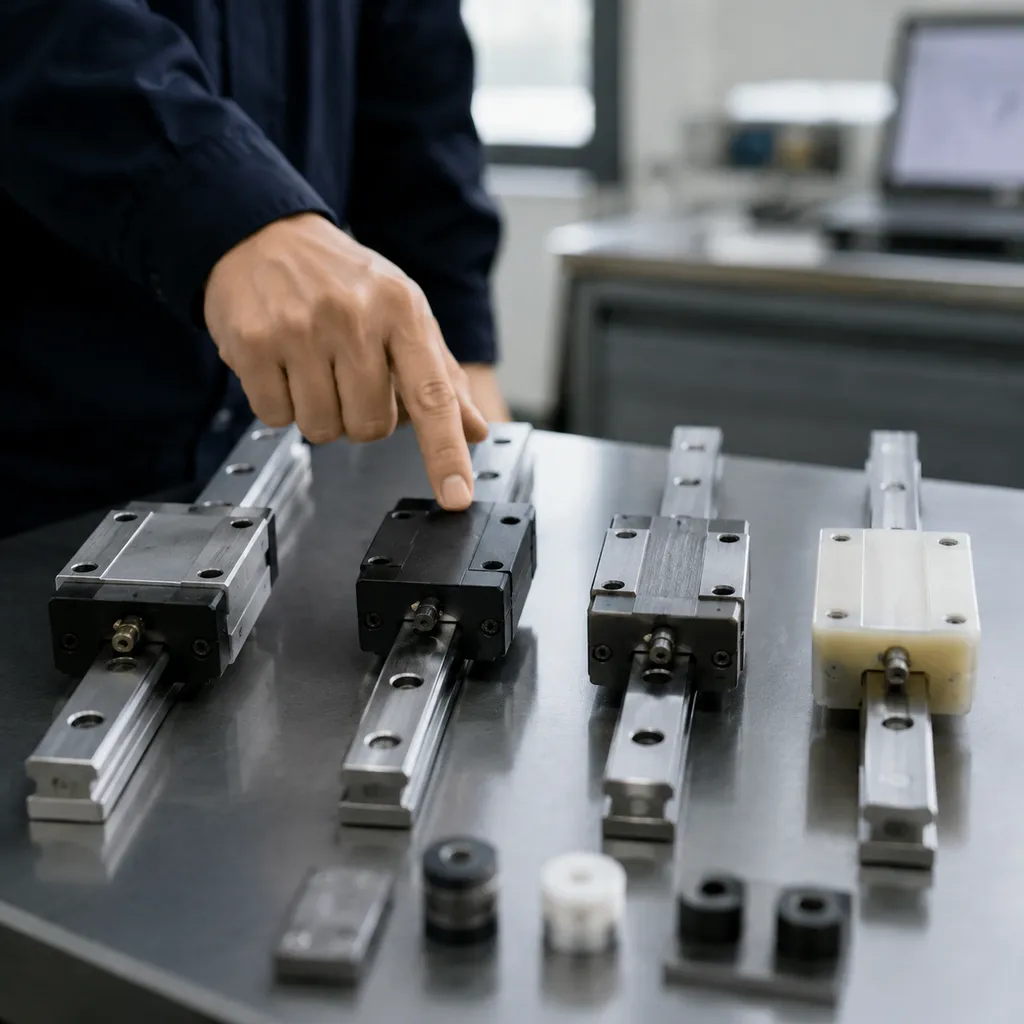
| Composite / Plastic Bushings | Completely removes metal sliding friction | High-cycle linear guide blocks |
Titanium vs. Stainless Steel vs. Aluminum for Packaging Components
Selecting between titanium, stainless steel, and aluminum comes down to balancing structural load, target motion speed, chemical exposure, and overall production budget.
Comparing Weight and Strength-to-Weight Requirements
Titanium provides an exceptional strength-to-weight ratio. Grade 5 titanium (Ti-6Al-4V) delivers tensile strength comparable to high-strength alloy steels while weighing roughly 40% less than stainless steel. Aluminum is lightweight but lacks the yield strength required for heavy mechanical stress.
| Material | Density (g/cm³) | Yield Strength (MPa) | Relative Weight | Primary Strength Advantage |
|---|---|---|---|---|
| Grade 5 Titanium | ~4.43 | ~880 | Moderate | Highest strength-to-weight ratio |
| 316L Stainless Steel | ~8.00 | ~290 | Heavy | High structural rigidity |
| 6061-T6 Aluminum | ~2.70 | ~276 | Light | Low mass for low-stress motion |
Comparing Corrosion and Environmental Requirements
316L stainless steel handles standard washdown environments using typical caustic cleaning agents, while specialized options like custom 17-4PH change parts for packaging machinery combine high strength with solid corrosion resistance. Titanium excels in extreme chemical environments containing chlorides, acids, or harsh sanitizing agents where stainless steel risks pitting.
Comparing Machining Complexity and Material Cost
Raw material costs and machinability dictate overall component economics. Titanium has low thermal conductivity and work-hardens quickly, which increases tool wear and machining cycle times. By comparison, manufacturing custom 6061-T6 aluminum CNC parts for packaging machines allows fast cutting speeds and lower total expenditure.
- Aluminum: Lowest material cost, rapid machining, ideal for high-speed low-stress components.
- Stainless Steel: Moderate material cost, manageable machining complexity, best for standard washdown frames.
- Titanium: High material cost, demanding machining requirements, reserved for critical high-stress performance needs.
Why No Single Material Is Best for Every Packaging Machine Part
We evaluate and specify materials based strictly on individual functional demands:
- High-Speed Reciprocating Components: Titanium reduces moving mass while maintaining high yield strength.
- Static Frames & Washdown Shafts: Stainless steel provides necessary rigidity and cost-effective corrosion resistance.
- Low-Inertia Guards & Brackets: Aluminum yields effective weight savings at lower production costs.
When Titanium Does Not Make Sense
Titanium offers remarkable performance, but specifying titanium guide components on every assembly leads to unnecessary expenses without adding functional value.
When 6061 Aluminum Already Meets the Mechanical Requirements
If dynamic loads are light and environmental exposure is mild, structural parts rarely need titanium. Standard 6061 aluminum provides exceptional machinability and structural strength at a fraction of the cost. In non-abrasive high-speed sections, evaluating hard-anodized aluminum vs 316L stainless packaging parts often proves that aluminum delivers all the dynamic inertia reduction required for long-term machine reliability.
When 316L Stainless Steel Provides the Required Corrosion Performance
Static mounting brackets, rigid machine frames, and stationary guide rails operate under fixed conditions. While food and pharmaceutical washdowns demand high chemical resistance, 316L stainless steel provides total protection against caustic cleansers. Because mass reduction offers zero performance improvement for non-moving components, paying a premium for titanium raw stock yields no functional return.
When Sliding Contact Creates Unresolved Galling Concerns
Titanium has a high coefficient of friction and a strong tendency to gall when subjected to direct metal-to-metal sliding contact:
- Uncoated Titanium on Titanium: Causes rapid adhesive wear and friction-induced micro-welding, leading to immediate system seizing.
- Titanium on Stainless Steel: Promotes severe surface material transfer under continuous load.
- Best Practice: Avoid titanium guide surfaces unless high-performance surface treatments (such as PVD coatings or nitriding) or specialized plastic wear strips are integrated into the assembly.
When Added Material and Machining Cost Provides No Functional Benefit
Grade 5 titanium raw material costs significantly more than industrial metals, and its low thermal conductivity rapidly wears down tooling, extending machine run times.
| Material Option | Material Cost | Machining Effort | Optimal Packaging Application |
|---|---|---|---|
| 6061-T6 Aluminum | Low | Very Low | Low-mass reciprocating arms and low-wear machine guards |
| 316L Stainless Steel | Moderate | Moderate | Heavy static frames, washdown brackets, and fluid manifolds |
| Grade 5 Titanium | High | High | Ultra-high-speed reciprocating components under corrosive exposure |
processing
Grade 5 Titanium and Other Titanium Grades
When Ti-6Al-4V Is Specified for Machine Components
Grade 5 (Ti-6Al-4V) is the standard alloy choice for high-performance titanium guide components that demand maximum structural strength at minimal weight.
- High Tensile Strength: Yield strength exceeds standard 304 and 316 stainless steel while cutting part weight nearly in half.
- Dynamic Stability: Ideal for high-speed reciprocating linkages, transfer arms, and load-bearing guides where low mass reduces mechanical lag and vibration.
- Manufacturing Requirements: Demands specialized Ti-6Al-4V CNC machining protocols, including high-pressure coolant, rigid tooling, and stable fixturing to manage cutting-zone heat.
When Commercially Pure Titanium May Be Considered
Commercially Pure (CP) titanium grades (Grades 1 through 4) prioritize chemical resistance over pure mechanical load capacity:
- Maximum Corrosion Resistance: Unalloyed titanium provides superior protection against highly oxidative chemicals, acidic liquids, and harsh washdown agents.
- Low Mechanical Loads: Best suited for static fluid housings, chemical delivery nozzles, or non-structural guards where extreme yield strength is not required.
- Formability: Softer than Grade 5, CP titanium is easier to weld, form, and machine into custom fluid-handling geometries.
Why Titanium Grade Should Follow the Engineering Specification
Matching exact alloy grades to original drawing specifications prevents costly mechanical failures and production line downtime. I always emphasize reviewing material selection early through our one-stop CNC sourcing for packaging machinery guide to verify that raw material specs match operating conditions.
- Avoid Structural Failure: Substituting CP titanium into a slot specified for Grade 5 can cause bending, rapid fatigue, or dynamic failure under operating loads.
- Avoid Unnecessary Cost: Specifying Grade 5 titanium components where CP titanium or stainless steel suffices needlessly increases machining cycle times, tool wear, and material expenses.
- Predictable Performance: Strict adherence to print callouts ensures predictable thermal expansion, yield limits, and long-term service life on the packaging floor.
CNC Machining Considerations for Custom Titanium Components
Machining titanium guide components requires strict control over heat, toolpaths, and cutting forces. In our production facility, we know firsthand that standard machining parameters used for traditional packaging alloys will fail quickly on titanium.
Low Thermal Conductivity and Cutting-Zone Heat
Unlike aluminum or steel, titanium is a poor thermal conductor. Heat generated during cutting does not escape into the chip; instead, up to 80% remains trapped at the tool edge and workpiece contact point.
Thermal concentration: Extreme cutting-zone temperatures trigger rapid thermal breakdown of carbide cutting edges.
Work hardening: Excessive localized heat causes the surface layer to harden, increasing abrasive wear during subsequent passes.
Tool Wear and Cutting Stability
Concentrated heat and high cutting forces cause rapid tool wear, notch wear, and built-up edge (BUE). Maintaining maximum rigidity across the machine tool, fixture, and spindle is critical to stop chatter before it damages parts. When machining intricate guide profiles, leveraging proven cam profile machining strategies maintains consistent chip load and dampens harmful vibrations.
Coolant Delivery and Chip Evacuation
Proper cooling and chip management prevent chip re-cutting and micro-welding along the workpiece margin.
High-pressure coolant: Delivering high-pressure coolant directly into the cut zone flushes chips instantly and keeps cutting temperatures manageable.
Specialized tool coatings: We rely on AlTiN or TiAlN coatings to create thermal barriers that extend tool life during Ti-6Al-4V CNC machining.
Why Titanium Machining Is More Demanding Than 6061 Aluminum
- Reduced cutting speeds: Titanium requires surface feet per minute (SFM) rates up to 75% slower than 6061 aluminum.
- Material springback: Titanium’s lower modulus of elasticity causes springback under cutter pressure, requiring sharp tools and positive rake geometries.
- Lower material removal rates: Extended cycle times and increased tool wear make custom titanium CNC parts far more demanding and costly to produce than standard aluminum guide parts.
When Custom CNC-Machined Titanium Guide Components Are Required
OEM-Specific Geometry and Mounting Interfaces
Standard off-the-shelf hardware rarely satisfies specialized packaging line layouts. When equipment demands unique bolt patterns, precise slot dimensions, or tailored mounting brackets, standard catalog items fall short. We engineer custom titanium CNC parts designed to drop directly into existing machine frames without field modifications. For complex packaging layouts requiring multi-axis contours, leveraging 5-axis CNC machined components guarantees accurate interface alignment and flawless integration.
Replacement Parts Made From Drawings and CAD Models
Whether updating legacy equipment or replacing worn titanium guide components, manufacturing directly from digital CAD files or engineering blueprints ensures exact interchangeability:
- 3D CAD Integration: Direct translation of STEP or IGES files preserves complex surface profiles.
- 2D Blueprint Fabrication: Precise machining built off dimensional tolerances and datum references from print drawings.
- Reverse Engineering: Accurate reproduction based on physical sample measurements when original prints are unavailable.
Critical Fits, Datums and Inspection Requirements
Titanium guide components frequently serve as sliding tracks or linear reciprocating guides. Maintaining accurate parallelism, true position, and surface flatness is non-negotiable to prevent mechanical binding or localized wear.
We set strict datum points during the machining process and verify all critical geometric tolerances using Coordinate Measuring Machines (CMM) before parts ship to your floor.
What Information to Provide for a Titanium Component RFQ
To ensure fast turnaround and accurate pricing for your machining project, include the essential parameters outlined in the table below:
| RFQ Parameter | Required Information |
|---|---|
| Design Files | 3D CAD files (STEP/IGES) and 2D PDFs detailing critical tolerances |
| Material Grade | Specific titanium grade (e.g., Grade 5 / Ti-6Al-4V or CP Grade 2) |
| Tolerance Limits | Specific fit tolerances, datums, and required surface finishes (Ra) |
| Surface Treatments | Anodizing, nitriding, or DLC coatings needed for wear management |
| Order Volume | Total quantity needed for initial prototypes or production runs |