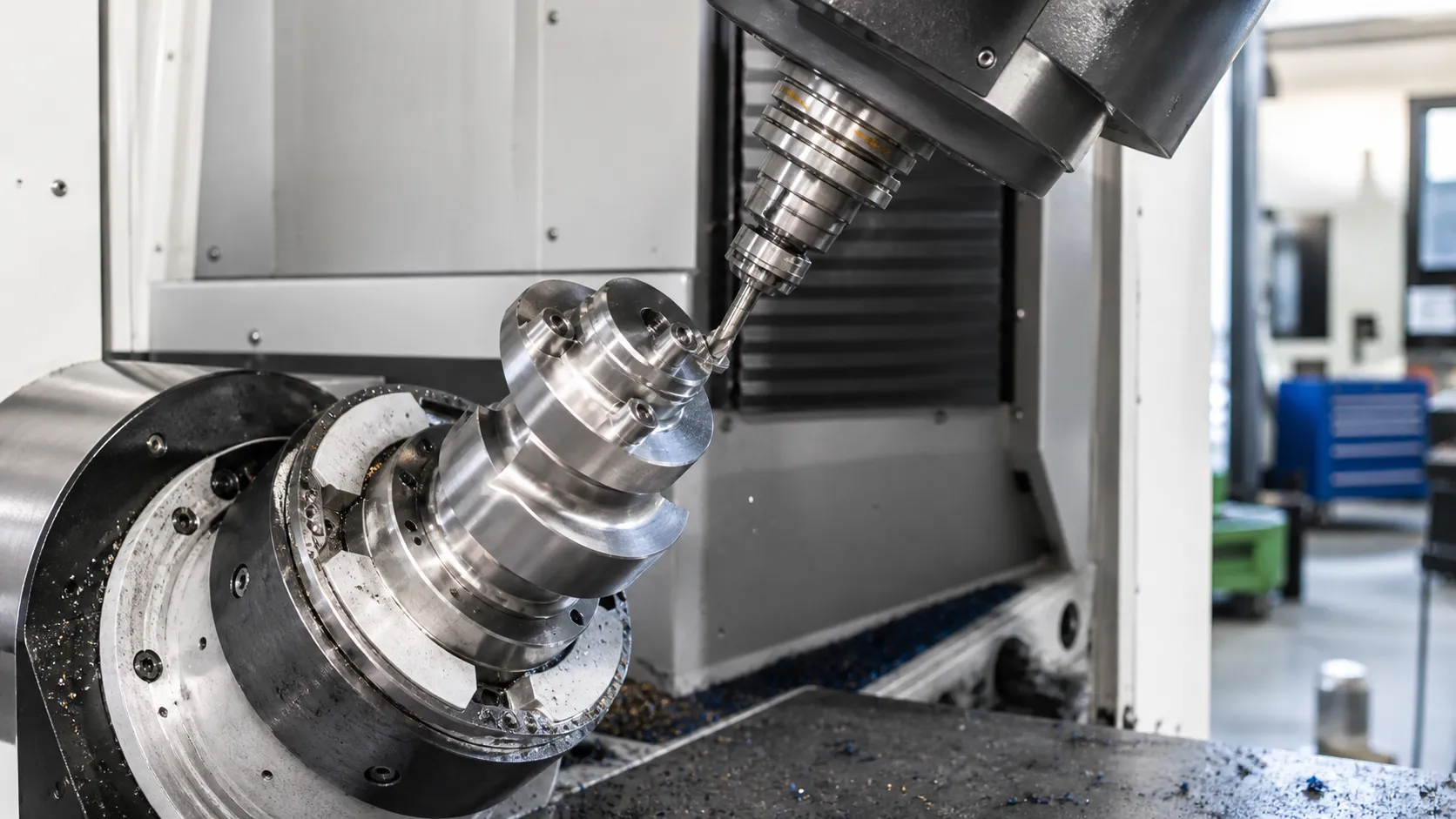
Are you struggling to choose between 3+2 positional and simultaneous 5-axis machining for your cam profile machining projects? Making the wrong call can lead to severe cusping marks, accelerated tool wear, and wasted spindle time. In this guide, you'll learn exactly how both methods compare across axis kinematics, tool rigidity, CAM programming complexity, and surface accuracy—plus how to match the right strategy to planar, cylindrical, and complex globoidal cams. Let’s dive right in!
Understanding 3+2 Positional vs. Simultaneous 5-Axis Machining
Machining tolerance review: Typical machining tolerance is ±0.01 mm. Selected dimensions may achieve ±0.005 mm after technical review. Final tolerances depend on the drawing, material, part size, geometry, finishing and inspection requirements and must be confirmed before order acceptance.
In modern precision manufacturing, cam profile machining demands maximum geometric accuracy, surface finish quality, and process efficiency. Selecting the right multi-axis milling strategy directly impacts part tolerances and cycle times. Modern CNC machining relies heavily on two primary multi-axis methodologies: 3+2 positional machining and simultaneous 5-axis machining.
What Is 3+2 Axis Machining
3+2 axis machining—frequently referred to as indexed 5-axis machining—operates by locking two rotational axes (typically A, B, or C) at fixed tilt angles. Once oriented, mechanical brakes lock these rotational axes, allowing the spindle to execute standard 3-axis linear moves (X, Y, and Z).
- Mechanism: Fixed-angle tilting with rigid axis lockup.
- Toolpath: Standard 3-axis linear motion executed from locked rotational planes.
- Core Value: Exceptional cutting tool rigidity using shorter, stiffer tooling setups.
What Is Simultaneous 5-Axis Machining?
Simultaneous 5-axis machining continuously moves all five axes—three linear axes (X, Y, Z) and two rotational axes—concurrently throughout the entire cutting cycle. The advanced machine controller recalculates and adjusts the tool vector in real time to maintain optimal cutter engagement.
- Mechanism: Continuous, fully synchronized 5-axis movement.
- Toolpath: Dynamic tool orientation aligned constantly along complex 3D surfaces.
- Core Value: Seamless contouring across organic surfaces without indexed transition marks.
How Motion and Axis Kinematics Differ
The kinematic difference between positional and simultaneous motion fundamentally alters tool movement and surface engagement.
| Motion Kinematics | 3+2 Positional Machining | Simultaneous 5-Axis Machining |
|---|---|---|
| Rotational Axes State | Locked in fixed angles during cutting | Continuously moving and interpolating |
| Tool Vector Angle | Static per indexed orientation | Dynamic and constantly updating |
| Kinematic Control | Linear X, Y, Z interpolation | Multi-axis synchronized interpolation |
| Primary Strength | Heavy material removal & high rigidity | Smooth machining of continuous curved profiles |
Key Differences in Cam Profile Machining
Axis Movement and Continuous Tool Orientation
In cam profile machining, the primary difference lies in how the cutting tool moves relative to the workpiece:
- 3+2 Positional Machining: Locks the two rotational axes at a fixed angle before cutting starts. The machine cuts using three linear axes ($X$, $Y$, $Z$). It works great for flat faces or indexed cam features, but the tool orientation stays static during the cut.
- Simultaneous 5-Axis Machining: Moves all five axes ($X$, $Y$, $Z$ plus two rotational axes) at the same time. The cutter continuously tilts to match the cam profile, maintaining optimal tool contact along smooth 3D curves.
We leverage advanced 5-axis machining capabilities to keep the cutter strictly perpendicular to complex cam paths, delivering consistent surface quality across intricate contours.
Tool Rigidity and Cutter Length Requirements
Cutting tool stability directly affects tolerances and surface finish when machining high-wear cam components:
- Shorter Tool Stickout in 3+2: By tilting the part to fixed angles, we can reach deep pockets or angled features using shorter, stubby tools. This increases cutting tool rigidity, reduces vibration, and allows heavier feed rates.
- Dynamic Clearance in Simultaneous 5-Axis: Continuous tilting allows short tools to clear tight geometry without long extensions. However, variable cutting forces during multi-axis motion require accurate machine controllers to prevent tool chatter.
CAM Programming and Toolpath Complexity
Generating toolpaths for cam profiles demands different levels of programming effort:
- 3+2 CAM Programming: Fast toolpath generation, straightforward simulation, and minimal risk of machine collision. Ideal for standard mechanical cams with predictable 2D profiles or stepped features.
- Simultaneous 5-Axis Toolpath Generation: Requires advanced CAM software, continuous vector control, and complete 3D machine simulation. It demands expert programming to prevent axis flipping and maintain constant surface speeds on organic cam tracks.
Setup Time and Workholding Fixtures
Both methods streamline production, but they handle part setups differently depending on cam geometry:
| Feature | 3+2 Positional Machining | Simultaneous 5-Axis Machining |
|---|---|---|
| Workholding Complexity | Standard vices or simple modular fixtures | Specialized zero-point workholding or custom arbor fixtures |
| Part Repositioning | Replaces multi-setup 3-axis operations with one indexed setup | Single-setup execution for multi-sided, continuous 3D cam contours |
| Production Fit | High-efficiency roughing and indexed finishing for standard cams | Single-pass complete machining for custom 5-axis packaging machine cams |
Impact on Surface Finish and Cam Profile Accuracy
When evaluating cam profile machining (3+2 vs simultaneous 5-axis), surface quality and geometric fidelity often decide the winner. Cams rely on smooth motion transfer, meaning every micro-step or surface imperfection directly impacts mechanical wear, noise, and system efficiency.
Surface Continuity and Cusping Marks
- 3+2 Positional Machining: Leaves subtle step-over lines or "cusping marks" where indexed toolpath sections intersect. Repositioning the rotational axes between cuts creates minute transition boundaries along continuous curves.
- Simultaneous 5-Axis Machining: Maintains fluid cutter engagement across complex contours. Continuous tool reorientation eliminates blend lines and delivers superior surface finishing quality, significantly reducing post-machining polishing work.
Tolerance Precision on Complex Cam Geometries
| Feature | 3+2 Positional Machining | Simultaneous 5-Axis Machining |
|---|---|---|
| Axis Motion | Rotational axes locked during cutting | All 5 axes move fluidly in real time |
| Geometric Accuracy | Ideal for planar, cylindrical, and indexed features | Superior for globoidal, barrel, and 3D spline cams |
| Profile Variance | Potential micro-deviations at index transitions | Consistent tight-tolerance tracking along the entire profile |
Simultaneous motion prevents profile distortion on freeform curves by sweeping the tool smoothly along the drive surface, maintaining true mathematical cam profiles without approximation steps.
Tool Wear and Cutting Parameter Optimization
Optimizing cutting parameters requires balancing tool rigidity with dynamic contact angles:
- Rigidity Control: 3+2 machining locks the machine table, letting us use shorter, stouter cutting tools to resist heavy cutting forces and eliminate chatter.
- Surface Speed Optimization: Simultaneous 5-axis tilting keeps the tool ball-nose tip off the workpiece center (where cutting speed drops to zero), maintaining consistent chip load and dramatically extending tool life.
2>Benefits and Limitations of 3+2 Axis Machining
Indexed 5-axis setups offer a practical, powerful bridge between standard 3-axis milling and full multi-axis continuous motion. Understanding where this method excels—and where it falls short—helps us optimize production for cam profile manufacturing.
Higher Rigidity and Heavy Material Removal
By locking the rotational axes into a fixed position during the cut, 3+2 axis machining delivers exceptional mechanical stability. This rigid setup allows us to use shorter, thicker cutting tools and push higher feed rates.
- Maximum Tool Rigidity: Fixed tilt angles reduce tool deflection and chatter during aggressive roughing.
- Aggressive Metal Removal: Ideal for hogging out heavy stock across various tough materials.
- Extended Tool Life: Stable cutting conditions minimize vibration and premature cutter wear.
| 3+2 Machining Feature | Production Advantage |
|---|---|
| Locked Rotational Axes | Eliminates axis lag and machine chatter |
| Short Cutting Tools | Supports heavy chip loads and higher feed rates |
| Positional Indexing | Allows multi-sided machining in a single setup |
Simpler Programming and Lower Operational Costs
3+2 positional machining uses standard 3-axis CAM programming strategies applied to tilted planes. This lowers the technical entry barrier and streamlines shop operations.
- Simplified Toolpath Generation: Standard 2.5D and 3D CAM toolpaths run smoothly without requiring complex continuous 5-axis post-processors.
- Lower Controller Processing: The machine controller processes simple linear movements without continuous kinematic recalibration.
- Reduced Overhead: Faster setup times and lower programming complexity yield immediate cycle time reduction and lower operational expenses.
Limitations on Continuous Curved Profiles
While 3+2 axis machining handles flat faces and angled features effortlessly, it presents distinct limits when machining smooth, complex cam profiles.
- Step-Over Marks: Fixed tool angles create visible cusping or step marks across continuous curved surfaces.
- Secondary Operations: Cam profiles often require additional hand polishing or fine finishing passes to achieve required tolerances.
- Geometry Restrictions: Deep 3D grooves and globoidal cam geometries cannot be reached without continuous tool orientation adjustments.
Benefits and Limitations of Simultaneous 5-Axis Machining
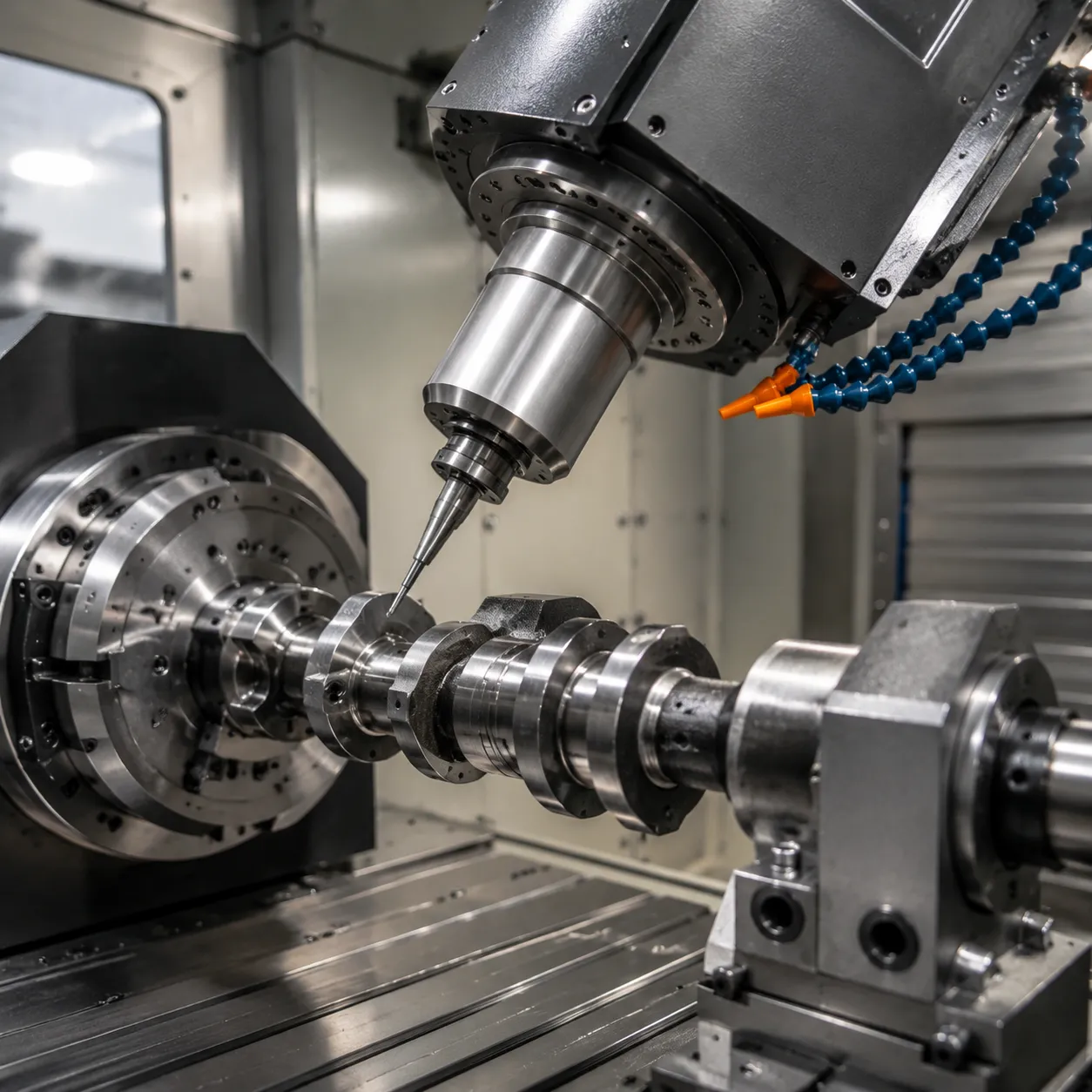
Seamless Contour Machining for Complex Cams
When we manufacture non-linear cam profiles, simultaneous 5-axis CNC machining coordinates all three linear and two rotational axes dynamically. Instead of locking position like in 3+2 indexing, the rotational axes continuously tilt and swing during toolpath execution. This fluid motion allows the cutting tool to follow complex 3D contours, barrel cam tracks, and organic geometries without interruptions. For specialized components like 5-axis CNC machined components with complex geometry, continuous axis movement guarantees exact profile tracking from start to finish.
Superior Surface Finish with Reduced Hand Polishing
Maintaining continuous contact between the cutter tip and the cam profile dramatically improves surface finish quality. Because the machine controller continuously tilts the tool, we can utilize the side of the end mill rather than just the ball nose tip.
- Eliminates Dwell Marks: Smooth axis transitions remove step-over lines and positional indexing scars.
- Maximizes Cutting Rigidity: Dynamic tool tilting lets us run shorter, stiffer cutters, virtually eliminating chatter and deflection.
- Cycle Time Reduction: Delivering high-precision surface profiles straight off the machine removes labor-intensive hand polishing steps.
Higher Machine Investment and Skill Requirements
While simultaneous continuous motion solves complex geometric challenges, it requires significant capital investment and specialized operational expertise compared to standard positional setups.
| Machining Factor | Simultaneous 5-Axis Impact |
|---|---|
| Capital Cost | Higher machine tool investment and advanced machine controller requirements |
| CAM Programming | Requires sophisticated toolpath generation and multi-axis collision simulation |
| Operator Expertise | Demands skilled programmers to manage complex tool orientations safely |
| Profile Quality | Superior contour accuracy and seamless surface continuity across organic shapes |
Matching Machining Methods to Cam Profile Types
Selecting the right CNC machining strategy comes down to part geometry, dynamic motion requirements, and required surface finish quality. In my shop, we evaluate the cam's physical profile first before committing to positional machining or continuous multi-axis motion.
Planar and Standard Cylindrical Cams
For standard flat plate cams, simple face cams, and basic cylindrical barrel cams with constant lead angles, 3+2 positional machining is usually the most efficient route.
- Setup Strategy: Lock the rotational axes to index the workpiece, then run short, rigid 3-axis toolpaths.
- Key Advantages: Maximizes cutting tool rigidity, allowing for heavy material removal rate and cycle time reduction on simpler features.
- Best For: Industrial packaging machinery cams, standard indexing plates, and flat 2D/2.5D profiles.
Complex 3D and Globoidal Cam Profiles
Globoidal cams, barrel indexing cams, and complex 3D profiles with dynamic sweeping curves require continuous tool reorientation. Here, simultaneous 5-axis machining is non-negotiable.
- Continuous Toolpath Generation: All rotational axes move smoothly alongside X, Y, and Z to keep the cutter flank aligned with changing wall angles.
- Application Fit: Crucial for high-speed indexing machinery and automated packaging lines. Just as optimizing timing screw pitch affects capping accuracy, smooth continuous motion on globoidal cams prevents mechanical binding and unwanted vibration.
- Result: Eliminates dwell marks and cusping steps across continuous curved faces.
High-Precision Automotive and Aerospace Cams
High-RPM automotive camshafts, performance engine components, and aerospace actuation cams demand strict tolerance precision and flawless surface continuity.
| Machining Requirement | 3+2 Positional Machining | Simultaneous 5-Axis Machining |
|---|---|---|
| Primary Fit | Stepped, planar, or indexed features | Sweeping 3D contours and complex radii |
| Surface Finish Quality | Minor cusping marks at index transitions | Seamless, uniform contours with minimal polishing |
| Tooling Approach | Short, stubby tools for high rigidity | Specialized tapered or ball-nose end mills |
| Geometric Accuracy | Ideal for flat planes and static angles | Ideal for continuous dynamic contours |
For performance-critical components, simultaneous 5-axis motion maintains continuous contact angles, minimizing secondary hand benching or grinding while preserving the exact mathematical cam profile.
How to Choose Between 3+2 and Simultaneous 5-Axis
Evaluating Part Geometry and Surface Requirements
To select the right method for cam profile machining, we start by evaluating the part geometry and target surface finish:
- 3+2 Axis Positional Machining: Ideal for standard cylindrical, planar, or flat plate cams where tool angles remain locked during cutting. This locked state maximizes cutting tool rigidity for fast stock removal.
- Simultaneous 5-Axis Machining: Essential for complex 3D, globoidal, or wrap-around cam profiles requiring continuous tool orientation changes. It yields smooth contours with exceptional surface finish quality, virtually eliminating post-machining bench work.
| Evaluation Factor | 3+2 Positional Machining | Simultaneous 5-Axis Machining |
|---|---|---|
| Geometry Fit | Planar tracks, 2D contours, standard cylindrical cams | Complex 3D surfaces, globoidal & barrel cams |
| Tooling Rigidity | Maximum (locked rotational axes) | Moderate (dynamic continuous movement) |
| Surface Finish | Good (potential step marks between index angles) | Superior (continuous tool contact, minimal cusping) |
| Programming Needs | Standard CAM programming | Advanced multi-axis toolpath generation |
Assessing Production Volume and Cycle Time
Production demands directly influence our operational choice in CNC machining:
- Heavy Roughing Efficiency: 3+2 setups allow shorter, stiffer tools and higher feed rates, driving significant cycle time reduction during heavy material removal.
- Single-Setup Execution: Simultaneous 5-axis machines complete intricate cam geometries in a single setup. Eliminating manual re-fixturing drastically shortens turnaround times. Implementing a precise workholding setup and datum strategy for 5-axis sanitary flange adapters or customized cam bodies ensures repeatable accuracy across full production runs.
Balancing Equipment Cost and ROI for Your Shop
Making the final decision requires balancing upfront machine investment against long-term shop capabilities:
- Lower Entry Barriers: 3+2 machining works on standard 5-axis machines or standard 3-axis mills fitted with trunnion tables, delivering faster payback for shops handling routine cam work.
- High-Value Market Access: Simultaneous 5-axis equipment demands higher capital and skilled labor, but it unlocks high-margin orders in aerospace, medical, and high-performance automotive sectors where extreme cam profile tolerances are required.
- Ensure your packaging line runs with zero timing drift. Explore our built to ±0.005 mm (selected dimensions; subject to review) profile accuracy.