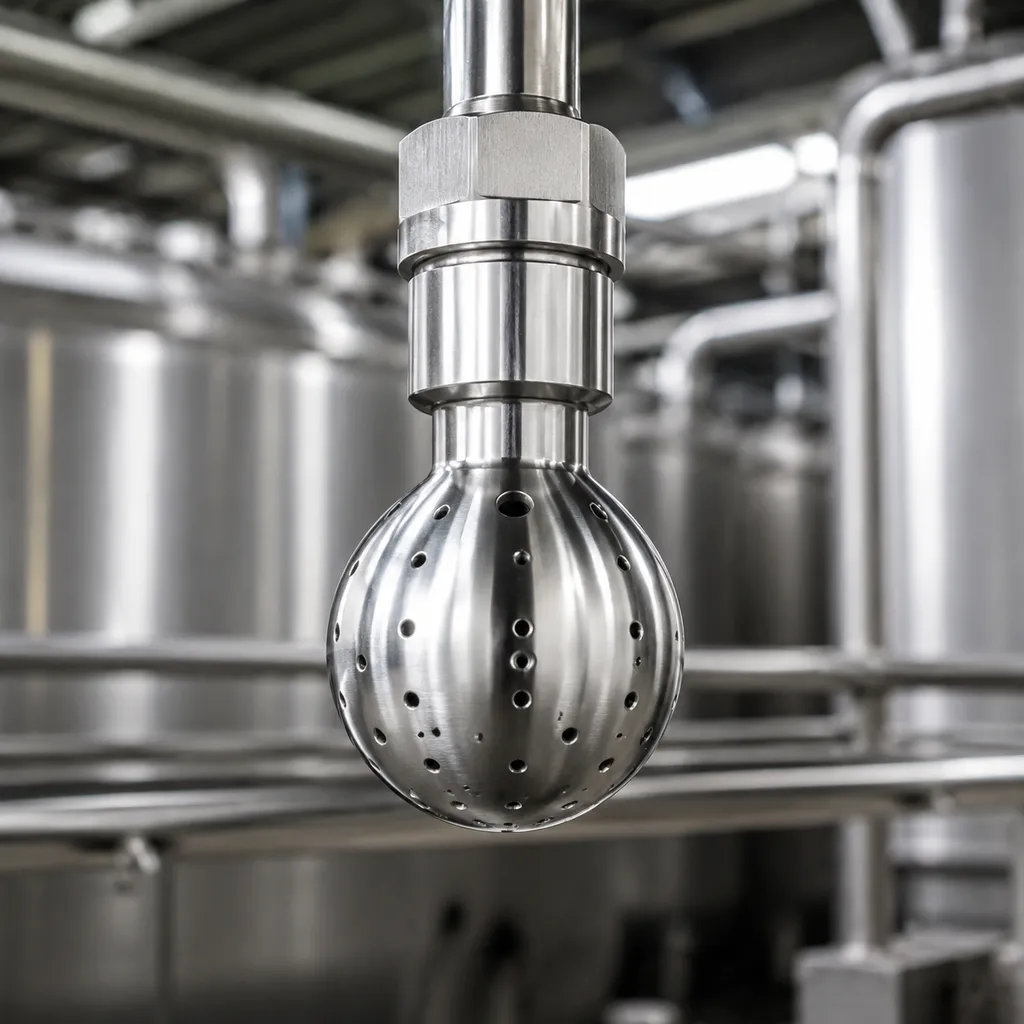
Overview
Custom 316L CIP Spray Balls for Dairy Tanks
We manufacture high-precision custom 316L CIP spray balls engineered specifically for hygienic dairy processing environments. Premium 316L stainless steel delivers superior corrosion resistance against aggressive CIP (Clean-in-Place) chemicals, ensuring reliable sanitation and long-term operating efficiency in dairy tank cleaning applications.
Made to OEM Drawings and Existing Spray Ball Specifications
We deliver direct-fit components built precisely to your technical drawings, CAD models, or existing physical samples.
| Specification | Capability & Features |
|---|---|
| Material | Certified Sanitary 316L Stainless Steel |
| Drawing Compatibility | OEM Drawings, 3D CAD, Physical Reverse-Engineering |
| Spray Coverage | 360° Complete, 180° Up/Down, Custom Orifice Layouts |
| Connection Types | Slip-fit (Pin), Threaded, Tri-Clamp, Weld-on |
Replacement, Prototype and Production Components
Our flexible CNC manufacturing capabilities support every phase of your project lifecycle:
- Prototypes: Fast-turnaround custom CIP tank cleaning nozzle samples for testing spray patterns and flow rates.
- Direct Replacements: Precise drop-in sanitary spray ball replacements to eliminate line downtime.
- Batch Production: High-volume manufacturing maintaining tight tolerances across every single unit.
Why 316L Stainless Steel for CIP Spray Balls?
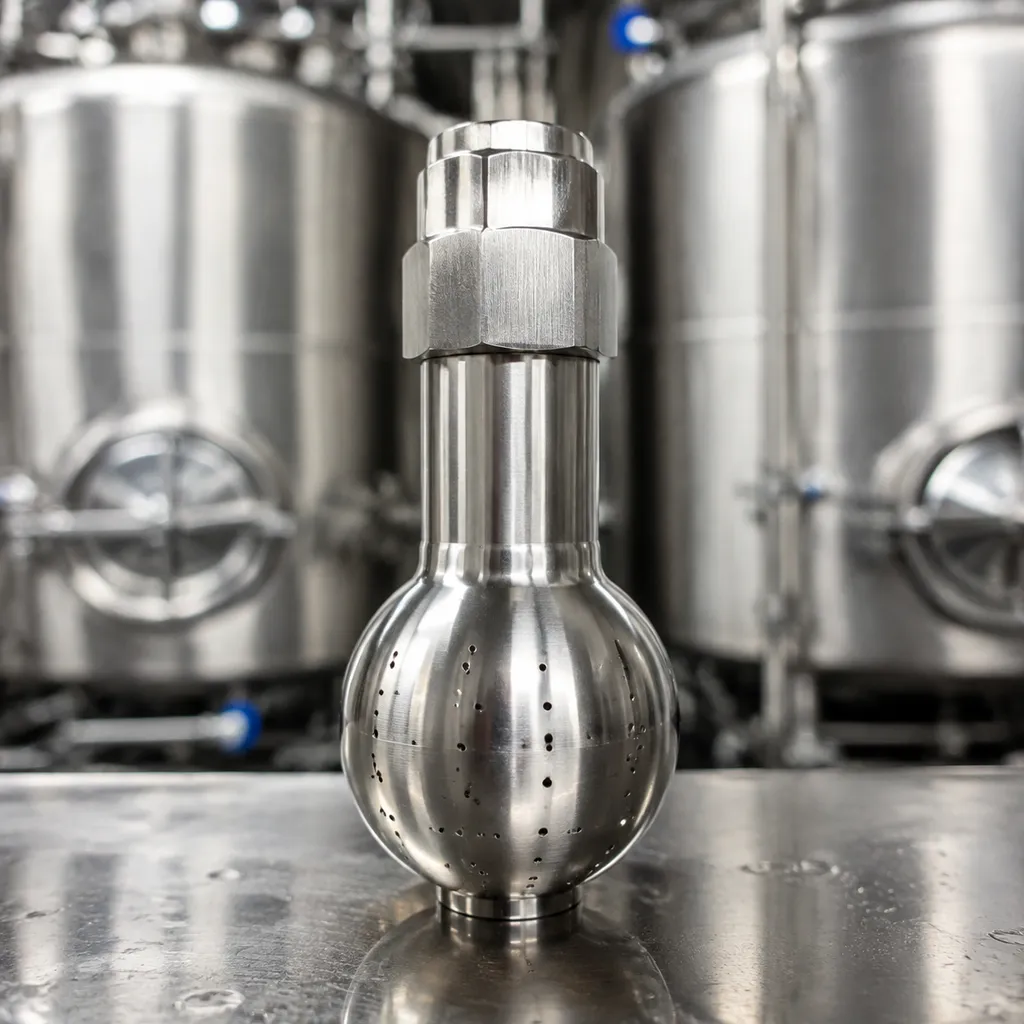
Dairy processing equipment requires sanitary cleaning components that resist continuous exposure to aggressive chemicals and thermal shock. We manufacture 316L CIP spray balls for dairy tanks using low-carbon austenitic stainless steel to guarantee long-term operational reliability and strict hygienic performance.
Corrosion Resistance in Repeated CIP Cleaning Cycles
Standard Clean-in-Place (CIP) regimes rely on alternating wash cycles featuring heated caustic soda (sodium hydroxide), nitric acid, and phosphoric acid mixtures.
- Molybdenum Addition: 316L contains 2% to 3% molybdenum, which dramatically improves resistance to chloride pitting and crevice corrosion compared to standard 304 alloys.
- Chemical Endurance: Withstands frequent exposure to acidic and alkaline sterilizing agents at temperatures exceeding 80°C (176°F).
- System Integrity: Just as with high-purity 316L valve manifolds used in fluid handling systems, specifying 316L for a CIP tank cleaning nozzle prevents stress corrosion cracking and extends component life.
Material Considerations for Dairy Processing Environments
Raw milk, whey, and processed dairy products contain organic fats, proteins, and minerals that bond to tank interiors. Selecting 316L ensures your sanitary spray ball remains non-reactive and free of surface defects where bacteria can harbor.
| Material Property | 304 Stainless Steel | 316L Stainless Steel | Advantage for Dairy Processing |
|---|---|---|---|
| Carbon Content | ≤ 0.08% | ≤ 0.03% | Prevents intergranular corrosion after welding |
| Pitting Resistance (PREN) | ~19 | ~23–25 | Higher resistance to harsh sanitizing solutions |
| Hygienic Safety | Standard | Superior | Eliminates batch contamination risks |
The ultra-low carbon content (≤ 0.03%) of 316L prevents chromium carbide precipitation during manufacturing, ensuring every dairy tank spray ball maintains uniform corrosion resistance across all machined surfaces.
Surface Finish and Electropolishing When Specified
Surface roughness directly impacts cleaning speed and efficiency. Microscopic rough spots trap soil, compromising the effectiveness of the CIP spray ball.
- Mechanical Polishing: We machine and finish internal and external surfaces down to Ra ≤ 0.4 µm (16 µin) or better.
- Electropolishing Option: Electropolishing removes microscopic surface peaks and builds a heavy chromium-oxide passive layer for optimal cleanability.
- Operational Savings: A smoother surface finish prevents residue buildup, allowing faster CIP wash cycles, reduced water consumption, and lower chemical usage.
Critical Features We Machine on CIP Spray Balls
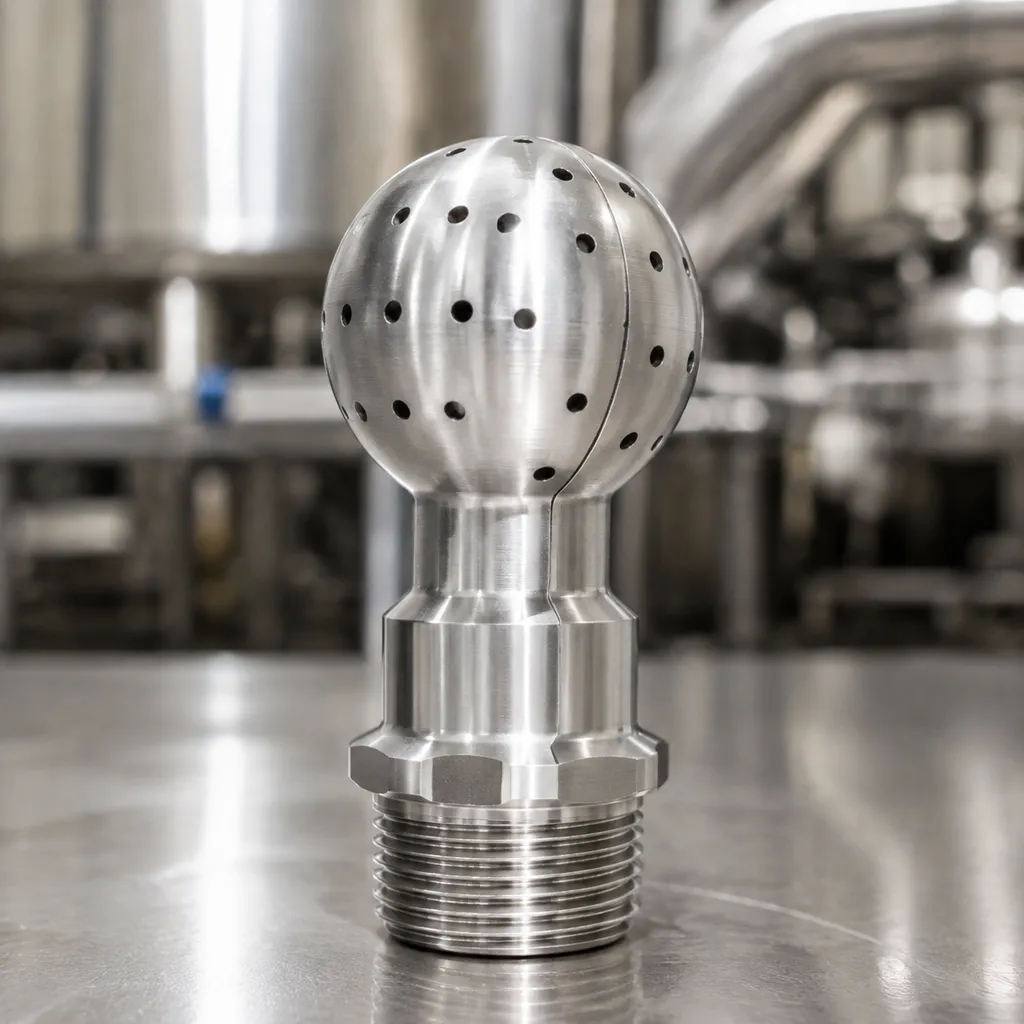
We precision-machine custom 316L CIP spray balls for dairy tanks, engineering every critical feature to handle demanding washdown cycles and deliver predictable cleaning performance.
Orifice Diameter and Hole Position
- Micro-Drilling Accuracy: We control orifice hole diameters to tight tolerances (±0.05 mm) to maintain exact flow rates and backpressure across the fluid line.
- True-Position Indexing: CNC indexing ensures consistent spacing between holes, eliminating cold spots or unwashed zones inside the tank.
- Burr-Free Flow Paths: Internal and external deburring prevents micro-burrs from disrupting spray stream trajectory or snagging milk solids.
Spray Hole Angle and Pattern
- Custom Spray Angles: We drill straight, compound, and angled holes designed to target tank domes, internal baffles, and agitator shafts.
- Advanced Multi-Axis Hole Placement: Utilizing precision setup techniques similar to multi-axis profile machining, we align every orifice precisely relative to the curved sphere surface.
- Coverage Flexibility: Available in 360°, 270°, and directional 180° patterns tailored to your static CIP spray ball layout.
Wall Thickness and Spherical Geometry
- Uniform Wall Thickness: Machining uniform walls ensures structural stability against thermal shock and high fluid velocity during hot caustic or acid rinses.
- Spherical Roundness: High-precision turning guarantees smooth hydraulic flow inside the sphere, eliminating stagnant fluid pockets.
Connection Interfaces and Mounting Features
| Connection Interface | Mounting Style | Hygienic Advantage |
|---|---|---|
| Sanitary Tri-Clamp | ISO / DIN / ASME BPE Clamp | Fast installation, flush hygienic seal, easy validation |
| Slip-On / Pin Fix | Secured with Sanitary R-Clip | Tool-less removal for quick routine maintenance |
| Threaded (NPT / BSP) | Internal or External Threads | Compact mounting footprint for smaller process vessels |
Custom Orifice Patterns for Tank Cleaning Applications
Every sanitary processing setup demands tailored coverage. Standard off-the-shelf options often leave shadow areas inside processing vessels, leading to inadequate cleaning or wasted wash chemicals. We custom-machine hole layouts to guarantee reliable surface coverage across every inch of your vessel.
Matching Hole Layout to the Customer Spray Pattern
We engineer specific orifice matrices based on your exact spray coverage requirements:
- 360-Degree Full Coverage: Complete spherical spray patterns for standard storage and processing tanks.
- 180-Degree Directional: Concentrated fluid streams targeting tank domes or lower cone sections.
- Targeted Jet Angles: Custom angle offset patterns designed to reach behind agitator shafts, baffle plates, and internal manways.
Controlling Small-Hole Diameter and Position
Precision drilling on a 316L CIP spray ball for dairy tanks directly dictates flow rate, pressure drop, and fluid velocity. Much like our precision manufacturing process for custom 316L filling nozzles for beverage lines, consistent hole sizing ensures steady hydraulic impact across every cycle.
- Micro-Tolerance Drilling: Multi-axis CNC indexing maintains tight tolerances on small-diameter holes to prevent flow variance.
- True-Position Accuracy: Exact hole positioning eliminates uneven spray overlap and keeps fluid distribution consistent.
Deburring Orifices Without Damaging the Flow Path
Internal burrs disrupt spray geometry, generate unwanted turbulence, and create harborage points for dairy residues and bacteria.
- Micro-Deburring Techniques: Specialized finishing clears internal burrs without altering drilled hole diameters or spray velocity.
- Smooth Flow Transitions: Removing sharp edges preserves fluid momentum, maintaining maximum impact force during high-pressure CIP cycles.
Why Tank Geometry and Installation Position Matter
A static CIP spray ball must perform predictably within its specific operating environment.
- Internal Vessel Obstructions: Agitator blades, heating coils, and dip tubes require customized spray angles to eliminate shadow zones.
- Mounting Depth & Orientation: Top-mounted, side-entry, or bottom-up installations require modified hole densities to compensate for gravity and fluid cascading. To understand similar fluid dynamics in precision setups, explore how hole patterns affect liquid injection and flow delivery.
CNC Manufacturing of 316L CIP Spray Ball Components
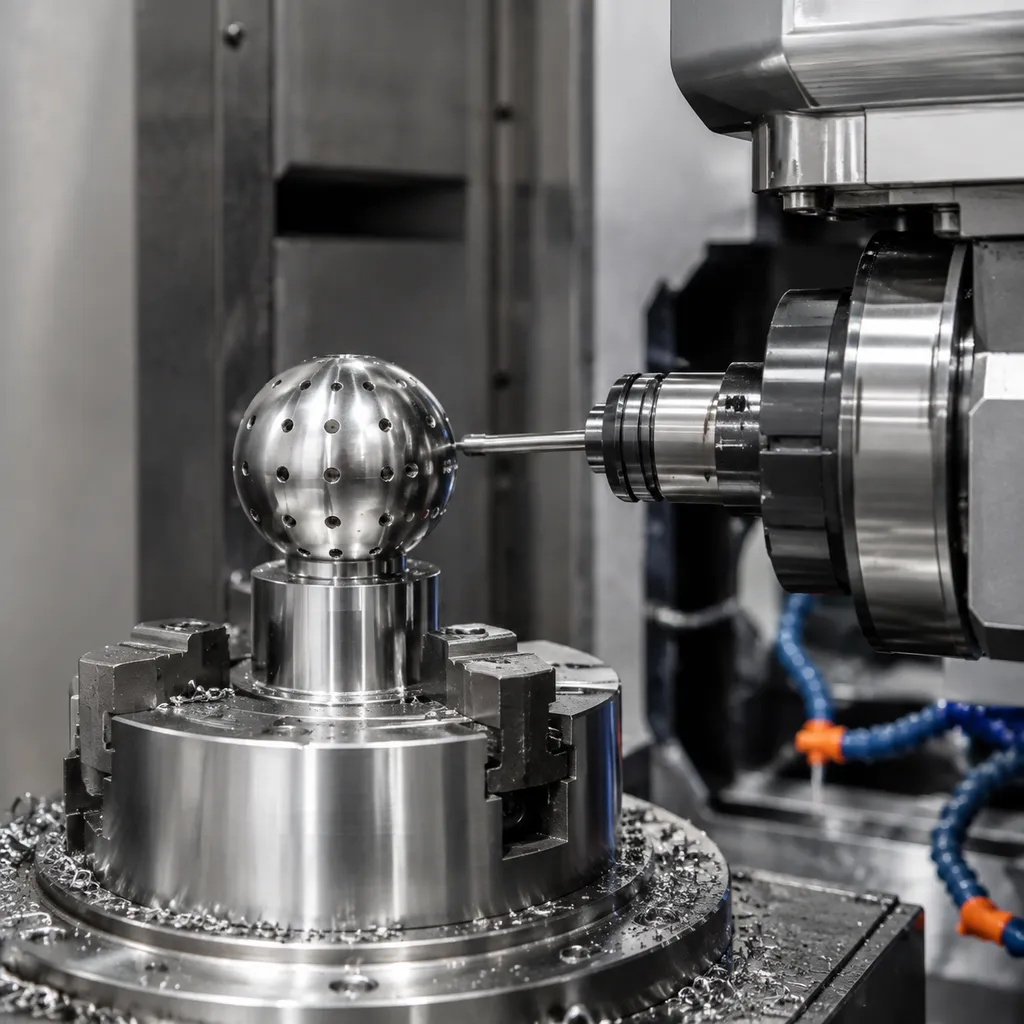
We precision-engineer every 316L CIP spray ball to meet strict hygienic standards for dairy processing applications. Using advanced machining setups, we transform solid 316L stainless steel stock into durable, high-performance tank cleaning spray ball assemblies.
Machining 316L Stainless Steel Components
316L stainless steel is prone to work-hardening during cutting, requiring strict process control. We utilize high-rigidity CNC turning and multi-axis milling centers to hold tight tolerances on spherical geometries, mounting threads, and connection necks. Understanding when to choose 5-axis CNC for food machinery components allows us to optimize toolpaths for complex spherical contours, delivering seamless surfaces without tool marks or chatter.
Drilling and Finishing Small Spray Orifices
Predictable CIP flow patterns depend entirely on precise orifice execution. We accurately drill custom hole layouts using specialized tooling to maintain exact flow dynamics across the entire sanitary spray ball.
- Controlled Feed Rates: Prevents tool deflection and guarantees consistent hole diameters.
- Internal Deburring: Eliminates micro-burrs that cause irregular spray breakup or collect dairy residue.
- Precision Indexing: Ensures accurate directional targeting for complete internal tank coverage.
Welding and Post-Weld Finishing When Required
For customized mounting stems, pipe extensions, or multi-piece assemblies, we employ full-penetration sanitary TIG welding.
- Crevice-Free Joints: Eliminates internal voids and cracks where bacteria could harbor.
- Seamless Blending: Post-weld grinding and polishing blend weld lines flush with adjacent base metal.
- Structural Integrity: Maintains spherical symmetry and uniform wall thickness across welded zones.
Passivation and Electropolishing When Specified
To withstand continuous exposure to aggressive caustic and acid cleaning chemicals, machined component surfaces undergo specialized post-treatment.
- Chemical Passivation: Citric or nitric treatments dissolve free iron contaminants, restoring the protective chromium-oxide layer on every 316L tank cleaning nozzle.
- Electropolishing: Micromachines the surface down to Ra < 0.4 µm, enhancing corrosion resistance and drastically reducing product adhesion.
- Inspection of Custom CIP Spray Balls
Every 316L CIP spray ball we manufacture undergoes a rigorous quality inspection process to ensure reliable performance in demanding dairy processing environments. Quality control is built into every step, guaranteeing that every sanitary spray ball meets exact OEM specifications before shipment.
- Orifice Diameter and Position Verification
Targeted coverage depends entirely on precise drilling patterns. We verify every spray hole using calibrated pin gauges, vision measurement systems, and optical comparators.
- Diameter accuracy: Holds tight tolerances on micro-drilled holes to maintain consistent fluid velocity and flow rates.
- Angular alignment: Ensures correct spray vector angles to cover all internal tank surfaces, agitator shafts, and top-dish dead spots.
- Pattern integrity: Verifies 360-degree, 180-degree, or custom directional flow coverage across the entire spherical geometry.
- Connection and Interface Inspection
A leak-free fit is non-negotiable for a hygienic CIP tank cleaning nozzle. We inspect all mounting interfaces to ensure seamless integration with existing dairy tank piping.
- Thread & Tri-Clamp fits: Checked with thread gauges and mating sanitary fittings for perfect mating.
- Pin & Clip alignment: Ensures smooth installation and secure locking on static CIP spray ball assemblies.
- Sealing surfaces: Inspected for flatness and finish to prevent bypass leakage during high-pressure wash cycles.
- Surface Condition and Burr Inspection
Bacteriological safety relies on ultra-smooth surfaces. We inspect every custom CIP spray ball under high magnification to confirm complete burr removal and hygienic surface quality.
- Deburring checks: Guarantees zero internal or external burrs that could disrupt spray patterns or harbor micro-organisms.
- Surface roughness (Ra): Measured with precision profilometers to meet sanitary standards, especially following electropolishing or passivation treatment.
- Material and Dimensional Documentation
Full traceability gives food and dairy processing facilities complete operational confidence.
- Material Test Reports (MTRs): 100% verified 316L stainless steel heat numbers confirming chemical composition and corrosion resistance.
- Dimensional inspection logs: Comprehensive documentation covering outer diameter, wall thickness, orifice position, and key mounting features.
Applications in Dairy Processing Equipment
Every stage of dairy production demands strict hygienic standards to prevent biofilm buildup and cross-contamination. We manufacture high-precision 316L CIP spray balls for dairy tanks engineered to deliver complete 360-degree impact coverage across critical equipment in the food processing industry.
Milk Storage and Holding Tanks
Large raw milk silos and cold holding vessels require consistent fluid distribution to strip away fat residues and liquid films:
- Complete Surface Coverage: Reaches upper dome heads, wall seams, and agitator shafts.
- Resource Efficiency: Designed to optimize flow rates, cutting down water and chemical wash cycles.
- Zero Cold Spots: Precision orifice placement eliminates dead zones where bacteria can thrive.
Fermentation and Mixing Vessels
Cultured dairy products like yogurt and cheese leave thick, sticky organic coatings that are tough to strip:
- Targeted High-Impact Streams: Custom hole configurations penetrate heavy residual layers.
- Hygienic Finish: Electropolished 316L stainless steel prevents product adhesion and speeds up CIP cycles.
- Agitator Clearance: Machined patterns spray behind and around mixing impellers effectively.
Pasteurization and Process Tanks
Thermal processing vessels endure thermal shock and stubborn, baked-on milk stone buildup:
- Corrosion & Heat Resistance: Premium 316L alloy withstands repeated exposure to hot acid and caustic CIP chemicals.
- Thermal Shock Stability: Precision CNC machining prevents orifice distortion during rapid temperature swings.
- Rapid Batch Turnover: Fast, repeatable cleaning keeps pasteurization lines running on schedule.
Other Hygienic Tank Cleaning Applications
Our custom dairy tank spray ball solutions adapt seamlessly to surrounding liquid processing environments:
- Whey Processing & Evaporators: Effectively rinses high-solids concentration vessels.
- CIP Rinse Tanks: Keeps cleaning-solution storage units sanitary and free of particulate buildup.
- Dosing & Flavoring Vats: Enables fast changeovers without flavor carryover in liquid dairy and beverage processing lines.
Ordering Custom 316L CIP Spray Balls from ZSCNC
We manufacture high-precision 316L CIP spray balls for dairy tanks tailored to exact process specifications. Whether engineering a quick OEM replacement or a custom flow pattern for specialized hygienic vessels, we deliver rapid production turnarounds backed by strict quality control.
What to Include in Your RFQ
To receive an accurate quote and fast delivery on a custom CIP spray ball, include these core project requirements:
- Engineering Drawings: CAD files (STEP, IGES, or PDF) showing full dimensional specs.
- Flow & Spray Parameters: Target coverage angle (180°, 270°, or 360°), required flow rate, and operating pressure.
- Production Volume: Specified quantities for prototype testing, one-off replacements, or high-volume manufacturing.
- Compliance Standards: Material test reports (MTRs), sanitary surface finish requirements, or passivated material certifications.
Drawing, Orifice Pattern, Connection and Surface Requirements
Every dairy tank spray ball is machined to meet strict hygienic processing standards and exact fluid dynamics. Use the parameters below to define your specification:
| Parameter | Options & Capabilities |
|---|---|
| Orifice Pattern | Custom drilling angles, hole diameters, and targeted spray coverage layouts |
| Connection Style | Tri-Clamp, threaded (NPT/BSP), slip-on / pin-fix, or direct weld-on fitting |
| Surface Finish | Standard Ra ≤ 0.8 µm (32 µin) up to electropolished Ra ≤ 0.4 µm (16 µin) |
| Material Grade | Dual-certified 316L stainless steel for maximum corrosion resistance |
In addition to tank cleaning assemblies, our shop routinely produces complex custom 316L food-grade precision parts engineered specifically for sanitary processing equipment.
Prototype, Replacement and Batch Production
Our CNC machining operations adapt directly to your equipment manufacturing lifecycle:
- Rapid Prototypes: Fast-turn manufacturing to validate spray pattern coverage, cleaning efficiency, and flow rates in active testing tanks.
- Exact OEM Replacements: Replicating worn or damaged sanitary spray ball units directly from sample parts or existing system drawings.
- Batch Production: Repeatable, automated CNC multi-axis drilling and electropolishing for scheduled OEM vessel production runs.