What is PEEK and Why Is It Used in Industrial Robotics?
Machining tolerance review: Typical machining tolerance is ±0.01 mm. Selected dimensions may achieve ±0.005 mm after technical review. Final tolerances depend on the drawing, material, part size, geometry, finishing and inspection requirements and must be confirmed before order acceptance.
Modern automation demands materials that combine mechanical strength with extreme lightness. As industrial robotics push toward higher speeds and tighter cycle times, traditional metals like aluminum and stainless steel often introduce unwanted mass and inertia. Polyetheretherketone (PEEK) has emerged as the premier solution, bridging the gap between light engineering polymers and structural metals.
Understanding Polyetheretherketone (PEEK) Polymer
Polyetheretherketone (PEEK) is an organic, semi-crystalline thermoplastic engineered for extreme operating environments. Its unique molecular architecture delivers an unprecedented balance of mechanical rigidity, thermal resistance, and chemical inertness.
Key structural characteristics include:
High Thermal Tolerance: Retains mechanical integrity at continuous operating temperatures up to 260°C (500°F).
Low Mass Density: Weighs roughly 50% less than aluminum and 80% less than stainless steel, significantly lowering system payload demands.
Inherent Wear Resistance: Withstands severe friction and repetitive mechanical stress without galling or degrading.
The Role of High-Performance Plastics in Modern Automation
The continuous drive for higher throughput in smart manufacturing requires rapid acceleration and instant deceleration. High-performance polymers play a crucial role in reducing the moving mass of robotic end effectors, allowing industrial arms to achieve maximum speed without overburdening drive motors.
| Material Property | Standard Engineering Plastics | Traditional Metals | High-Performance PEEK |
|---|---|---|---|
| Weight-to-Strength Ratio | Low | Moderate | Exceptionally High |
| Inertia Impact | Low | High | Minimal |
| Part Protection | Soft (Non-marring) | Hard (Risk of scratching) | Protective & Non-Marring |
By replacing traditional metals with PEEK, automated systems achieve faster cycle rates, reduced energy consumption, and longer equipment lifespans—making high-performance polymers a primary driving force in next-generation robotic integration.
- Key Properties That Make PEEK Ideal for High-Speed Gripper Fingers
When we design robotic end effectors for high-acceleration pick-and-place lines, material selection directly dictates performance limits. Polyether ether ketone (PEEK) stands out because it combines the durability of metal with the agility of lightweight polymers.
Here are the primary material characteristics that make PEEK the ultimate aluminum alternative for high-speed end-of-arm tooling (EOAT):
High Strength-to-Weight Ratio for Reduced Inertia
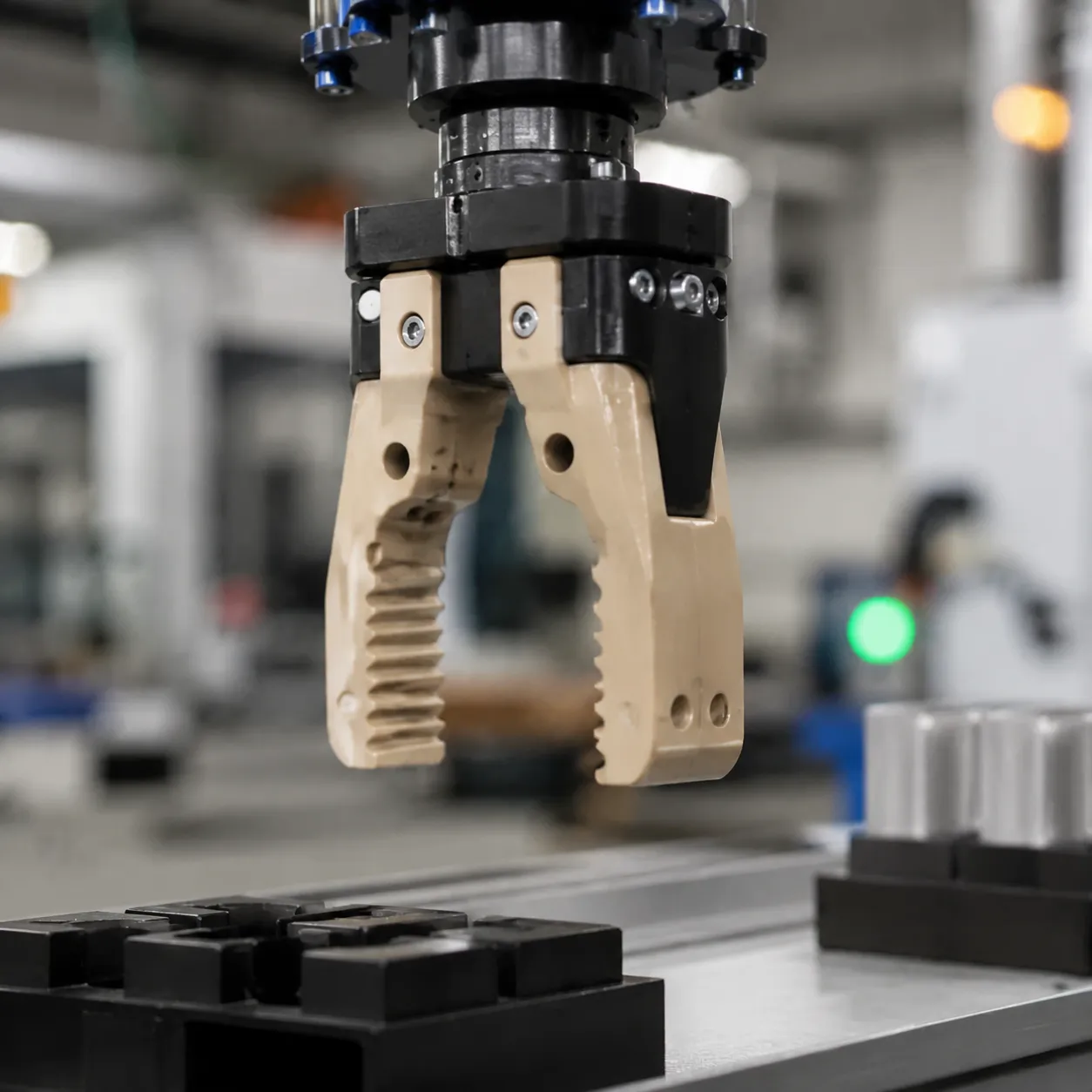
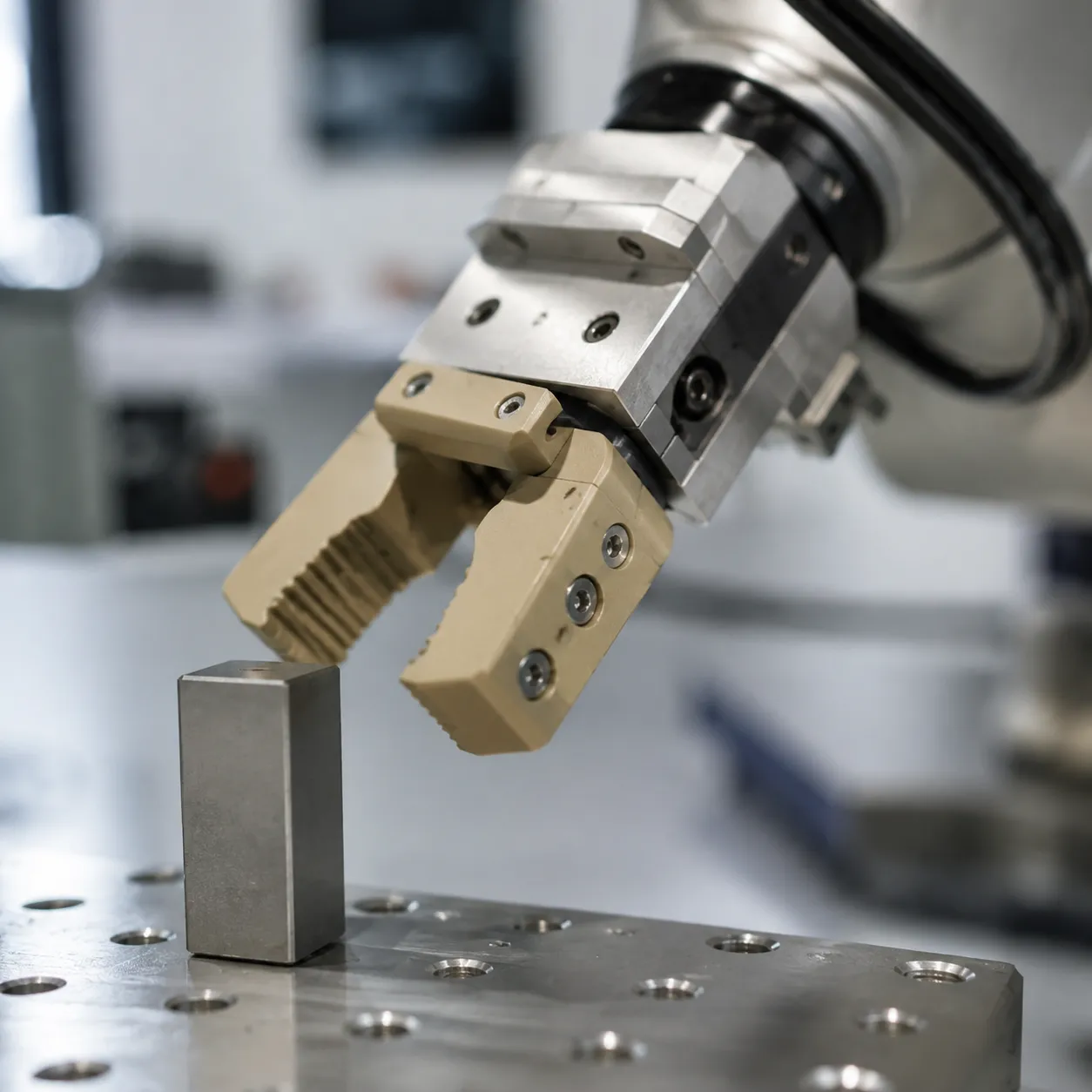
At roughly half the weight of aluminum, PEEK serves as an exceptionally lightweight material without sacrificing structural strength.
- Minimized Kinetic Energy: Lower mass on the robot tool center point reduces dynamic load on servo motors and gearboxes.
- Rapid Acceleration: Less mass yields low inertia, enabling higher acceleration speed during rapid direction changes without inducing system vibration.
- Higher Precision: Reduced momentum prevents overshooting during fast positioning stops.
Exceptional Wear and Fatigue Resistance
Continuous high-speed cycling causes significant mechanical stress on finger tips and contact surfaces. PEEK maintains its structural integrity over millions of actuation cycles.
| Property | Benefit in High-Speed Grippers |
|---|---|
| High Fatigue Limit | Prevents micro-cracking during rapid, repetitive clamping actions. |
| Low Friction Coefficient | Reduces contact surface wear when handling rough workpieces. |
| Impact Endurance | Absorbs high-frequency impulse forces without fracturing. |
When analyzing high-performance thermoplastics, comparing UHMW-PE, POM, and PEEK for automation reveals that PEEK offers unmatched mechanical strength and longevity under intense friction loads.
High Thermal and Chemical Stability
High-speed operations generate localized friction heat, while many production environments subject grippers to harsh cleaning agents or process chemicals.
- Continuous Heat Resistance: Retains rigid mechanical properties at operating temperatures well exceeding 200°C (392°F).
- Chemical Immunity: Impervious to standard industrial solvents, lubricants, coolants, and sterilization chemicals used in packaging or pharmaceutical lines.
Low Outgassing and Precision Dimensional Stability
For ultra-precise high-speed tasks, dimensional drift is unacceptable. PEEK features an extremely low coefficient of thermal expansion (CTE) and near-zero water absorption.
- Tight Tolerance Retention: PEEK components maintain precise geometry despite humidity shifts or temperature spikes.
- Cleanroom Compliance: Extremely low outgassing characteristics prevent volatile contamination, making it essential for sensitive electronic assembly.
Core Advantages of PEEK Gripper Fingers in High-Speed Operation
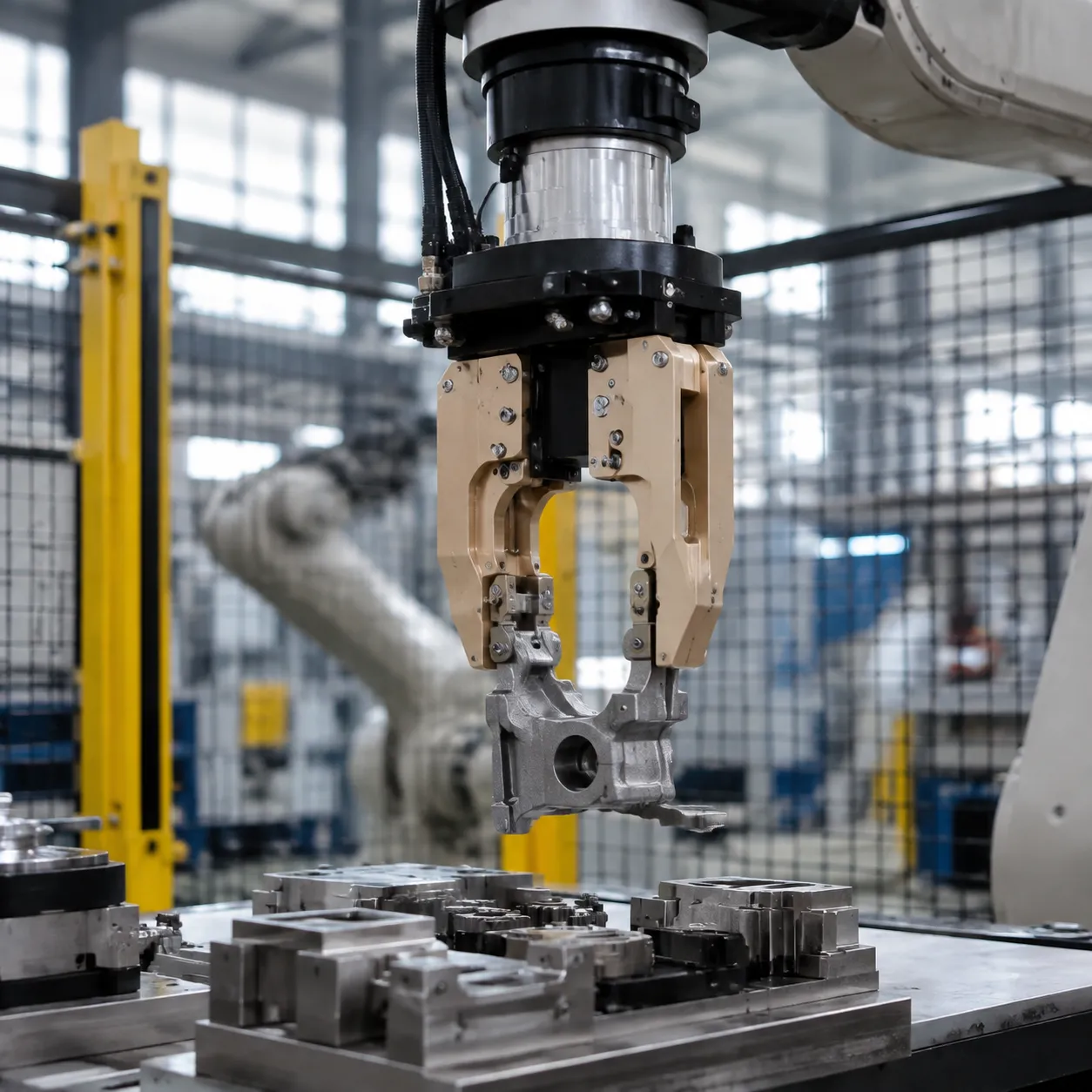
When you run high-speed automation lines, every millisecond counts. Upgrading your robotic end effectors from heavy metals to PEEK transforms overall system dynamics, delivering immediate gains in throughput, efficiency, and part safety.
Faster Cycle Times and Accelerated Production Speeds
Mass at the tip of a robotic arm dictates how fast it can move, stop, and settle. Standard metal end-effectors add unnecessary weight, creating high inertia that forces high-speed delta robots and cobots to slow down to avoid overshoot and severe cell vibration.
- Reduced Dynamic Inertia: Cutting mass at the tool center point dramatically drops inertial resistance during rapid directional changes.
- Higher Acceleration Speeds: Lower tool weight allows drive motors to reach maximum acceleration speed without tripping fault limits.
- Instant Settle Times: Minimizing rotational inertia lets your gripper stop instantly and grip parts with precision, shaving valuable milliseconds off every single cycle.
Switching to lightweight PEEK materials keeps moving mass to an absolute minimum, letting you push your automated lines to their highest engineered speeds.
Increased Payload Capacity and Reduced Energy Consumption
Every ounce spent on tooling is weight subtracted from your robot's net payload capacity. PEEK acts as the ultimate aluminum alternative, freeing up operational capacity so you can carry larger workpieces without stepping up to a larger, more expensive robot.
| Performance Parameter | Standard Metal Gripper Fingers | High-Performance PEEK Gripper Fingers |
|---|---|---|
| Tooling Mass | High (Consumes payload capacity) | Very Low (Maximizes net payload capacity) |
| Actuator Energy Draw | Higher amperage per peak move | Lower power consumption across all axes |
| Drive-Train Wear | Accelerates joint gearbox fatigue | Minimizes shock loads and extends motor life |
Because your motors aren't constantly fighting heavy tooling mass, overall power consumption drops, and long-term wear on robot gearboxes is substantially reduced.
Gentle and Non-Marring Contact with Delicate Workpieces
High-speed handling shouldn't come at the cost of part quality. Metal gripper jaws regularly scuff, scratch, or gouge sensitive parts during high-impact, rapid actuation.
- Mark-Free Part Handling: PEEK offers a smooth, tough contact interface that holds parts firmly without marring polished, painted, or delicate surfaces.
- Shock Absorption: The high-performance polymer absorbs minor impact kinetic energy upon contact, preventing surface cracks or micro-fractures in glass, optics, or thin-walled electronics.
- Zero Part Contamination: PEEK naturally resists flaking, galling, and particle shedding, ensuring delicate components stay pristine throughout high-speed handling.
PEEK Material Options and Production Methods
Choosing the right grade of polyether ether ketone and manufacturing process determines how well your robotic end effectors perform in high-speed applications. We balance material composition and production techniques to optimize strength, weight, and cycle speed.
Unfilled PEEK vs. Carbon Fiber-Reinforced PEEK
We evaluate material grades based on operational load and acceleration speed demands. Unfilled PEEK offers excellent surface purity and non-marring flexibility, while carbon fiber-reinforced PEEK maximizes stiffness for extreme acceleration.
| Material Grade | Tensile Strength | Stiffness | Key Advantage | Best Application |
|---|---|---|---|---|
| Unfilled PEEK | High | Standard | High purity, non-marring, compliant | Delicate workpieces, cleanrooms |
| Carbon Fiber-Reinforced PEEK | Very High | Exceptional | Ultimate rigidity, minimal flex at speed | Heavy payloads, extreme acceleration |
- Unfilled PEEK: Ideal when you need a gentle touch and cleanroom compatibility without shedding particles.
- Carbon Fiber-Reinforced PEEK: Integrates micro-carbon fibers to create an ultra-stiff aluminum alternative. This high performance polymer grade reduces flex during rapid directional changes, maintaining tight gripping accuracy.
Precision CNC Machining vs. 3D Printing PEEK Components
The production method directly impacts part density, dynamic fatigue life, and dimensional tolerance for high-speed gripper fingers.
- Precision CNC Machining: The ultimate choice for maximum structural stability. Machining solid PEEK stock delivers full material density, zero micro-voids, and tight tolerances. Understanding when to choose 5-axis CNC for food machinery components and high-speed automation allows us to create complex, lightweight finger profiles without compromising mechanical integrity.
- 3D Printing (Additive Manufacturing): Great for rapid prototyping or light-duty custom shapes. However, printed PEEK parts often possess anisotropic weaknesses between layers, making them susceptible to fatigue under constant, high-frequency impact.
| Production Method | Tolerances | Dynamic Strength | Lead Time | Surface Finish |
|---|---|---|---|---|
| Precision CNC Machining | Extremely Tight (±0.005 mm (selected dimensions; subject to review)) | Maximum | Fast for low-to-mid production | Smooth, burr-free |
| 3D Printing (FFF/SLS) | Moderate (±0.1 mm) | Reduced (Layer bonding) | Rapid prototyping | Layer-lined, porous |
For high-speed gripper fingers running continuous, demanding cycles, CNC machined PEEK provides superior fatigue resistance and consistent low inertia performance.
Target Application Scenarios for PEEK Robotic End-Effectors
We see PEEK robotic end-effectors making the biggest impact in fast-paced industries where traditional metal components simply fall short. By swapping heavy metal for this high performance polymer, high-speed automated systems achieve faster cycle times, reduced wear, and zero risk of product damage.
Automated Packaging and Pharmaceutical Assembly Lines
In rapid pick-and-place packaging, every millisecond counts. PEEK gripper fingers deliver the wear resistance and low mass required for continuous, high-speed sorting and boxing.
- Sterilization & Cleanliness: Resists harsh chemical washdowns and thermal sterilization cycles without degrading or swelling.
- Gentle Material Contact: Protects delicate blister packs, vials, and soft packaging from scratches and dents.
- Line Efficiency: Integrating lightweight PEEK end-effectors alongside custom components—like those featured in our one-stop CNC sourcing for packaging machinery guide—drastically cuts drive-system fatigue and lowers maintenance downtime.
Semiconductor and Cleanroom Electronics Manufacturing
Cleanroom environments demand materials that will not contaminate sensitive microelectronics. Polyether ether ketone naturally meets strict cleanroom standards while maintaining structural integrity.
- Ultra-Low Outgassing: Minimizes airborne volatile contaminants during high-vacuum wafer and circuit board handling.
- Zero Particle Shedding: Offers exceptional friction resistance, eliminating micro-debris generation near exposed chips.
- Precision Stability: Holds microscopic tolerances even during rapid, repetitive positioning movements.
High-Speed Collaborative Robots (Cobots) in Smart Factories
Modern cobot automation relies on lightweight tooling to operate at maximum efficiency while maintaining workplace safety standards.
- Reduced Inertia: Lower tool weight allows collaborative robots to reach peak acceleration speed without triggering safety-stop torque limits.
- Enhanced Safety: Minimal moving mass reduces kinetic impact energy, protecting human operators in shared workspaces.
- Payload Optimization: Preserves maximum wrist payload capacity for the actual workpiece rather than heavy end-of-arm tooling.
How to Select and Design PEEK High-Speed Gripper Fingers
Evaluating Operating Speeds, Loads, and Environmental Factors
Choosing the right grade of PEEK for high-speed gripper fingers requires a close look at your system's operational demands. Before settling on a design, we evaluate three critical operational parameters:
- Acceleration and Speed Requirements: Higher acceleration speeds demand lower dynamic mass. Unfilled or carbon-filled PEEK drastically cuts end-effector weight compared to metal alternatives.
- Payload and Clamping Forces: Ensure the material yield strength supports your gripping pressure without flexing or warping during rapid directional changes.
- Operating Environment: Account for exposure to harsh CIP chemicals, elevated ambient temperatures, or cleanroom outgassing requirements.
Key Design Considerations for Custom PEEK End-Effectors
To get maximum performance out of custom robotic end effectors, optimization goes beyond simple material selection. We focus on smart structural design to maximize stiffness while minimizing weight:
- Lightweighting Structures: Integrate pockets, hollowed sections, or ribbing patterns to remove non-critical material without sacrificing rigidity.
- Threaded Inserts: Use stainless steel or brass inserts for high-torque mounting points rather than tapping threads directly into PEEK for long-term repeatability.
- Contact Geometry: Design contoured contact surfaces or textured gripping faces to increase friction, allowing lower overall clamping force on delicate parts.
Cost-Benefit Analysis: PEEK vs. Aluminum and Stainless Steel
While PEEK carries a higher initial raw material cost, its performance benefits deliver a rapid return on investment in high-cycle, high-speed automated production. Similar to trade-offs evaluated when choosing hard-anodized aluminum vs. 316L stainless packaging parts, selecting the optimal material directly impacts machine wear, power consumption, and maintenance frequency.
| Material | Relative Mass | Wear Resistance | Max Operating Speed Potential | Long-Term ROI |
|---|---|---|---|---|
| PEEK (Unfilled / Carbon) | Ultra-Light | High / Self-Lubricating | Maximum | Highest (Low Wear & Energy Use) |
| Aluminum (Anodized) | Moderate | Medium | High | Moderate (Prone to surface wear) |
| Stainless Steel (316L) | Heavy | High | Low - Moderate | Low in High-Speed Applications |
Upgrading to PEEK as an aluminum alternative reduces wear on pneumatic actuators and servo motors, driving down overall operating costs across the lifecycle of your high-speed automation lines.
Need non-marring, food-grade gripper fingers for your high-speed line? Explore our built to withstand 24/7 pick-and-place cycles