Overview
What Are PEEK Gripper Fingers for Pick-and-Place Systems?
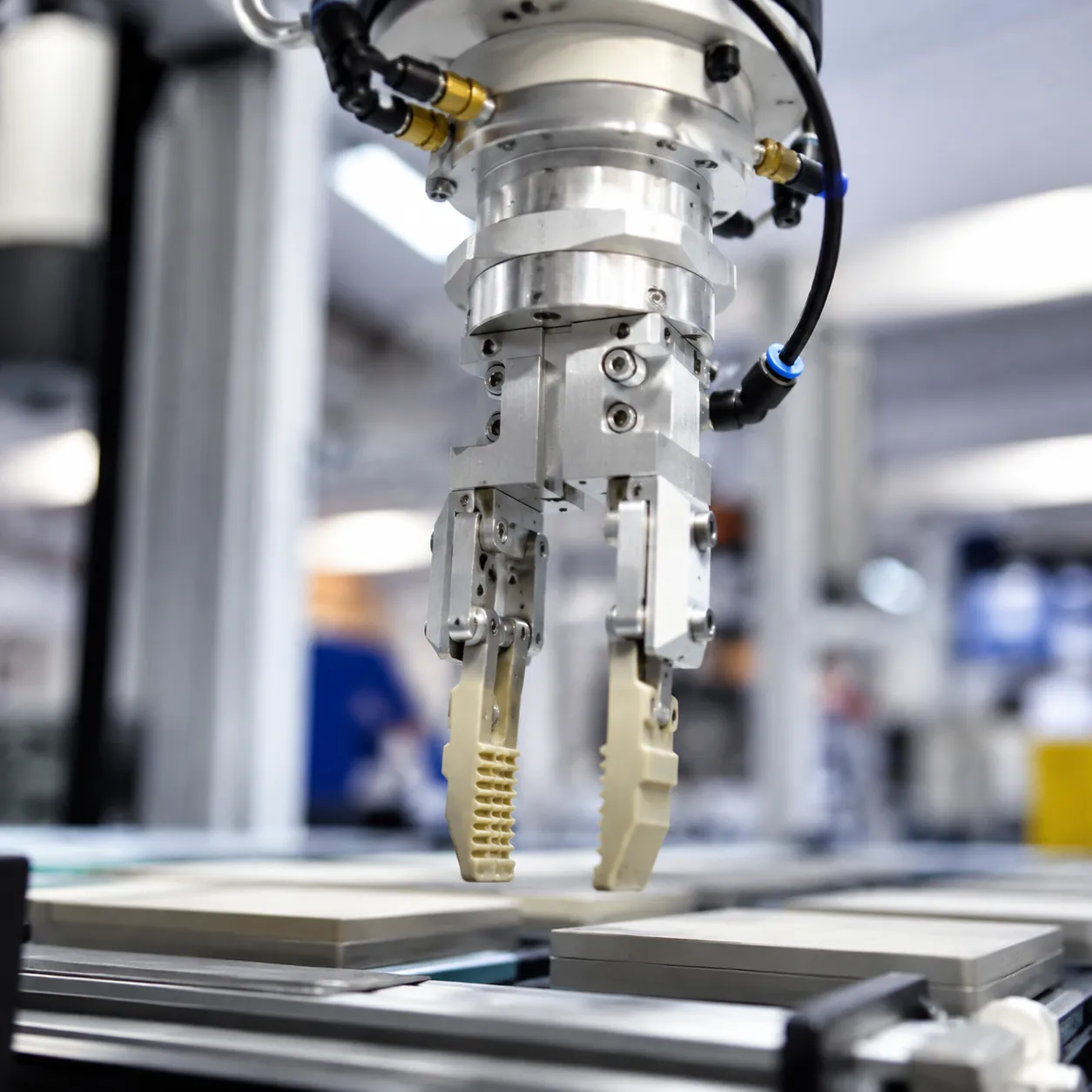
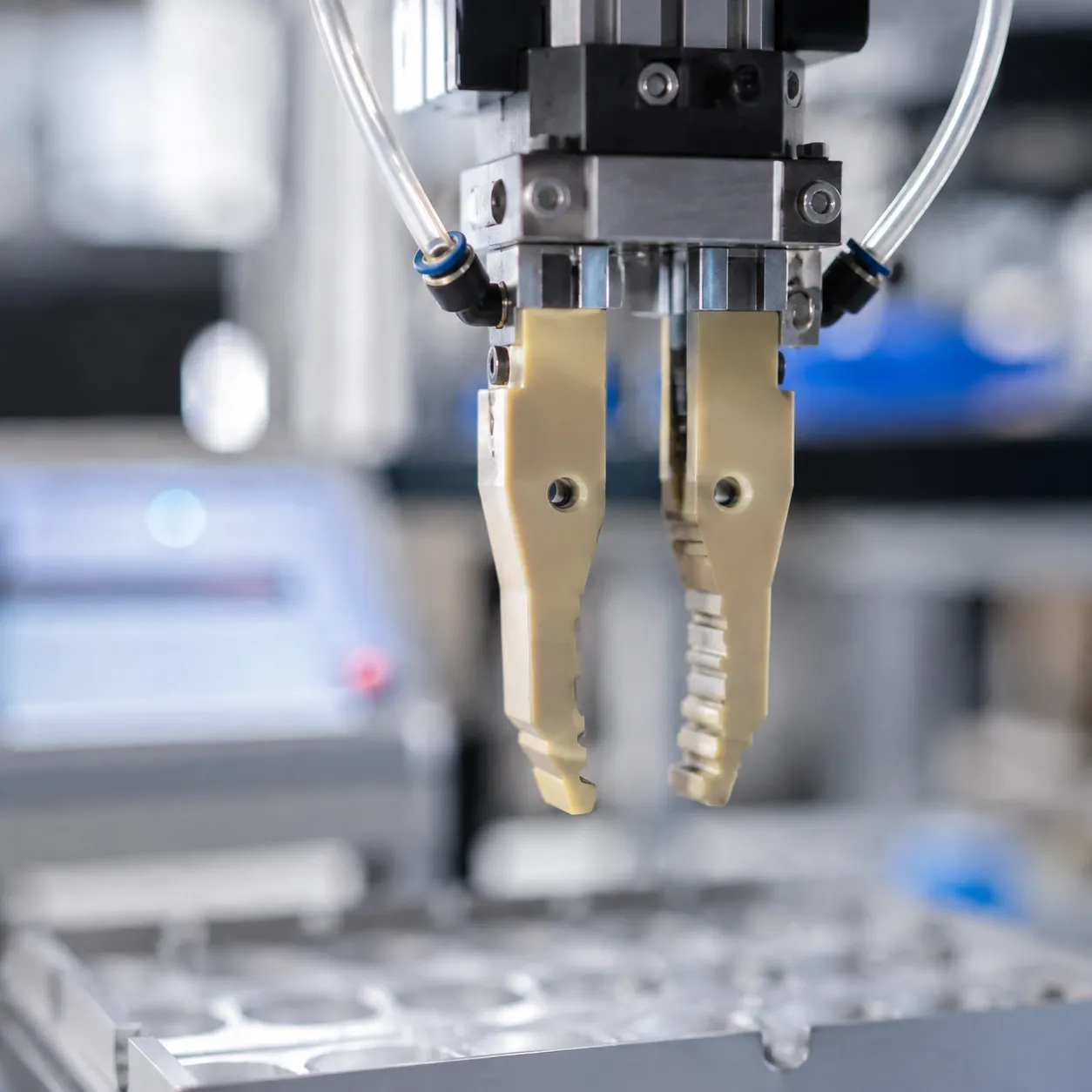
PEEK gripper fingers are high-performance contact components designed for high-speed pick-and-place robotic systems. Engineered from polyether ether ketone, these specialized end-of-arm tooling components bridge the gap between heavy metals and standard industrial plastics, delivering exceptional durability and precision in modern industrial automation.
Definition and Role in End-of-Arm Tooling (EOAT)
In a robotic end effector setup, gripper fingers serve as the direct contact interface between the automated arm and the payload. Manufactured from premium polyether ether ketone (PEEK), these custom fingers attach directly to pneumatic or electric grippers to perform precise handling operations.
- Direct Contact Interface: Safely grips, holds, and releases delicate or high-precision components.
- Payload Protection: Prevents surface scratches, micro-fractures, and contamination.
- System Optimization: Serves as a vital lightweight component in advanced EOAT assemblies.
How PEEK Gripper Fingers Work in Automated Handling
Integrated into parallel jaw grippers or angular motion actuators, PEEK gripper fingers actuate rapidly to execute repetitive transfer tasks. Upon signal activation, the robotic arm positions the fingers around the workpiece, applies controlled clamping force, transfers the part along a designated path, and releases it cleanly. Their low coefficient of friction and exceptional dimensional stability ensure precise positional accuracy across millions of continuous cycles.
Importance of Material Selection in Robotics
Material choice directly dictates system reliability, cycle speed, and component longevity in automated assembly. Traditional materials often force a compromise between mechanical strength and surface protection.
| Material Type | Structural Weight | Wear Resistance | Surface Protection | Thermal Resistance |
|---|---|---|---|---|
| Aluminum | Moderate | Moderate | Low (Risk of scratching) | Moderate |
| Steel | Heavy | High | Poor (Causes marring) | High |
| Standard Plastics | Light | Low | Good | Low |
| PEEK Polymer | Lightweight | Superior | Non-Marring | Up to 260°C (500°F) |
Selecting PEEK eliminates operational compromises. Its lightweight profile reduces inertial load on robotic actuators, allowing higher speed acceleration while its non-marking material properties safeguard sensitive parts during high-speed transfers.
Key Advantages of PEEK in Pick-and-Place Applications
We consistently turn to polyether ether ketone (PEEK) when designing high-performance end-of-arm tooling. This advanced engineering thermoplastic offers an unmatched combination of mechanical strength, thermal stability, and material purity that traditional metals simply cannot match in modern industrial automation.
High Mechanical Strength and Lightweight Design
PEEK provides an exceptional strength-to-weight ratio, making it an ideal material for high-speed pick-and-place operations. By swapping heavy aluminum or stainless steel fingers for PEEK, we significantly lower payload mass on the robotic end effector.
- Lower Inertia: Reduced weight allows your robots to accelerate and decelerate faster.
- Extended Equipment Life: Less mass minimizes mechanical strain on your pneumatic gripper actuators and robot joints.
- Higher Cycle Speeds: Lighter EOAT components directly boost overall throughput across your production line.
When integrating lightweight end-effector setups, pair them with custom anodized mounts and brackets for OEM packaging to maintain rigid, vibration-free alignment at maximum speeds.
Superior Wear, Chemical, and Heat Resistance
In demanding operational environments, standard plastics wear down quickly or fail under thermal stress. PEEK stands up to severe industrial conditions without compromising dimensional stability.
| Property | Benefit in Automation Systems |
|---|---|
| High Temperature Resistance | Retains structural integrity in continuous service temperatures up to 260°C (500°F). |
| Chemical Inertness | Resists aggressive solvents, washdown chemicals, oils, and industrial lubricants. |
| Low Wear & Friction | Delivers exceptional wear resistance during continuous, repetitive gripping cycles. |
Non-Marring Properties for Sensitive Components
Metal gripper fingers often leave surface scratches, scuffs, or metallic transfer on delicate workpieces. PEEK acts as a superior non-marking material that protects surface finish quality.
- Scratch-Free Handling: Safely grips polished metals, coated optics, glass, and painted automotive components.
- Reduced Scrap Rates: Eliminates cosmetic defects caused by high clamping forces during rapid transfer.
- Durable Yield: Soft enough to avoid scratching delicate parts, yet tough enough to resist indentation over millions of cycles.
ESD Compliance and Cleanroom Suitability
Static discharge and particulate contamination can devastate sensitive electronics and pharmaceutical packaging. PEEK meets strict compliance standards for highly controlled environments.
- ESD-Safe Grades: Carbon-filled PEEK variants safely dissipate static charges, protecting sensitive semiconductor devices.
- Low Outgassing: Releases virtually no volatile compounds under vacuum or elevated temperatures.
- Cleanroom Approved: Extremely low particulate generation makes PEEK fingers suitable for ISO Class cleanroom environments.
Types and Configurations of PEEK Gripper Fingers

Selecting the right mechanical layout for end-of-arm tooling directly determines how reliably your pick-and-place system operates. We supply a range of standard and specialized PEEK gripper finger configurations designed to integrate seamlessly with your robotic end effector and match your specific workpiece geometry.
Parallel Motion Gripper Fingers
Parallel motion fingers move in a synchronized straight line toward or away from the workpiece centerline. This layout ensures uniform gripping force and flat surface contact across the entire part interface.
- Best for: High-precision electronic assembly, rectangular parts, and uniform cylindrical components.
- Key advantage: Consistent centering accuracy and steady clamping force regardless of slight part size variations.
Angular Motion Gripper Fingers
Angular configurations open and close on a pivot hinge, sweeping outward to release components. This design provides maximum jaw clearance with a compact footprint, making it ideal for restricted automation cells.
- Best for: High-speed pick-and-place operations with limited clearance around the workpiece.
- Key advantage: Fast actuation speed and simple mechanical linkage using standard pneumatic gripper drives.
Custom-Machined and Conformal Gripper Fingers
When handling complex or irregular parts, standard off-the-shelf tooling often leaves marks or fails to hold securely. By applying precision custom machining to engineering-grade PEEK material, we produce custom-contoured fingers that perfectly match your component's exact outer profile.
- Best for: Asymmetrical castings, delicate optics, and thin-walled components.
- Key advantage: Distributes gripping pressure evenly to eliminate point loading, slipping, and surface damage.
Soft and Compliant Contact Fingers
For ultra-sensitive or fragile workpieces, compliant PEEK finger designs incorporate engineered flexures or modified geometry. These structures offer slight elastic yield to absorb minor positional misalignment and shock during rapid movement.
- Best for: Semiconductor wafers, glass substrates, and medical device parts.
- Key advantage: Gentle, non-marring contact combined with excellent wear resistance and cleanroom compatibility.
Key Selection Criteria for PEEK Gripper Fingers
Selecting the right PEEK gripper fingers for pick-and-place systems comes down to balancing mechanical demands with delicate component handling. When we design and integrate these end-of-arm tooling (EOAT) components, we evaluate four critical operational factors to ensure maximum efficiency and minimal system wear.
Payload Capacity and Gripping Force Requirements
While polyether ether ketone (PEEK) delivers an exceptional strength-to-weight ratio, you must match the finger geometry to your system's dynamic forces:
- Mass vs. Force: Calculate both static payload mass and high-speed acceleration forces to prevent slippage during rapid pneumatic gripper actuation.
- Friction Coefficient: Unfilled PEEK offers a smooth surface. For heavier parts, incorporate machined serrations, cross-hatching, or textured inserts to boost grip force without increasing clamping pressure.
- Structural Rigidity: Ensure finger thickness supports high side-loads without flexing, maintaining precise centerlines across millions of pick-and-place cycles.
Component Shape, Size, and Surface Sensitivity
The geometry and surface finish of your target workpiece dictate the physical design of the robotic end effector contact points.
| Target Component | Key Risk | PEEK Finger Strategy |
|---|---|---|
| Silicon Wafers & Optics | Surface scratching / ESD damage | ESD-safe PEEK with mirror-polished contact pads |
| Polished / Coated Metals | Marring or denting | Flat, non-marking virgin PEEK contact surfaces |
| Complex / Irregular Parts | Part drop / Misalignment | Custom-machined conformal PEEK finger profiles |
Operating Environment and Temperature Range
Standard materials fail under extreme chemical or thermal exposure. We select specific PEEK grades based on environmental demands:
- High Temperature Resistance: Standard PEEK maintains structural integrity up to 250°C (482°F) continuous use, making it ideal for hot-mold extraction or thermal curing lines.
- Chemical Exposure: PEEK resists aggressive solvents, degreasers, and acidic cleaning solutions commonly found in industrial automation processing lines.
- Cleanroom Standards: For low-outgassing and particle-free environments, unfilled PEEK prevents particulate contamination during high-frequency cycling.
Precision, Cycle Speed, and Stroke Length
In high-throughput pick-and-place automation, every gram of weight impacts overall system speed and actuator longevity:
- Weight Reduction: PEEK is roughly 50% lighter than aluminum and 80% lighter than stainless steel, dramatically reducing payload inertia.
- Faster Acceleration: Lower mass allows your robotic arm or pneumatic actuator to achieve higher acceleration rates and shorter stroke cycle times.
- Positional Accuracy: Reduced inertial momentum minimizes end-of-stroke vibration, enabling immediate, high-precision part placement.
Primary Applications in Industrial Automation
In modern manufacturing, PEEK gripper fingers for pick-and-place systems deliver exceptional reliability across demanding, high-precision environments. Here is where these high-performance robotic end effectors make the biggest operational impact:
Semiconductor and Electronics Assembly
Handling delicate silicon wafers, PCBs, and microchips requires extreme cleanliness and ESD protection.
Static Dissipation: Prevents electrostatic discharge from damaging sensitive micro-electronics.
Low Outgassing: Ideal for vacuum and cleanroom environments where chemical contamination must be avoided.
Non-Marring Contact: Grips fragile substrates securely without scratching micro-circuits or leaving residue.
Medical Device and Pharmaceutical Packaging
Hygiene and material safety are non-negotiable in pharmaceutical and healthcare automation.
Sterilization-Ready: Withstands repeated autoclave cycles, gamma radiation, and harsh chemical sanitizers.
Regulatory Compliance: Meets strict biocompatibility standards for medical device handling and drug packaging.
Precision Transfer: Maintains tight positioning tolerances when transferring vials, syringes, and surgical components.
Automotive and Precision Parts Handling
Automotive assembly lines demand high speed, structural integrity, and durability against aggressive fluids.
Chemical Immunity: Impervious to lubricants, coolants, and hydraulic oils commonly used on factory floors.
High Temperature Resistance: Retains rigid mechanical strength near hot engine parts or heat-curing stations.
Reduced Mass: Lightweight polyether ether ketone lowers payload inertia, optimizing pneumatic gripper cycle speeds.
High-Speed Food and Beverage Pick-and-Place
Fast-moving packaging lines require compliant, wear-resistant tooling that prevents product contamination. We supply optimized components built for the food automation industry to maintain continuous hygienic reliability.
FDA Compliance: Safe for direct contact during high-speed sorting, picking, and primary packaging.
Washdown Resistance: Withstands frequent high-pressure steam cleaning and caustic detergents without degrading.
Chipping Prevention: High impact toughness prevents fragmentation, protecting consumable products from foreign material risks.
Frequently Asked Questions
Why choose PEEK over metal gripper fingers?
Choosing polyether ether ketone (PEEK) over metal components like aluminum or stainless steel drastically improves handling efficiency for sensitive or high-speed operations. PEEK provides high structural integrity while remaining lightweight, non-marking, and resistant to aggressive chemicals.
| Feature | PEEK Gripper Fingers | Metal Gripper Fingers |
|---|---|---|
| Weight & Inertia | Ultra-lightweight (50% lighter than aluminum) | Heavy (increases robot arm motor stress) |
| Surface Contact | Non-marking material; protects sensitive parts | Can scratch, chip, or damage components |
| Chemical & Thermal Limits | Exceptional chemical resistance; up to 260°C continuous | Prone to chemical corrosion or thermal drag |
| ESD Safety | Available in ESD-compliant anti-static grades | Requires secondary conductive coatings |
How do PEEK gripper fingers improve cycle speeds in pick-and-place systems?
Upgrading your end of arm tooling (EOAT) components to PEEK directly lowers payload weight on the robotic end effector. Lower overall mass translates to key performance boosts across high-speed industrial automation setups:
- Lower System Inertia: Reduced weight allows high-speed pneumatic gripper systems and servo actuators to accelerate and decelerate faster.
- Shorter Stabilization Time: Less mass minimizes end-of-stroke vibration, allowing immediate component transfer without waiting for mechanical settling.
- Extended Motor & Gripper Life: Decreased momentum places far less mechanical strain on pneumatic grippers, linear drives, and robotic arm joints.
Can PEEK gripper fingers be customized for complex component geometries?
Yes, we routinely produce custom machined fingers tailored to match exact part contours, asymmetrical shapes, and delicate components. PEEK machines with exceptional dimensional stability, making it ideal for precision CNC milling, tight tolerances, and intricate geometric features:
- Conformal Contours: Machined to fit complex cylindrical, spherical, or stepped profiles perfectly.
- Pocketing & Vacuum Channels: Integrated features like vacuum suction channels, sensor cutouts, or soft-touch inserts.
- Repeatable Accuracy: Holds ultra-tight manufacturing tolerances over millions of high-speed pickup cycles without wearing out or deforming.