Overview
What Is a 5-Axis CNC Machined Rotary Valve Body?
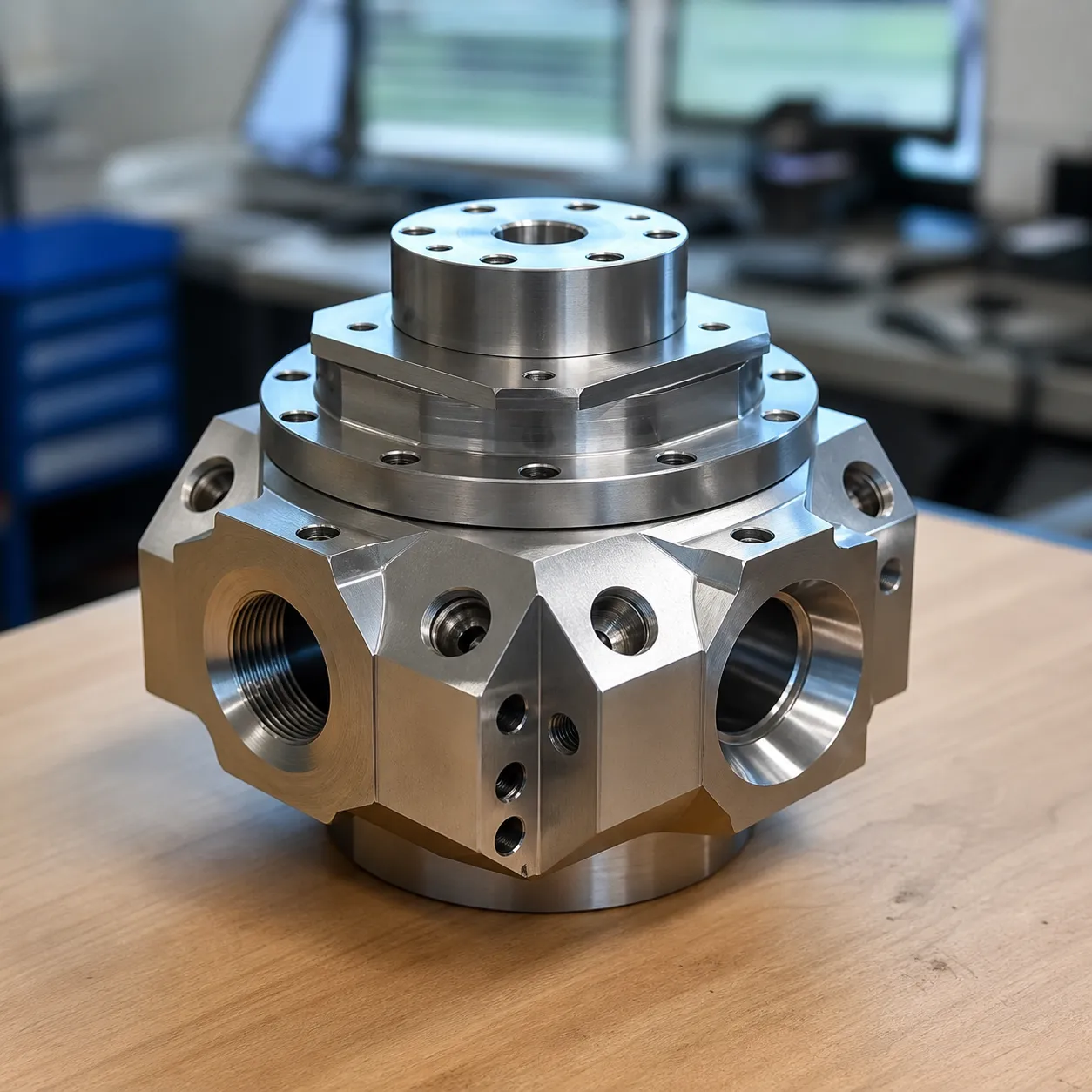
A 5-axis CNC machined rotary valve body is a high-precision mechanical housing engineered to control, divert, and regulate fluid or gas flow within high-performance fluid control systems. Utilizing advanced manufacturing capabilities, these components integrate intricate internal geometries into a single, highly durable block of material.
Understanding Rotary Valve Bodies with Complex Geometries
Rotary valve bodies rely on internal rotor motion to align internal ports and direct fluid paths. Modern industrial and aerospace demands require these components to feature highly complex geometries that go beyond standard cylindrical shapes.
- Multi-Port Routing: Complex internal passages that seamlessly direct fluids across multiple circuits.
- Compound Angles and Undercuts: Angled ports and recessed channels designed to minimize fluid turbulence and pressure drop.
- Freeform Surfaces: Optimized contours that demand extreme geometric accuracy for leak-free operations.
How 5-Axis CNC Machining Works for Precision Components
Traditional 3-axis machinery requires multiple re-fixtures to access intricate internal features, increasing setup error and reducing accuracy. 5-axis CNC machining resolves this by moving the cutting tool and workpiece along five different axes simultaneously.
This advanced approach provides direct, continuous access to complex features while maintaining tight tolerances down to micron levels. By eliminating multiple setups, 5-axis machining guarantees true geometric alignment across all valve ports and critical sealing faces.
Linear and Rotary Axis Movement Explained
To achieve continuous tool contact across complex valve geometries, 5-axis machines coordinate two distinct types of motion:
| Movement Type | Axis Designation | Operational Function |
|---|---|---|
| Linear Movement | X, Y, Z | Moves the tool or part along standard length, width, and depth dimensions. |
| Rotary Movement | A, B, or C | Tilts and rotates the part or spindle to maintain optimal tool orientation against compound angles and curved flow channels. |
This unified motion allows cutting tools to maintain ideal engagement angles, delivering unmatched surface finish quality and precise feature execution across every angle of the rotary valve body.
Key Advantages of 5-Axis Machining for Complex Valve Bodies
Manufacturing a 5-Axis CNC machined rotary valve body with complex geometry requires extreme precision. Traditional 3-axis methods often require multiple setups, increasing the risk of dimensional stack-up errors. Leveraging multi-axis technology transforms how we manufacture intricate fluid control components, delivering unmatched accuracy, speed, and structural performance.
Single-Setup Machining Efficiency and Accuracy
The primary advantage of simultaneous 5-axis machining is setup reduction. Machining all sides of a multi-port valve body in a single clamping eliminates manual repositioning errors and guarantees true position accuracy across every feature.
- Eliminates Datum Shifts: Features like compound angles, cross-drilled flow channels, and internal undercuts maintain exact geometric relationships.
- Shorter Lead Times: Combining operations drastically cuts cycle times and handling risks.
- Consolidated Workflows: By leveraging advanced 5-axis machining capabilities, we produce fully finished components directly from raw material stock in one seamless process.
Superior Surface Finish and Tight Tolerances
Achieving tight tolerances on freeform surfaces and internal chambers demands precise cutter contact. 5-axis movement allows the cutting tool to maintain an optimal angle relative to the workpiece at all times.
| Feature | Traditional 3-Axis | 5-Axis CNC Machining |
|---|---|---|
| Tool Reach | Long, flexible tools prone to chatter | Short, rigid tools with minimal deflection |
| Surface Finish | Manual polishing often required | Exceptional machine-finished surface quality |
| Tolerance Control | Stack-up errors from re-fixturing | Sub-micron accuracy maintained across all axes |
This optimized tool tilt prevents tool vibration, delivering a smooth surface finish directly off the machine and ensuring critical seal seats perform flawlessly.
Leak-Proof Integrity for Critical Fluid Control
In high-pressure systems and aerospace components, a minor surface flaw or micro-misalignment can lead to catastrophic leaks. Machining internal flow paths without dynamic steps or offset line mismatches ensures continuous, smooth fluid motion.
Smooth transitions inside multi-port valve bodies minimize turbulence and pressure drops. Machining sealing surfaces in the same setup as the pivot bore ensures absolute concentricity, delivering leak-proof performance under extreme operating conditions.
Extended Tool Life and Reduced Fixture Costs
Complex geometries typically demand expensive, specialized fixtures for every angle. 5-axis technology uses standard workholding while letting the machine spindle and table do the tilting.
- Rigid Cutting Conditions: Shorter cutting tools reduce chatter, allowing faster feed rates and deeper cuts.
- Longer Tool Wear: Maintaining consistent chip load extends carbide tool life significantly.
- Lower Overall Production Cost: Eliminating complex custom fixtures lowers tooling investment and speeds up job changeovers.
2-Axis CNC Machining Techniques and Configurations
Choosing the right setup is critical when producing a 5-Axis CNC Machined Rotary Valve Body (Complex Geometry). The exact combination of machine motion and structural setup dictates how efficiently we carve intricate flow channels, compound angles, and internal undercuts without compromising part accuracy.
Simultaneous 5-Axis vs. 3+2 Axis Machining
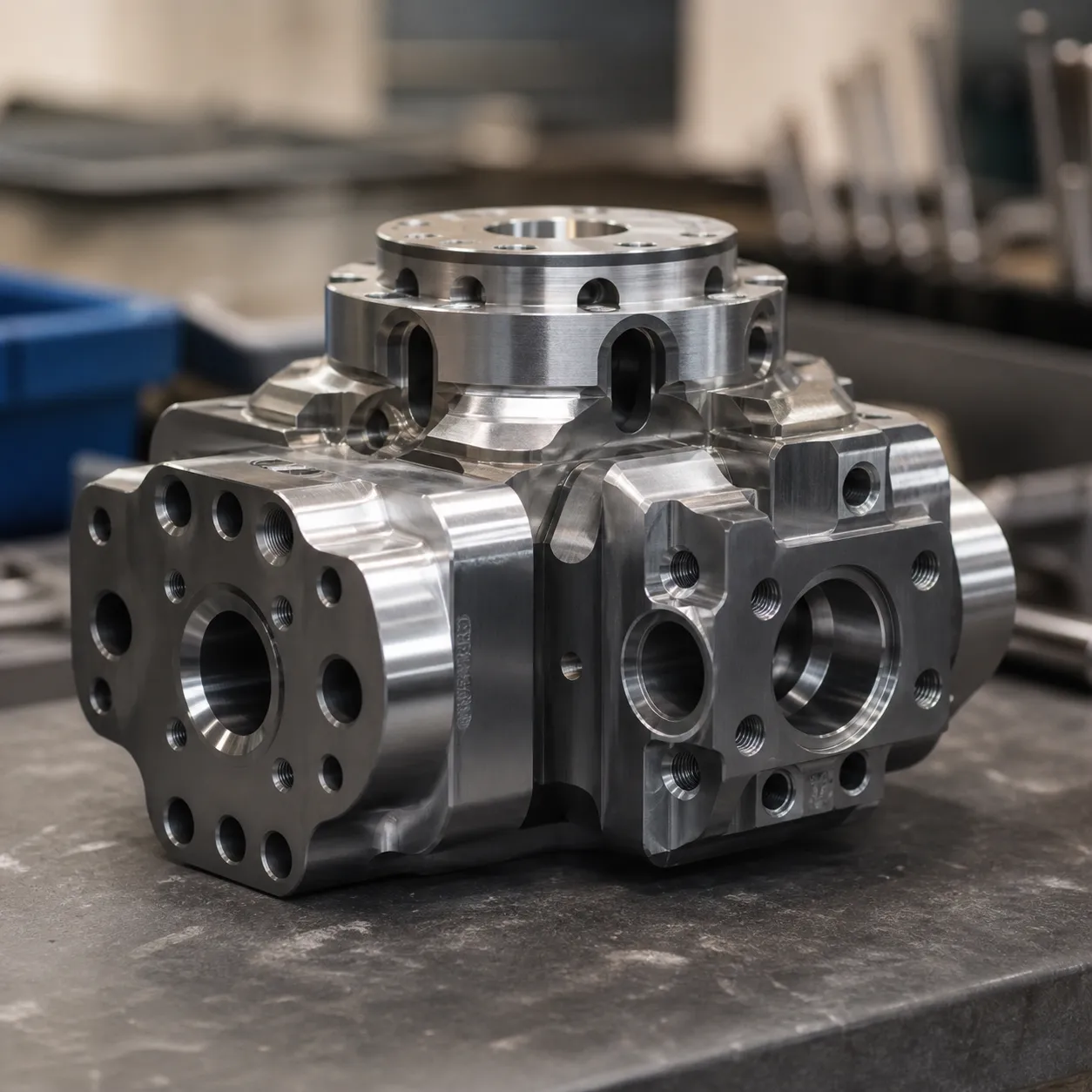
Not all multi-axis motion operates the same way. Matching the machining strategy to your specific valve body geometry directly impacts surface finish quality and dimensional stability.
- Simultaneous 5-Axis Machining: All five axes ($X$, $Y$, $Z$, plus two rotary axes) move continuously in tandem during the cut. This technique is essential for sculpting smooth internal flow channels, dynamic freeform surfaces, and organic port transitions. Maintaining uninterrupted tool contact eliminates tool marks and delivers a superior surface finish across fluid paths.
- 3+2 Axis Machining (Positional): The machine locks two rotary axes at fixed compound angles while the cutting tool moves along three linear axes. This approach works exceptionally well for machining flat faces, deep pockets, or straight-drilled ports positioned at awkward angles. It provides high rigidity for heavy stock removal, though it cannot continuously sculpt curved paths.
Trunnion Style vs. Swivel Head Machine Configurations
The physical machine structure dictates how the workpiece moves relative to the tool during high-precision cutting.
| Configuration | Mechanism | Best Applied To | Key Advantage |
|---|---|---|---|
| Trunnion Style | The table tilts and rotates while the spindle stays in a vertical plane | Small to medium-sized rotary valve bodies | Offers an exceptional tilt range, high rigidity, and unmatched accuracy on compact components |
| Swivel Head | The spindle head swivels/tilts while the table rotates or remains stationary | Large, heavy valve housings | Eliminates weight limitations on the table and prevents heavy workpieces from shifting during aggressive cuts |
Multi-Axis Milling vs. Multi-Axis Turning Integration
Rotary valve bodies feature tight cylindrical bores for internal spools as well as complex multi-port channels across the outer shell. Rather than moving parts between separate machines, combining processes on a single platform keeps tolerances tight.
By integrating our advanced CNC milling capabilities with multi-tasking precision CNC turning services, we complete complete valve bodies in fewer operations.
- Single-Pass Alignment: Turning the main central bore and milling complex porting in one seamless operation eliminates re-clamping errors, guaranteeing strict concentricity between valve seats and exterior ports.
- Significant Setup Reduction: Multi-tasking mill-turn integration slashes handling times, drastically shortening production cycles while holding tight tolerances across critical sealing faces.
Material Selection for Machined Rotary Valve Bodies
Selecting the right raw material for a 5-axis CNC machined rotary valve body depends directly on working pressure, temperature, chemical exposure, and weight limits. Because 5-axis machining allows us to carve complex geometries and multi-port valve bodies from a single solid block, choosing a material with stable mechanical properties ensures dimensional accuracy across every flow channel.
Aluminum Alloys for Lightweight Applications
Aluminum is our top choice when minimizing weight is essential without sacrificing structural strength. It machines cleanly, making it perfect for complex freeform surfaces and deep undercuts.
- Common Grades: 6061-T6, 7075-T6.
- Key Benefits: High strength-to-weight ratio, excellent thermal conductivity, and rapid machining speeds.
- Best Uses: Aerospace components, high-performance racing fluid systems, and portable pneumatic controls.
Stainless Steel for High Corrosion Resistance
When your rotary valve body operates in aggressive chemical environments or sterile fluid systems, stainless steel provides the toughness and corrosion resistance needed to maintain leak-proof performance.
- Common Grades: 316L, 304, 17-4 PH.
- Key Benefits: Outstanding resistance to pitting, high tensile strength, and stability under extreme thermal cycling.
- Best Uses: Marine hydraulics, chemical processing, and sanitary applications—such as a specialized beverage valve manifold 316L for sanitary processing that requires strict hygiene and zero fluid contamination.
Copper Alloys for Superior Thermal Conductivity
Copper and brass alloys deliver excellent thermal transfer and low friction, which prevents galling in dynamic rotary valve assemblies.
- Common Grades: C360 Brass, Beryllium Copper, Bronze alloys.
- Key Benefits: Exceptional heat dissipation, natural antimicrobial properties, and self-lubricating mating characteristics.
- Best Uses: High-speed cooling circuits, heavy-duty hydraulic valves, and spark-resistant fuel management systems.
Quality Control, Surface Finishing, and Testing Standards
Surface Treatment and Anodizing Options
When we manufacture a 5-axis CNC machined rotary valve body, achieving the exact physical geometry is only half the job. Post-machining treatments protect internal flow channels and sealing surfaces from wear, erosion, and chemical attack. Through our advanced surface finishing solutions, we enhance the durability of multi-port valve bodies operating in harsh environments.
| Surface Treatment | Target Material | Primary Benefit |
|---|---|---|
| Type III Hardcoat Anodizing | Aluminum Alloys | Superior wear resistance and dielectric protection |
| Electroless Nickel Plating | Steel / Copper | Uniform coverage across deep internal undercuts |
| Passivation | Stainless Steel | Removes free iron to maximize corrosion resistance |
Leak Testing and Pressure Integrity Validation
Intricate internal ports, internal undercuts, and intersecting passages mean that sealing integrity is non-negotiable. Every complex valve body undergoes rigorous pressure validation to prevent cross-port leakage and shell failure:
- Pneumatic Pressure Decay: Rapid, high-sensitivity checks for standard low-to-medium pressure seals.
- Hydrostatic Testing: High-pressure liquid validation to confirm structural pressure limits.
- Helium Mass Spectrometry: Trace gas analysis designed for high-spec aerospace components requiring zero-leak performance.
Precision CMM Inspection and Quality Assurance
Validating compound angles and complex freeform surfaces demands specialized metrology. We combine 5-axis tactile CMM probing with high-density optical scanning to verify tight tolerances down to the micron level.
By leveraging dedicated quality inspection standards, we ensure every finished part aligns 100% with your design model:
- 5-Axis Contact CMM: Precision measurement of angled bore positions, port alignment, and internal features.
- Non-Contact 3D Optical Scanning: Rapid surface profile verification across complex external contours.
- Profilometer Surface Testing: Direct measurement of sealing faces to ensure optimal smoothness and fluid sealing.
Tool Call Result:
Key Applications of 5-Axis Machined Rotary Valve Bodies
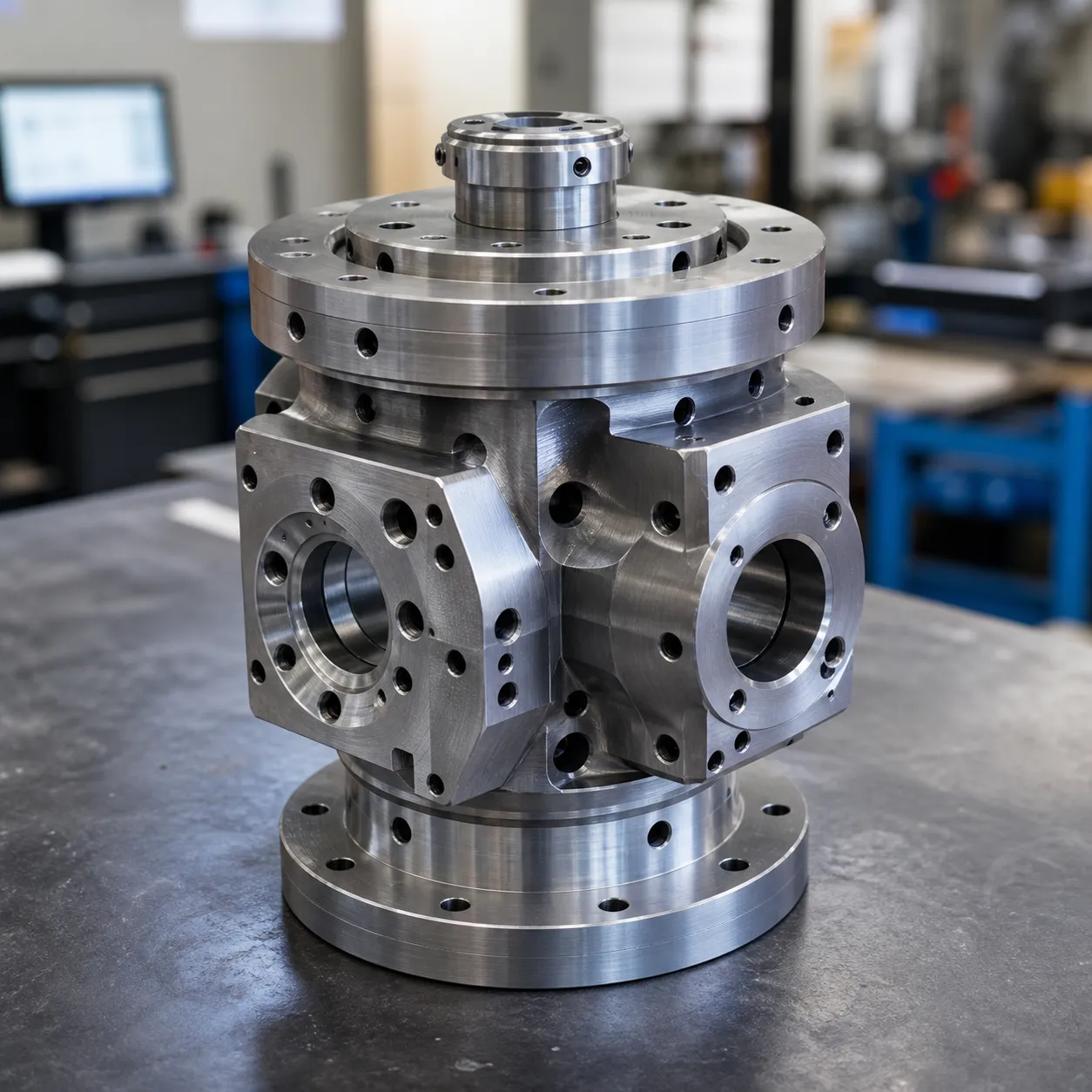
When fluid control systems require high precision, multi-directional flow, and zero leakage, standard components fall short. Utilizing a 5-axis CNC machined rotary valve body with complex geometry provides the seamless internal flow paths and structural integrity necessary for mission-critical operations.
Aerospace and Defense Fluid Control Systems
In aerospace components and defense fluid regulation, weight reduction and extreme reliability are paramount. We leverage simultaneous 5-axis machining to produce rotary valve bodies that withstand harsh pressure spikes and severe thermal shifts.
- Fuel Metering & Actuation: Machined internal flow channels ensure precise fuel distribution without pressure drop or latency.
- Hydraulic Controls: Intricate compound angles allow fluid pathways to maneuver around compact airframe constraints efficiently.
- Mission-Critical Reliability: Maintains strict tight tolerances to prevent catastrophic leaks in flight-essential hydraulic and environmental systems.
Automotive and High-Performance Liquid Cooling
Electric vehicle (EV) power electronics, battery management systems, and high-performance engines rely on dynamic multi-port valve bodies to regulate fluid routing on the fly.
- Dynamic Thermal Management: Directs liquid coolant across multiple internal circuits to prevent thermal runaway in battery packs.
- Reduced Pumping Resistance: Superior internal wall finishes minimize fluid friction, improving overall system energy efficiency.
- Proven Precision: Drawing from our specialized experience in high-integrity fluid management—such as our https://zscncpack.com/case-studies/beverage-valve-manifold-316l/](https://zscncpack.com/case-studies/beverage-valve-manifold-316l/)">316L stainless steel valve manifold project—we engineer every port to maintain seamless sealing under continuous pressure cycling.
Medical Devices and Precision Hydraulics
Precision medical instrumentation and micro-hydraulic systems require contamination-free fluid paths and exact displacement control.
- Diagnostic & Surgical Pumps: Delivers precise micro-fluidic dosing for automated laboratory and dialysis equipment.
- Zero Dead-Volume Geometry: Smoothly contoured internal passages prevent fluid stagnation and cross-contamination risks.
- Concentricity & Alignment: Single-setup machining guarantees exact alignment across all intersecting fluid ports, ensuring immediate response times in sensitive hydraulic actuators.
How to Choose the Right Machining Partner for Complex Valve Bodies
Selecting the right partner to manufacture a 5-Axis CNC Machined Rotary Valve Body (Complex Geometry) requires looking beyond basic milling capabilities. You need a manufacturing team that understands continuous toolpath planning, intricate flow channels, and stringent pressure requirements.
Evaluating Tolerances and Multi-Axis Capabilities
Not all multi-axis shops offer true simultaneous movement. When evaluating potential partners, ensure they possess the advanced equipment and CAM programming expertise required to handle complex freeform surfaces, undercuts, and compound angles in a single process.
| Feature / Capability | Standard Machining Shop | Advanced 5-Axis Partner |
|---|---|---|
| Machining Approach | Positional (3+2 axis) indexing | Simultaneous 5-axis continuous movement |
| Tolerance Precision | Standard commercial tolerances | Micron-level tight tolerances |
| Geometry Handling | Simple ports and flat faces | Complex internal flow channels & compound angles |
| Fixture Setup | Multiple setups required | Single-setup machining efficiency |
Assessing Material Expertise and Quality Certifications
Rotary valve bodies operate under intense pressures and demanding environmental conditions, requiring specialized experience across a range of high-performance machining materials. Working with a partner skilled in machining challenging metals like stainless steel ensures structural integrity and leak-proof performance.
Key qualifications to look for:
Industry Certifications: ISO 9001 and AS9100 compliance for quality management.
In-House Inspection: Full CMM verification, optical profiling, and strict surface finish auditing.
Traceability: Complete material certifications and lot-tracking protocols.
Balancing Production Efficiency and Overall Costs
The lowest initial bid rarely reflects the total cost of production. True cost efficiency stems from setup reduction, minimal scrap rates, and optimized cycle times. We work closely with engineering teams during the prototyping stage to refine designs for manufacturability, lowering overall production costs without sacrificing critical valve body performance.