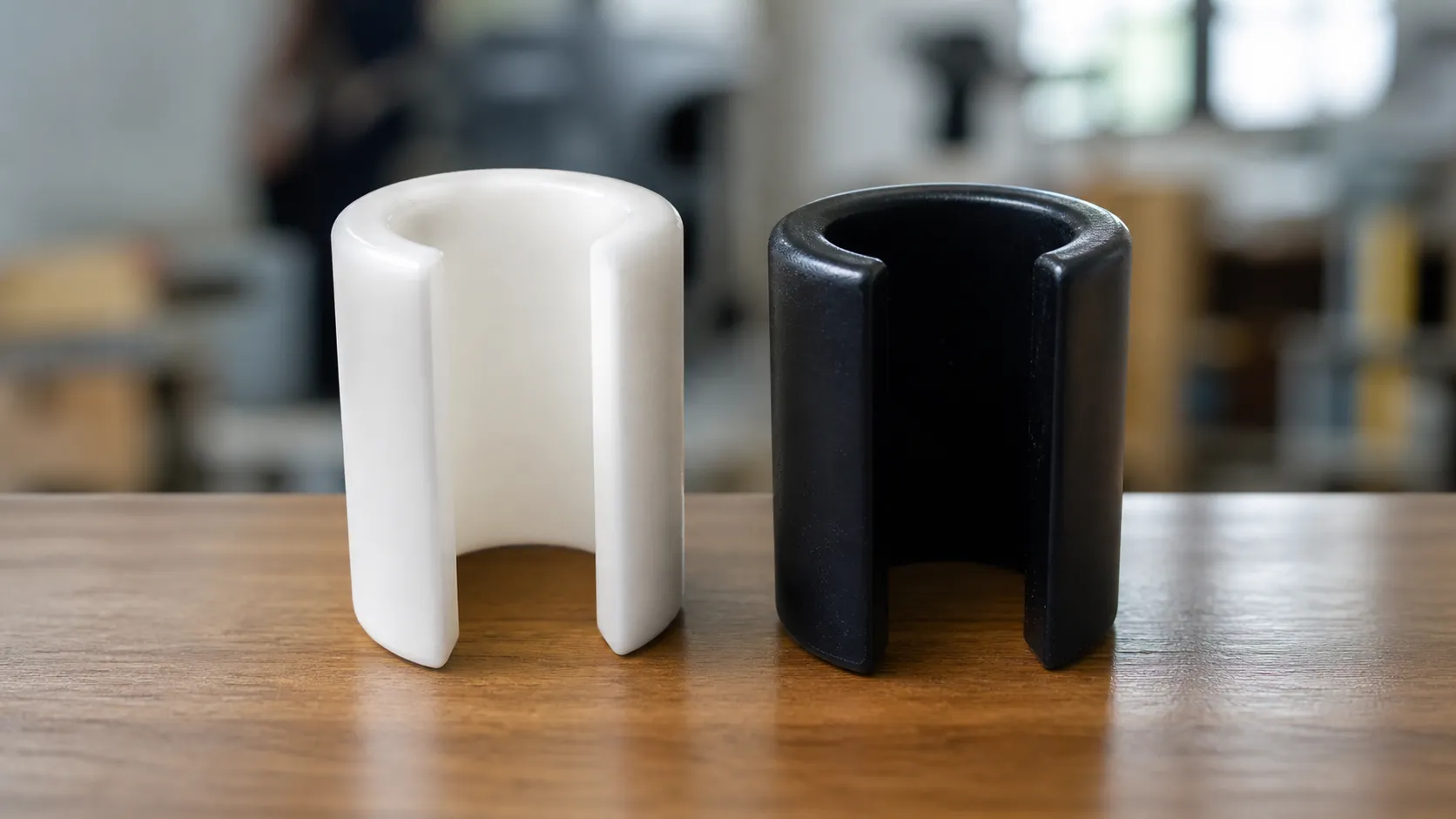
Understanding POM and UHMW-PE for Conveyor Systems
Machining tolerance review: Typical machining tolerance is ±0.01 mm. Selected dimensions may achieve ±0.005 mm after technical review. Final tolerances depend on the drawing, material, part size, geometry, finishing and inspection requirements and must be confirmed before order acceptance.
Selecting the right plastic for bottle neck guides directly affects line stability, sanitation, and service life. In beverage and bottling conveyors, POM vs UHMW-PE for bottle neck guides is primarily a choice between dimensional precision and long-term low-friction wear performance. Both materials are available as food-grade engineering plastics for custom-machined conveyor components.
What Is POM (Acetal)?
POM, also called acetal or polyoxymethylene, is a food-grade engineering plastic suited to components that require accurate structural dimensions and stable CNC-machined features. It is commonly selected for bottle neck guide designs with detailed profiles, mounting points, and close-fit interfaces around filling, capping, and transfer equipment.
For bottling line components, POM supports:
- Precise dimensional control for consistent bottle guidance
- High mechanical stability in structured guide assemblies
- Complex CNC geometries produced through milling, turning, or 5-axis machining
- Smooth, sanitary-finished surfaces for food-contact applications
POM is a practical choice where guide alignment and repeatable geometry are critical to avoiding bottle misfeeds.
What Is UHMW-PE?
UHMW-PE, or ultra-high molecular weight polyethylene, is a food-grade engineering plastic widely used for conveyor wear components, track guides, and bottle-contact surfaces. It is designed for low-friction movement, wear resistance, and reliable performance in continuous conveying environments.
For bottle neck guide applications, UHMW-PE is valued for:
- Low-friction bottle contact along guide tracks
- Strong resistance to wear in continuous-use areas
- Suitability for washdown-oriented conveyor environments
- Long service life in high-contact transfer and guide sections
UHMW-PE is particularly effective where bottles travel continuously against straight or curved guide rails and low-resistance movement is the main priority.
The Role of Bottle Neck Guides in Bottling Lines
Bottle neck guides keep containers controlled as they move through beverage filling, rotary capping, labeling, and conveyor transfer stages. They help maintain bottle orientation, reduce instability, and support consistent movement through high-speed bottling lines.
A properly machined neck guide must combine a smooth bottle-contact surface with accurate mounting geometry. Material selection should reflect the guide’s operating conditions, including continuous contact, line speed, wear exposure, washdown requirements, and required assembly tolerances.
For custom bottle neck guides, both POM and UHMW-PE can be CNC machined from traceable food-grade material. Precision manufacturing, dimensional inspection, and sanitary surface finishing help ensure the component is suitable for demanding beverage and packaging equipment.
Key Performance Comparison: POM vs. UHMW-PE

For bottle neck guides, POM and UHMW-PE are both food-grade engineering plastics used in conveyor and bottling equipment. The right choice depends on whether the priority is long-term sliding wear, impact handling, or precise guide geometry.
| Performance area | POM (Acetal) | UHMW-PE |
|---|---|---|
| Primary advantage | Precise, stable machined geometry | Low-friction, wear-resistant sliding surfaces |
| Typical guide use | Tight-fit and complex neck-guide profiles | Continuous-contact conveyor tracks and guide rails |
| CNC suitability | Strong choice for detailed precision features | Suitable for durable wear components |
| Food-contact control | Material traceability and certification available | Material traceability and certification available |
Wear Resistance and Friction Coefficient
UHMW-PE is a practical choice where bottles make continuous contact with guide surfaces. Its low-friction, high-wear characteristics help it perform well on transfer lines, conveyor wear strips, and high-contact guide tracks. It is widely suited to applications where PET bottles move continuously through rinsing, filling, capping, or labeling areas.
POM also supports smooth bottle movement, but its main value is often precision rather than maximum sliding-wear performance. For conveyor applications centered on extended abrasion resistance, our food-grade UHMW-PE guide rails and conveyor wear strips are designed for low-friction contact and washdown use.
Mechanical Strength and Dimensional Stability
POM, also known as acetal or polyoxymethylene, is well suited to bottle neck guides that need stable dimensions and accurately machined features. It supports complex CNC milling and turning work where guide spacing, mounting points, and bottle-control profiles must fit closely within the assembly.
At ZSCNC, we machine precision parts to tolerances down to ±0.01 mm when the design and application require it. This makes POM a strong option for detailed neck-guide forms used around filling valves, rotary capping equipment, and other closely controlled bottle-handling stations.
UHMW-PE is generally selected more for its wear performance than for highly detailed precision geometry. It remains a reliable material for guide rails and wear elements, especially where contact surfaces take priority over rigid, intricate profiles.
Impact Resistance and Toughness
UHMW-PE is a strong choice for demanding conveying conditions where repeated bottle contact, vibration, and impact are part of daily operation. Its durable nature supports long service life in high-contact transfer areas and guide paths.
POM is better matched to applications where guide shape retention and mechanical stability are the main requirements. For bottle neck guides with precise grooves, narrow clearances, or complex mounting interfaces, POM can provide a more controlled machined form.
Chemical and Moisture Resistance
Both POM and UHMW-PE can be supplied as certified food-grade plastics for sanitary bottling environments. Material selection should match the line’s washdown routine, product-contact requirements, and guide design.
For either material, we maintain material traceability and apply IQC and OQC controls. CMM dimensional reports, raw-material documentation, and surface finishing support are available for projects requiring controlled food-contact manufacturing. Smooth, sanitary machining helps reduce areas where residue could collect on bottle-handling components.
Performance in Bottle Neck Guide Applications
Straight vs. Curved Neck Guides
Straight bottle neck guides mainly need consistent alignment and a smooth contact surface along the conveyor path. UHMW-PE is well suited to long, high-contact runs where low friction and wear resistance matter most. POM is often a stronger choice where the guide must hold a more exact profile or interface accurately with mounting points and machine assemblies.
Curved guides place greater demands on fit, surface quality, and geometry control. We machine custom POM and UHMW-PE guide components from customer drawings, CAD files, samples, or photos. For detailed designs, our POM bottle neck guides for filling lines support precise guide profiles for beverage filling and capping equipment.
High-Speed Conveying and Noise Reduction
At high conveyor speeds, bottle movement can create friction, wear, and unstable transfer conditions. UHMW-PE is commonly used for guide tracks that experience continuous bottle contact because its low-friction behavior helps bottles travel smoothly through transfer sections.
POM provides a stable, accurately machined guide surface for applications where PET bottles must stay in a controlled position near filling valves, rotary cappers, or labeling stations. Material selection should match the line’s guide shape, contact load, speed, and required assembly precision.
Machinability and Custom Fabrication
POM is suitable for bottle neck guides requiring strict dimensions, detailed cutouts, and complex CNC-machined forms. UHMW-PE is effective for durable conveyor wear strips, track guides, and long wear components designed for repeated contact.
We use CNC milling, turning, and 5-axis machining to produce custom neck-guide parts in food-grade POM or UHMW-PE. Our manufacturing process supports dimensional control down to ±0.01 mm, with material traceability, CMM inspection reporting, and sanitary surface finishing available for food and beverage equipment.
When to Choose POM for Bottle Neck Guides
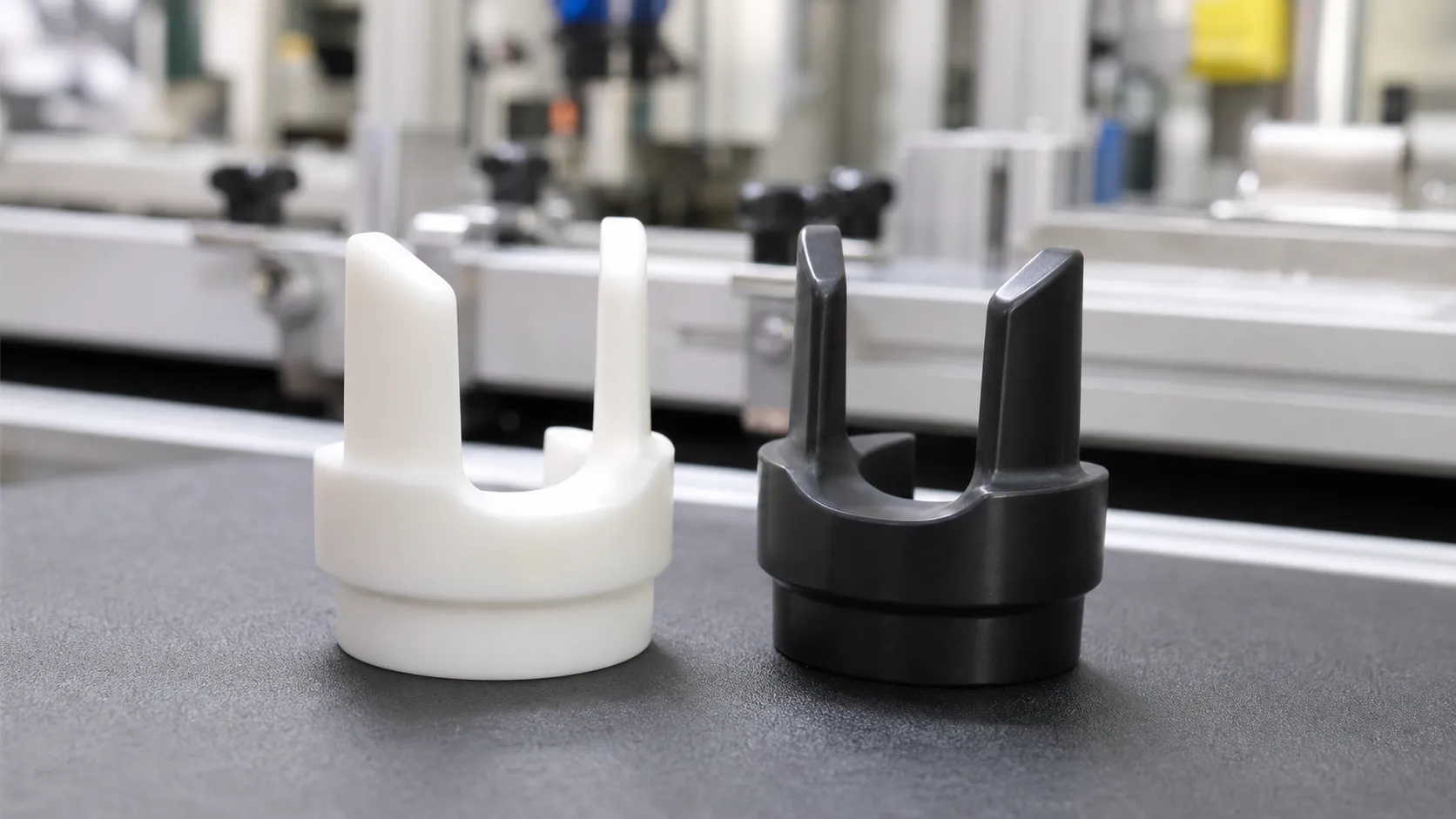
Choose POM (acetal) for bottle neck guides when accurate bottle control, rigid support, and repeatable fit are the priority. Its suitability for precise structural dimensions makes it a strong choice for detailed guide profiles used around filling, capping, and bottle-transfer equipment.
High-Precision and High-Rigidity Requirements
POM is well suited to neck-guide parts that must hold their shape through continuous operation. We machine food-grade POM for complex guide forms, mounting features, and close-fitting bottle-contact areas where stable positioning helps reduce misfeeds.
| Requirement | Why POM Fits |
|---|---|
| Precise bottle positioning | Supports accurate guide geometry |
| Rigid guide structure | Suitable for stable, shaped components |
| Complex profiles | Compatible with CNC milling, turning, and 5-axis machining |
| Food-contact documentation | Available with material traceability and certification |
For intricate assemblies, 5-axis CNC machining for food machinery components supports complex POM bottle neck guide geometries with controlled surface finishing.
Applications Demanding Drawing-Specified Dimensional Tolerances
Use POM when the neck guide must align closely with PET bottles or other container formats through rotary capping, filling valves, and high-speed transfer sections. Tight dimensions help maintain a consistent bottle path where guide spacing and mounting alignment matter.
Our CNC process can achieve tolerances down to ±0.01 mm for suitable complex geometries. Each custom POM bottle neck guide can be supported by CMM dimensional reporting, IQC/OQC inspection, and material batch traceability.
POM is a practical choice for:
- Precision bottle neck guide segments
- Rotary capping and filling-line guide assemblies
- Custom brackets and shaped guide components
- Applications requiring repeatable mounting and close fit
When to Choose UHMW-PE for Bottle Neck Guides
Extreme Wear and High-Impact Environments
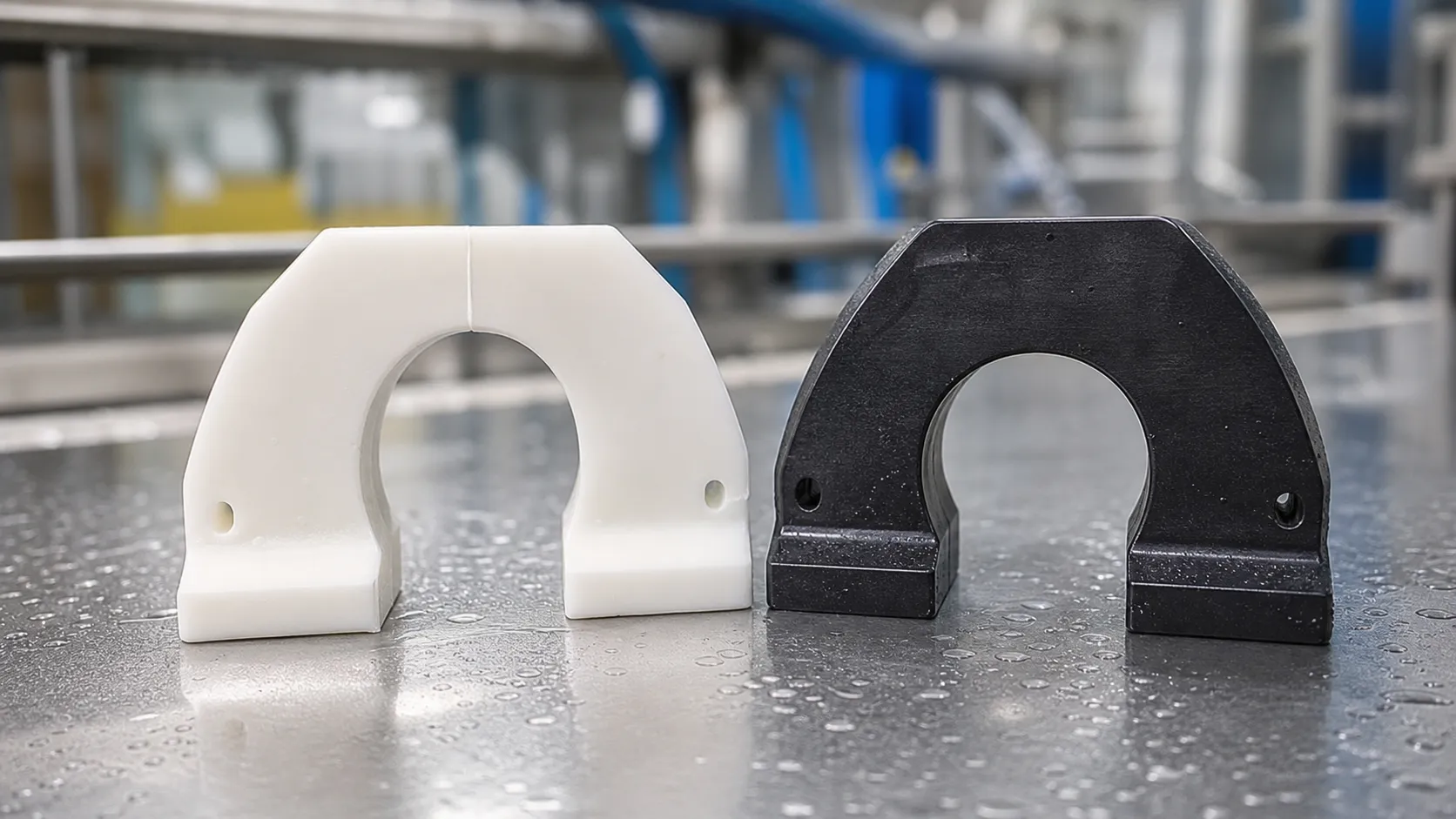
Choose UHMW-PE for bottle neck guides where bottles run continuously against the guide surface and wear life is the main priority. Its low-friction, wear-resistant properties suit high-contact conveyor sections, transfer lines, and guide tracks handling PET bottles.
| Operating need | Why UHMW-PE fits |
|---|---|
| Continuous bottle contact | Built for long-term abrasion resistance |
| High-speed transfer areas | Helps bottles move smoothly along the guide |
| Impact-prone conveyor zones | Suitable for durable wear components |
| Long guide rail runs | Supports extended service life |
We machine UHMW-PE guide rails and custom wear components for beverage and bottling equipment, including complex track layouts. Our direct CNC manufacturing setup supports prototypes through repeat production, with material traceability and dimensional inspection controls. For broader component sourcing across packaging equipment, see our one-stop CNC sourcing guide for packaging machinery.
Frequent Chemical Washdowns and Low-Friction Needs
UHMW-PE is a practical choice for bottling lines that require regular washdowns and clean, low-resistance bottle movement. It is commonly used for conveyor wear strips, neck guides, and transfer components where friction can affect bottle stability.
Use UHMW-PE when the application needs:
- Low-friction contact for stable bottle flow
- Wear resistance in high-use conveyor areas
- Washdown-ready guide and track components
- Food-grade material documentation and batch traceability
- Custom-machined straight, curved, or formed neck-guide profiles
For sanitary beverage equipment, we provide food-contact material certification, IQC and OQC checks, and CMM dimensional reports where required. Smoothly machined guide surfaces also support hygienic equipment design by reducing areas where contamination may collect.
How to Select the Right Material for Your Bottling Line
Evaluating Operating Temperature and Load Conditions
We select bottle neck guide material around the real line conditions: bottle speed, guide geometry, contact load, washdown routine, and required fit. Both POM and UHMW-PE are food-grade engineering plastic options, but each supports a different operating priority.
| Operating condition | Better material focus | Reason |
|---|---|---|
| Continuous bottle contact on long conveyor sections | UHMW-PE | Low friction and strong wear resistance support extended service on guide tracks. |
| Tight guide profiles and complex mounting features | POM | High mechanical stability supports precise CNC-machined dimensions. |
| Rotary capping and filling areas with strict alignment | POM | Suitable for close-tolerance neck-guide configurations that help control bottle movement. |
| High-contact transfer points and abrasion-heavy tracks | UHMW-PE | Designed for wear components and low-friction movement. |
| Food-contact applications requiring documented control | Both | Material traceability, mill sheets, and IQC/OQC inspection records can be applied. |
For bottling lines, the best material is not always the one with the lowest initial part cost. The guide must maintain stable bottle travel while handling the demands of conveyors, transfer lines, filling equipment, and capping stations. Our food-grade machining material options support material selection based on the component’s actual duty cycle and geometry.
Cost Efficiency and Component Longevity Comparison
Cost efficiency should be measured across machining, installation, wear life, and replacement frequency. UHMW-PE is often the practical choice where conveyor wear strips and neck guides experience constant sliding contact. Its low-friction behavior and wear resistance can help reduce guide replacement needs in high-use areas.
POM is often the better value where the guide requires consistent dimensions, rigid support, or intricate CNC features. A precisely machined POM neck guide can help maintain reliable bottle positioning in demanding filling and rotary capping assemblies.
| Selection factor | POM | UHMW-PE |
|---|---|---|
| Primary value | Precision and structural stability | Low friction and wear life |
| Best fit | Detailed, close-tolerance guide parts | High-wear conveyor and transfer guides |
| CNC fabrication | Suited to complex precision geometries | Suited to durable guide rails and wear elements |
| Long-term focus | Accurate bottle control | Reduced friction under continuous contact |
We machine POM and UHMW-PE bottle neck guides to the required design, from prototype quantities to production supply. CMM dimensional reporting, material certification, and controlled inspection help keep parts consistent for global beverage and bottling operations.