Overview
- Understanding Datum Strategy in 5-Axis Machining
Executing precision 5-axis machining for sanitary flange adapters requires a rigorous datum strategy. Because multi-axis movement introduces complex kinematics, a robust baseline ensures parts meet strict hygienic standards and tight geometric tolerances across every operation.
Datums and the Datum Reference Frame (DRF) Explained
A Datum Reference Frame (DRF) is a three-dimensional coordinate system established by a hierarchy of theoretical planes, axes, and points. In GD&T, the DRF completely locks all six degrees of freedom—three spatial translations (X, Y, Z) and three rotations (pitch, roll, yaw).
- Primary Datum: Eliminates 3 degrees of freedom (1 translation, 2 rotations).
- Secondary Datum: Eliminates 2 degrees of freedom (1 translation, 1 rotation).
- Tertiary Datum: Eliminates the final 1 degree of freedom (1 translation).
For 5-axis CNC milling, establishing an accurate DRF guarantees seamless coordination between the machine tool's rotary axes and the part geometry.
Difference Between Datum, Datum Feature, and Simulator
Achieving high repeatability requires distinguishing between physical manufacturing elements and theoretical references.
| Term | Definition | Sanitary Flange Adapter Example |
|---|---|---|
| Datum Feature | The actual physical surface, bore, or edge on the part. | Precision sealing face or center bore surface. |
| Datum Feature Simulator | The physical equipment or virtual boundary contacting the part. | Precision expanding arbor, fixture plate, or zero-point chuck. |
| Datum | Theoretical, geometrically perfect plane, axis, or point derived from the simulator. | Perfect theoretical center axis or flat base plane. |
The 3-2-1 Principle in 5-Axis Workholding
The 3-2-1 principle forms the foundation of reliable workholding fixtures. It systematically locates a workpiece using minimal contact points to avoid over-constraint:
- 3 Points (Primary Base): Establishes the main plane, typically referencing the main flange face.
- 2 Points (Secondary Axis): Aligns the part, typically referencing the central bore or cylindrical body.
- 1 Point (Tertiary Stop): Fixes rotational orientation, using a clocking pin or specific feature location.
In 5-axis setups, applying the 3-2-1 method ensures accurate, repeatable part positioning while maintaining maximum toolpath accessibility during multi-angle cutting.
Importance of Proper Datums for Sanitary Flange Adapters
Machining tolerance review: Typical machining tolerance is ±0.01 mm. Selected dimensions may achieve ±0.005 mm after technical review. Final tolerances depend on the drawing, material, part size, geometry, finishing and inspection requirements and must be confirmed before order acceptance.
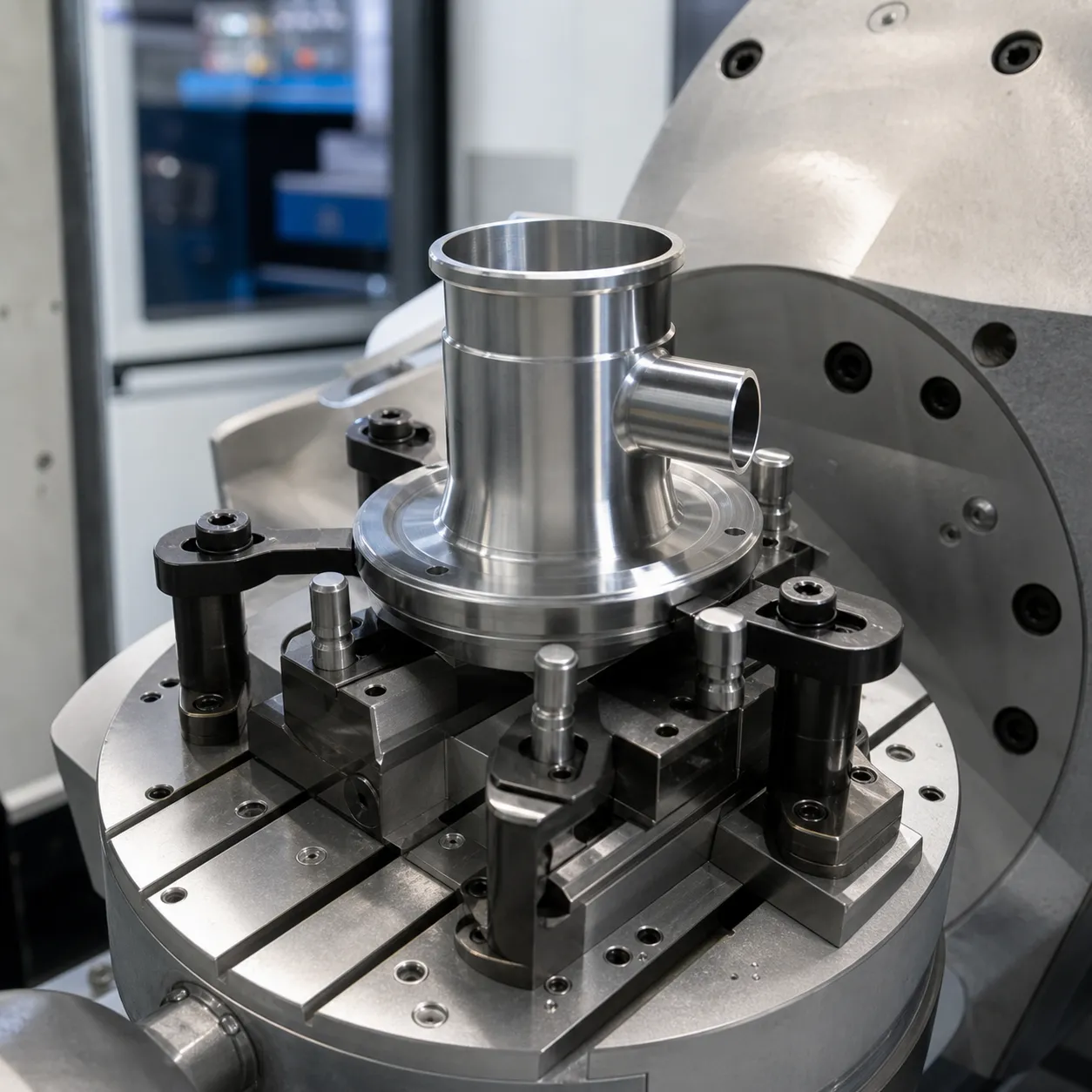
Setting a clear datum strategy for 5-axis sanitary flange adapters directly determines whether a fitting holds up under rigorous hygienic standards. When cutting complex sanitary features on multi-axis equipment, a well-planned datum scheme keeps every seal face, bore, and mounting detail perfectly true.
Maintaining Tight Tolerances and Hygienic Seal Integrity
Sanitary fittings rely on flawless contact surfaces. A weak datum setup causes minor misalignments, leading to uneven gasket compression, fluid trap points, and eventual contamination risks.
- Zero Micro-Gaps: Precise datum targeting locks in sealing face flatness, eliminating microscopic crevices where bacteria can gather.
- Uniform Gasket Load: Proper alignment ensures clamp rings distribute pressure evenly around the entire circumference.
- Surface Finish Consistency: Stable datum positioning avoids chatter, preserving polished, low-Ra surface finishes during multi-axis sweeps.
Whether producing custom sanitary adapters or high-precision sanitary equipment hardware, controlling sealing face tolerances is essential for long-term production reliability.
Eliminating Cumulative Clamping and Multi-Axis Rotation Errors
While 5-axis CNC milling cuts down on manual repositioning, multi-axis rotation can introduce tolerance stack-up if reference points aren't rock solid. Without an accurate datum reference frame, minor angular errors compound across every rotated feature.
| Machining Factor | Impact of Poor Datum Strategy | Result with Optimized Strategy |
|---|---|---|
| Rotational Offset (A/C Axis) | Centerline drift between opposing port faces | Perfectly concentric bores across all rotary positions |
| Workholding Stress | Wall distortion on thin hygienic necks | Stress-free clamping using designated datum pads |
| Tolerance Stack-Up | Compounded positioning errors on compound angles | True feature positioning tied to a single origin |
Ensuring Consistency Between Machining and Quality Inspection
Discrepancies often occur when a part measures accurately on the CNC machine but fails during quality assurance. This usually happens when the machinist and the quality engineer align the part using different reference points.
Applying a unified datum strategy for 5-axis sanitary flange adapters across both machining fixtures and coordinate measuring machine (CMM) inspection routines solves this issue completely.
- Matching Reference Frames: Mirrors the exact physical clamping locations inside CMM probing routines.
- Fewer False Rejects: Prevents acceptable parts from failing inspection due to setup discrepancies.
- Faster Quality Turnaround: Streamlines first-article inspection and routine batch validation.
Establishing the Datum Reference Frame for Sanitary Flange Adapters
Setting up a solid Datum Reference Frame (DRF) is the foundation of high-precision 5-axis CNC milling. For sanitary flange adapters, an accurate DRF ensures that every multi-axis tilt and rotation lands exactly where it should, maintaining tight geometric tolerances across complex surface contours.
Selecting the Primary Datum on the Flange Sealing Face
The flat sealing face serves as our primary datum (Datum A). Because sanitary flanges require uniform gasket compression to prevent leakage, this surface provides the most reliable foundation.
- Constrains 3 Degrees of Freedom: Stops Z-axis translation along with pitch and roll rotation.
- Maximizes Surface Contact: Utilizing the largest flat functional surface minimizes rocking or fixture deflection during heavy machining passes.
- Direct Hygienic Impact: When determining when to choose 5-axis CNC for food machinery components, locating directly off the finished sealing face prevents angular mismatch and gasket pinch points.
Defining the Secondary Datum for Center Bore Concentricity
Our secondary datum (Datum B) is established along the internal center bore axis or the precision ground hub diameter.
- Constrains 2 Degrees of Freedom: Locks down X-axis and Y-axis side-to-side translation.
- Ensures Smooth Fluid Flow: Aligning off the central axis guarantees absolute concentricity between the adapter bore and connecting piping, eliminating internal ridges where bacteria could collect.
- Supports Multi-Axis Tool Access: Keeps the center of rotation perfectly aligned with the 5-axis machine's rotary table center.
Establishing the Tertiary Datum for Angular Orientation and Features
The tertiary datum (Datum C) locks down the final rotational orientation around the central axis.
- Constrains 1 Degree of Freedom: Stops yaw (rotation around the Z-axis).
- Fixes Feature Positions: Uses a precision bolt hole, keyway, or index slot to establish a fixed 0-degree point.
- Coordinates Complex Angles: Ensures side ports, sensor boss taps, and mounting flanges align seamlessly during complex multi-axis operations. This level of orientation accuracy is essential when manufacturing high-grade components like a beverage valve manifold 316L for sanitary processing, where zero-dead-leg geometry depends on exact feature placement.
| Datum Level | Feature Selected | Degrees of Freedom Constrained | Key Purpose in Sanitary Flanges |
|---|---|---|---|
| Primary (A) | Flat Sealing Face | 3 (Pitch, Roll, Z-Translation) | Ensures leak-tight, uniform gasket compression |
| Secondary (B) | Center Bore / Precision Hub | 2 (X & Y Translation) | Maintains bore concentricity and smooth fluid flow |
| Tertiary (C) | Alignment Hole or Slot | 1 (Rotation around Z-Axis) | Guarantees exact angular orientation for side ports |
Advanced 5-Axis Datum Implementation Strategies
Executing an effective datum strategy for 5-axis sanitary flange adapters requires integrating modern hardware, automated probing, and smart GD&T callouts. Combining these advanced techniques streamlines high-precision manufacturing across demanding sectors like the food processing industry and the beverage processing industry.
Utilizing Zero-Point Clamping and Datum Positioning Systems
Zero-point clamping systems establish a physical datum reference frame instantly, eliminating manual alignment during setup changes.
- Fixture Repeatability Review: Quick-change pallet systems lock workholding fixtures into position within < a repeatability limit confirmed for the selected fixture and setup; it is not a guaranteed finished-part tolerance.
- Reduced Setup Time: Swap raw billets or pre-machined forgings without re-indicating physical datum faces.
- Rigid Clamping Force: High pull-down forces resist multi-axis cutting loads without introducing stress deformation on delicate sanitary seal faces.
| System Feature | Benefit for Sanitary Adapters | Impact on 5-Axis CNC Milling |
|---|---|---|
| Zero-Point Baseplate | Fixed location origin | Eliminates manual indicator setup |
| Pneumatic Lock Pin | Uniform clamping force | Prevents thin-wall flange distortion |
| Indexable Fixturing | Quick 90°/180° reorientation | Maintains center bore concentricity |
In-Process Probing and Automated WCS Alignment
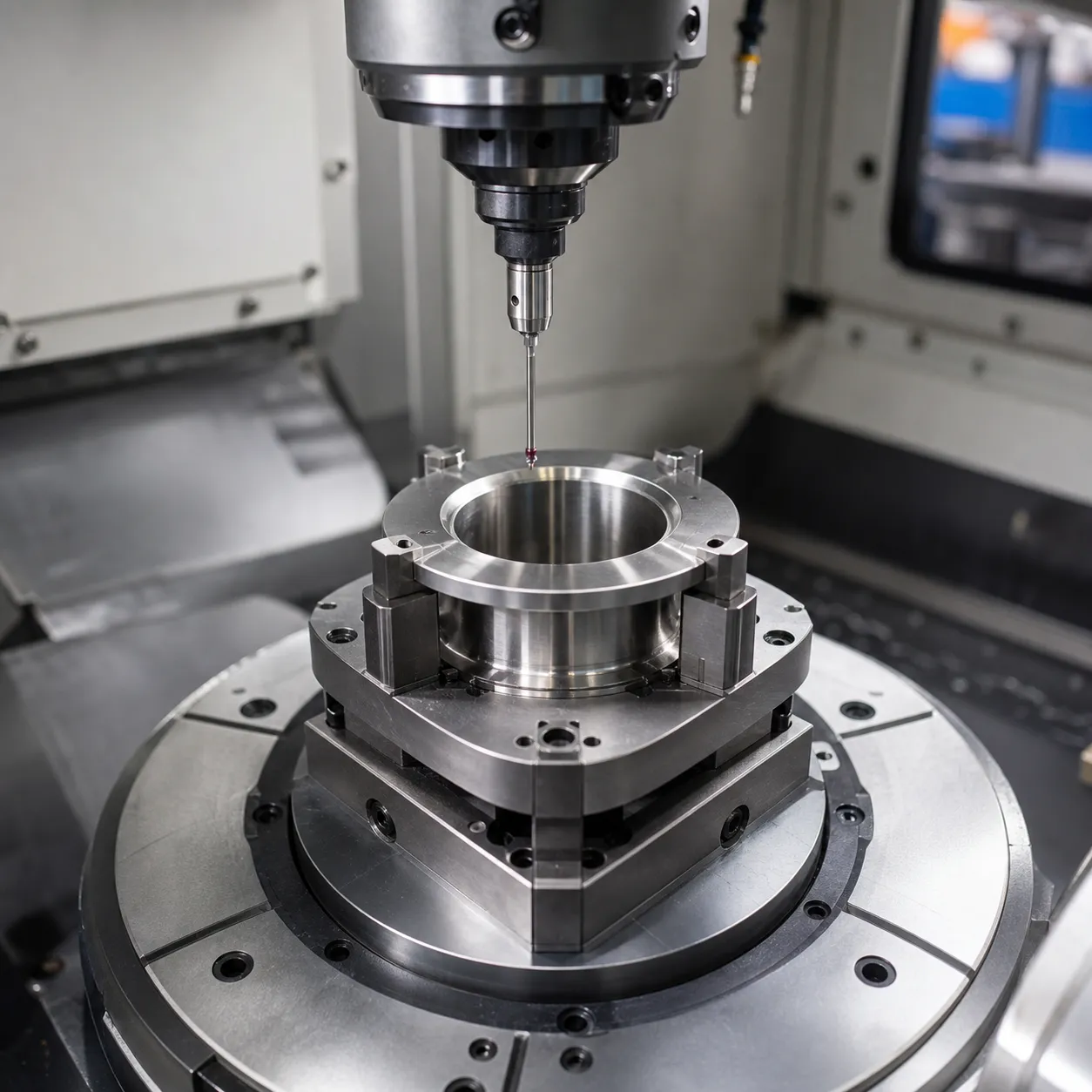
Spindle-mounted touch probes transform physical features into precise Work Coordinate Systems (WCS) automatically, compensating for raw material variation.
- Dynamic Offset Adjustment: Probes locate the primary datum face and center bore to compute real-time dynamic work offsets (G54.2 / TCPC / TWP).
- Vector Compensation: Automated 3D rotation measurements adjust for tilt or axis misalignment before high-speed CNC milling begins.
- In-Process Verification: Measure critical hygienic feature depths between roughing and finishing passes to correct for tool wear automatically.
Applying GD&T Material Condition Modifiers
Using standard GD&T principles with material condition modifiers maximizes manufacturing tolerances while guaranteeing fit and function during final CMM inspection.
Maximum Material Condition (MMC - Ⓜ): Applying MMC to secondary center bores or mounting bolt patterns grants additional "bonus tolerance" as feature sizes depart from their maximum material limits, keeping scrap rates low without compromising sealing integrity.
- Least Material Condition (LMC - Ⓛ): Ensures minimum wall thickness around hygienic seal grooves to prevent wall collapse under high CIP/SIP line pressures.
- Regardless of Feature Size (RFS): Critical primary datum sealing faces strictly enforce surface profile tolerances regardless of feature dimensions to guarantee leak-tight performance.
Overcoming Datum Setup Challenges for Flange Adapters
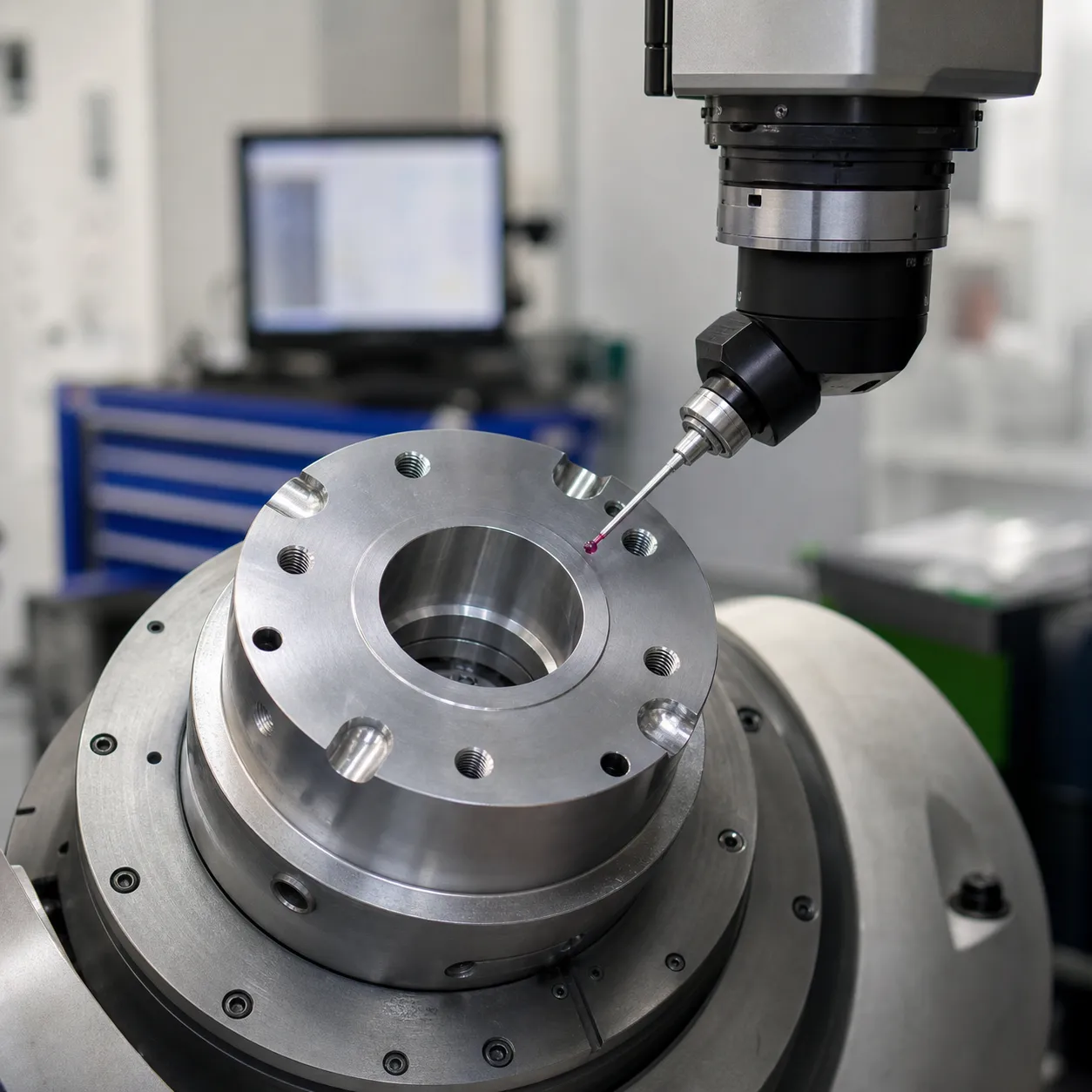
Executing a successful datum strategy for 5-axis sanitary flange adapters requires solving real-world physical and kinematic obstacles. When machining hygienic components, physical deflection, thermal variation, and measurement discrepancies can quickly degrade your datum reference frame.
Preventing Part Deformation in Thin-Walled Hygienic Designs
Thin-walled sanitary ferrules and flange adapters are notoriously sensitive to mechanical clamping forces. Over-tightening traditional jaw chucks crushes the wall profile, causing out-of-round conditions that distort both the primary datum and sealing surfaces.
- Distributed Clamping Force: Use specialized pie jaws, diaphragm chucks, or expansion arbors to spread force evenly across the perimeter.
- Low-Pressure Workholding: Utilizing engineered fixtures for high-precision machine parts prevents part distortion while maintaining rigid mechanical locking during aggressive tool passes.
- Decoupled Datum Seating: Ensure physical datum targets contact the part clean without introducing bending moments into delicate thin-walled sections.
Managing Thermal Drift and Multi-Axis Machine Kinematics
Continuous rotary axis movement and high-speed spindle operation generate heat during 5-axis CNC milling operations. Thermal expansion subtly alters axis pivot points, shifting the active work coordinate system during multi-axis toolpaths.
| Challenge Source | Impact on Datum | Solution Strategy |
|---|---|---|
| Rotary Axis Friction | Center-of-rotation pivot drift | Automated kinematic calibration cycles |
| Spindle Heat | Z-axis growth affecting primary datum | Closed-loop linear optical scales |
| Ambient Temp Shifts | Volumetric accuracy breakdown | In-process spindle probing before finishing passes |
Resolving Discrepancies Between CNC Setup and CMM Inspection
A frequent failure point in high-precision manufacturing is an alignment mismatch between the machine tool setup and quality lab verification. If the physical workholding on the mill doesn't mirror the mathematical datum reference frame used during coordinate measuring machine (CMM inspection), artificial non-conformances occur.
- Standardized Alignment Protocols: Mirror the physical datum target locations on the fixture directly into the CMM software setup.
- Identical GD&T Evaluation: Verify that both the machinist and quality inspector calculate features against the exact same primary, secondary, and tertiary feature hierarchy.
- Unified Manufacturing Protocols: Applying consistent datum alignment protocols across 5-axis CNC machined components with complex geometry eliminates false inspection rejections and guarantees true sanitary seal integrity.
2>Best Practices for Specifying Flange Adapter Datums
Developing a reliable datum strategy for 5-axis sanitary flange adapters requires aligning your initial CAD design with real-world machining and final quality validation. When you synchronize your drawing specifications directly with shop-floor execution, you eliminate guesswork, trim cycle times, and guarantee hygienic compliance.
Design for Manufacturing and Inspection (DFM/DFI) Considerations
Flawless production starts on the drawing board. Designing with both machining and quality control in mind prevents costly alignment mismatches down the line.
- Establish Clear Reference Points: Define robust physical features for your primary datum early in the design phase, prioritizing the main sealing face.
- Harmonize Standards: Apply consistent GD&T callouts across engineering drawings, CAM models, and quality checklists to avoid conflicting setups.
- Ensure Feature Accessibility: Verify that all secondary and tertiary features remain fully accessible for both 5-axis CNC milling operations and probe styli during inspection.
Optimizing Datum Targets and Fixture Layouts
Consistent workholding is critical when securing thin-walled or complex sanitary components against multi-axis cutting forces.
- Use Specific Datum Targets: When machining raw forgings or castings, designate precise datum targets to establish an initial, repeatable baseline before finish-machining critical sealing surfaces.
- Balance Clamping Pressure: Design specialized workholding fixtures that apply clamping force directly opposite solid support points, preventing part flexing or ovality.
- Simplify Modular Tooling: Utilize standardized zero-point receiver plates so parts transfer smoothly between machining centers without losing coordinate alignment.
Standardizing Inspection Protocols in CMM Software
A well-planned datum setup on the machine tool only works if your inspection lab evaluates the part using the exact same spatial baseline.
- Replicate the DRF: Build CMM alignment routines that precisely mirror the physical datum reference frame created on the 5-axis machine fixture.
- Automate Probe Paths: Standardize probe vector routines and sample-point densities within your coordinate measuring machine software to remove operator bias.
- Maintain Traceable Quality: Validate complex geometric features by pairing standardized probing routines with our comprehensive CMM quality inspection protocols, guaranteeing every flange adapter satisfies strict hygienic standards.