
Overview
Anodized Mounts & Brackets for Packaging OEM Overview
High-performance packaging automation demands structural hardware that combines precision engineering with long-lasting durability. Custom anodized mounts & brackets for packaging OEM applications deliver the exact structural alignment and environmental resilience needed to keep automated lines running smoothly.
What Are Custom Anodized Brackets and Mounts?
Custom anodized mounts and brackets are precision-machined structural hardware engineered specifically to secure sensors, guide rails, actuators, and inspection equipment within packaging machinery. Through an electrochemical anodizing process, raw aluminum profiles receive a durable oxide layer that dramatically improves surface hardness, wear resistance, and corrosion defense.
- Custom Geometry: Engineered to match exact machine dimensions and mounting profiles.
- Enhanced Surface Protection: Specify the coating and the required corrosion or wear acceptance criteria.
- Precision Tolerances: Define the final mounting and fit dimensions on the approved drawing.
The Role of Precision Hardware in Packaging Machinery
In automated packaging environments, even sub-millimeter shifts in hardware can cause jam-ups, misaligned labels, or inaccurate sensor readings. Precision mounting components serve as the backbone of machinery stability.
- Vibration Resistance: Keeps critical sensors and cameras locked in position during high-speed production cycles.
- Operational Repeatability: Ensures consistent material handling across filling, capping, and sealing lines.
- Minimized Downtime: Rigid, reliable mountings reduce the frequency of recalibration and maintenance stops.
Choosing Anodized Aluminum for OEM Packaging Equipment
Specify the bracket alloy, loading and exposure conditions before selecting the finish. Anodizing must be reviewed with the intended cleaning procedure and final fit requirements. It is not an automatic substitute for stainless steel in every packaging environment.
- Cleaning exposure: Provide chemical names, concentrations, temperature and cleaning frequency.
- Moving assemblies: Identify the allowable mass, mounting loads and deflection limits.
- Finish acceptance: Agree coating type, thickness, sealing, appearance and any required test evidence.
Key Advantages of Anodized Aluminum Brackets
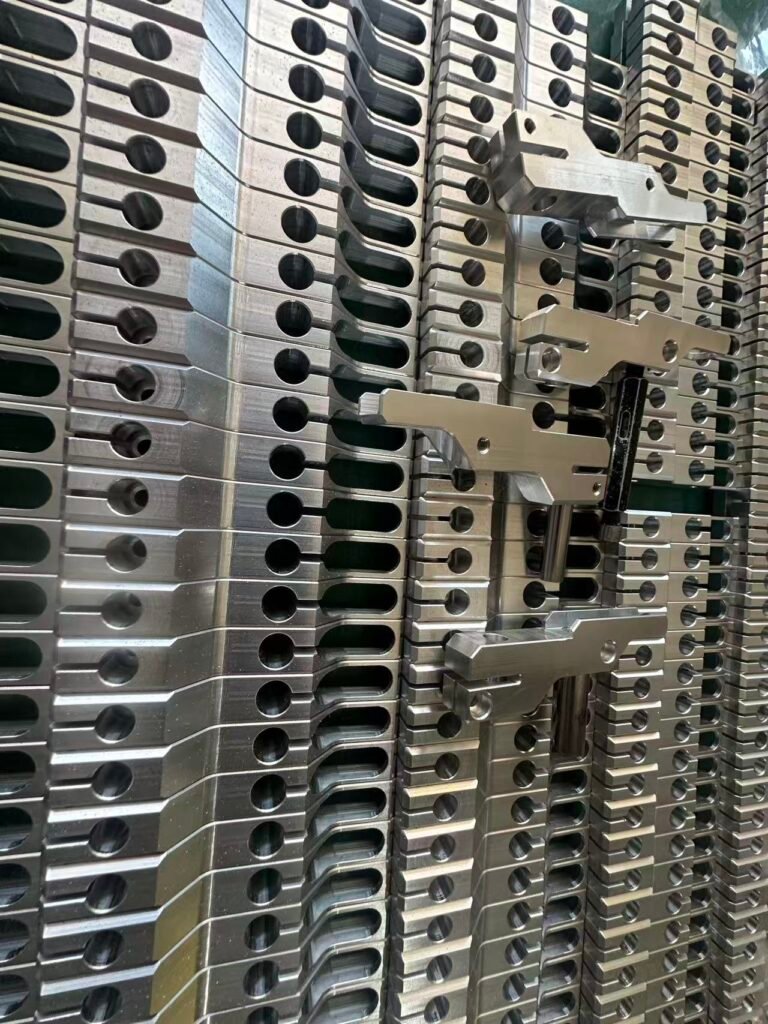
For repeat batches of mounts and brackets, identify the critical bore, slot and mounting-face relationships on the drawing. Specify whether fit dimensions apply before or after anodizing, together with coating thickness, masking requirements and the approved revision.
For custom anodized brackets, provide the approved geometry, alloy, finish and batch requirements. Final suitability and service performance depend on the complete design and intended use.
Corrosion and Wear Requirements
For anodized brackets, define the required coating specification and exposure conditions. Do not assume resistance to all washdown chemicals, friction or handling damage. Confirm masking, sealing and the inspection or testing required for the order before production.
High Strength-to-Weight Ratio for High-Speed Automation
High-speed automation demands minimal dynamic mass. Our aluminum CNC machining processes allow us to produce rigid, heavy-duty universal L brackets and surface mounted brackets at a fraction of the weight of traditional stainless steel hardware.
- Reduced Inertia: Lighter components allow robotic arms and servo-driven actuators to start and stop faster with lower energy consumption.
- Lower Equipment Wear: Reduced mass minimizes vibration and stress on drive systems, motor bearings, and linear guides.
- Maintained Rigidity: Specify permissible deflection and load conditions; confirm design acceptance with the equipment engineer.
Cleaning and Hygienic Design Requirements
Provide the cleaning procedure and identify any direct or incidental product-contact areas. Drainage, joints, fasteners and access for cleaning require review by the equipment designer. Anodizing alone does not establish hygienic suitability or prevent bacterial accumulation. For packaging industry hardware, agree the material, finish and required compliance evidence before order acceptance.
Aesthetic Customization and Color-Coding Options
Anodizing delivers clean visual finishes and functional color-coding directly integrated into the metal surface with coating thickness and dimensional growth that must be considered for fits.
- Sleek Appearance: A classic black anodized finish or clear satin coat provides a clean, modern look for OEM machinery.
- Functional Color-Coding: Agree available colors and an appearance sample before production. Color coding and any safety-related identification require OEM approval; exact shade matching between alloys or batches is not assumed.
Manufacturing Capabilities and Customization Services
We specialize in end-to-end production of anodized mounts & brackets for packaging OEM builds, turning complex CAD designs into high-precision, production-ready components.
CNC Machining Scope and Process Review
Our Wuxi machining base focuses on CNC milling and turning to approved drawings. We have no in-house 5-axis machining, EDM or wire cutting. Multi-sided features, secondary finishing and any customer-specified blank or casting require a route review before quotation; casting production is not included by default.
Custom Dimensions, Angles, and Universal Mounting Profiles
We build custom mounting profiles tailored to fit seamlessly into existing packaging line frames:
- Universal L Brackets: Feature slotted holes and keyways for rapid, tool-less adjustment on conveyor systems.
- Surface Mounted Brackets: Flat-profile mounts designed for rigid bolting onto structural T-slot aluminum extrusions or stainless steel machine chassis.
- Multi-Angle & Articulating Profiles: Engineered specifically for mounting sensors, vision cameras, and ink-jet coders at precise operational angles.
Anodizing Types: Type II Decorative and Type III Hardcoat
Specify the applicable surface finishing requirements, including coating type, thickness, sealing, color and masking. Confirm feasibility against the alloy and intended environment.
| Anodizing Standard | Thickness | Core Benefits | Best Packaging Applications |
|---|---|---|---|
| Type II (Standard Anodizing) | Specify thickness and tolerance on the drawing | Reliable corrosion resistant coating, vibrant color-coding, slick black anodized finish | Outer machine guarding, sensor brackets, non-contact guide mounts |
| Type III (Hardcoat Anodizing) | Specify thickness and tolerance on the drawing | Specify hardness or wear requirements and the applicable test method | High-speed conveyor guides, filler nozzle brackets, capping stations |
Secondary Finishing, Laser Etching, and Hardware Assembly
Marking, inserts and kitting are supplied only when included in the agreed quotation and bill of materials:
- Laser Etching: Permanent marking of part numbers, alignment measurement scales, and OEM logos.
- Threaded Inserts & Hardware: Pre-installation of stainless steel hardware, including Helicoil inserts and press-fit PEM studs, preventing thread wear in soft aluminum.
- Kitted Delivery: Brackets shipped pre-assembled with required mounting hardware to speed up your final packaging equipment assembly.
Packaging Industry Application Scenarios

High-speed packaging lines require mounting hardware that withstands continuous vibration, chemical exposure, and rapid cycling. We manufacture anodized mounts & brackets for packaging OEM machinery, designed to maintain exact alignment across every stage of the packaging process.
Conveyor Systems and Material Handling Hardware
Conveyor guide rails, drive motors, and transfer points require rigid hardware that will not wear down under high-friction conditions.
- Precision Rail Alignment: Specify rail mounting dimensions and alignment acceptance criteria; verify transfers on the equipment.
- Corrosion Resistance: Agree coating requirements against the specified cleaning and wear conditions.
- Versatile Mounting: We supply custom universal L brackets and surface mounted brackets for quick conveyor rail adjustments and lane reconfigurations.
Automated Filling, Capping, and Sealing Equipment
For brackets near filling, capping or sealing stations, identify splash exposure, cleaning conditions and heat sources. The equipment designer must confirm suitability for the intended food processing or beverage processing environment. Hardcoat anodizing is not a blanket guarantee against caustic cleaners or product contamination.
Labeling, Coding, and Inspection Camera Mounts
Provide the required adjustment range, camera or coder mounting pattern, allowable vibration and appearance specification. Black anodizing does not by itself guarantee glare elimination or vibration isolation. Verify optical performance and alignment on the equipment with an approved sample.
Robotic Assembly and Sensor Mounting Brackets
Modern pick-and-place robotics and end-of-arm tooling (EOAT) rely on minimal dead weight to maximize payload capacity and cycle speeds.
- Payload Optimization: Anodized aluminum components reduce robotic arm inertia compared to heavy stainless steel hardware.
- Sensor Shielding: Rigid wall mount brackets and custom housings protect photoelectric, inductive, and proximity sensors from physical impacts.
- Tailored OEM Integration: Through drawing-based CNC machining, we match mounting bolt patterns directly to your specific robotic payload requirements.
Material Options and Technical Specifications
Aluminum Alloys: 6061-T6 vs. 7075 vs. 5052
Choosing the right alloy determines how well your anodized mounts & brackets for packaging OEM applications handle stress, weight, and environmental exposure. We offer several high-performance aluminum alloys tailored to your exact mechanical requirements:
| Alloy | Key Characteristics | Best Used For |
|---|---|---|
| 6061-T6 | Excellent strength-to-weight ratio, high workability, and superior anodizing finish | General mounting brackets, conveyor frame ties, sensor blocks |
| 7075-T6 | Grade, temper, design loads and finishing requirements to be reviewed | High-stress robotic pick-and-place arms, fast-actuating grippers |
| 5052-H32 | High formability, exceptional salt-water and chemical corrosion resistance | Sheet metal covers, guard mounts, light-duty surface mounted brackets |
Load and Mechanical Acceptance Requirements
Provide the approved bracket design, mounting arrangement, static and dynamic loads, and permissible deflection. Specify fatigue or service-life requirements and the validation method where applicable. ZSCNC reviews machining feasibility; FEA, design certification and fatigue testing are not included by default.
- Geometry: Mark critical sections, ribs, wall thicknesses and hole relationships on the drawing.
- Fastening: State hardware, thread engagement, tightening and locking requirements for engineering review.
- Approval: Validate sample fit and function in the intended assembly before releasing repeat batches. No zero-deflection or fixed-cycle-life guarantee is assumed.
Precision Tolerances and Design File Compatibility
Specify individual functional tolerances, datums, thread standards and the applicable general-tolerance standard. ISO 2768-m is not a universal ±0.01 mm capability statement. Feasibility depends on geometry, material, finishing and inspection. Send a matching STEP model and dimensioned PDF; confirm other formats before transfer.
OEM Procurement and Quality Assurance
We streamline the procurement process for your anodized mounts & brackets for packaging OEM machinery, delivering reliable, precision-machined hardware built to strict engineering specifications.
Prototyping, Production Volumes, and Lead Times
We support every stage of your product lifecycle, balancing fast speed-to-market with flexible, predictable scheduling:
- Rapid Prototyping: Fast-turnaround functional prototypes let you validate fit, form, and alignment on your packaging machinery before committing to mass production.
- Scalable Production: Provide sample quantity, quantity per release and annual demand so batch size and scheduling can be reviewed.
- Reliable Lead Times: Lead time is confirmed with the quotation after reviewing drawings, quantity, finishing and inspection requirements.
Quality Control, Inspection Protocols, and Packaging Standards
Agree critical mounting dimensions, final coated fits, coating inspection and report coverage before order acceptance. CMM or optical measurement is confirmed only where required and available for the geometry. Material documents, finish evidence, marking, hardware assembly and protective packaging must be included in the quoted scope. See our quality inspection information.
How to Request a Custom OEM Manufacturing Quote
Getting your custom anodized mounts and brackets into production is fast and straightforward:
- Submit Design Files: Upload your 3D CAD models (STEP, IGES) along with 2D drawings specifying critical dimensions and tolerances.
- Define Specifications: Select your preferred aluminum alloy, anodizing coating (Type II or Type III hardcoat), finish color, and secondary operations like laser etching.
- Receive Fast Quote & DFM Review: We review your files for manufacturability (DFM) and return a clear, competitive quote tailored to your order volume.
- Frequently Asked Questions (FAQ)
How should an OEM choose between anodized aluminum and stainless steel mounts?
Compare the complete bracket designs against the required mass, stiffness, loads, cleaning exposure and budget. Provide the grade and finishing specification for each option. A material substitution may require geometry changes and renewed customer approval; neither lower cost nor improved machine throughput is assumed for every aluminum bracket.
Can OEM mounts be customized for washdown packaging environments?
Provide cleaning chemistry, concentration, temperature, exposure and the required evidence before material and finish selection. Anodizing is not automatically resistant to caustic or acidic cleaners. Agree coating type, thickness, sealing, masking and final fits; the OEM validates the complete bracket design and cleaning procedure for its intended application.
What CAD files are required to initiate a custom quote?
To generate an accurate manufacturing quote and fast turnarounds, we ask for both 3D models and 2D engineering drawings:
- 3D CAD Files: STEP (.stp), IGES (.igs), or SolidWorks (.sldprt) files for fast CNC toolpath programming.
- 2D Technical Drawings: PDF or DXF blueprints specifying tight tolerances, thread specs, and preferred surface finishes (such as a black anodized finish).
Sending complete design files ensures our production team evaluates your mounting hardware geometry quickly and delivers precise, production-ready parts without guesswork.
For a batch quotation, include each bracket part number and revision, sample quantity, quantity per release and estimated annual demand. Identify left/right variants and whether quantities mean pieces or complete mounting kits. Upload packaging bracket drawings for quotation with the alloy, finish specification, final fit requirements and requested dates. Use PDF, STEP or DWG files up to 5 MB per file; email info@zscncpack.com for larger files or other formats.