A single hidden crevice in your tool storage can trigger a disastrous pathogen outbreak in your facility.
When it comes to preventing cross-contamination and passing strict sanitation audits, standard racks just won't cut it. You need tool storage engineered specifically for high-stakes food safety.
In this guide, you're going to learn the 5 criteria for hygienic knife holders in meat processing—covering everything from food-grade material selection and open-structure design to sterilization and disinfection compatibility.
If you want to elevate your plant's hygiene standards and stay fully compliant with global food safety regulations, let's dive right in.
Understanding Hygienic Knife Holders in Meat Processing
In modern meat processing facilities, maintaining an uncompromising standard of hygiene is non-negotiable. Knives and cutting tools are in direct, continuous contact with raw proteins, making tool storage a critical control point for plant sanitation. Understanding the core requirements—including the 5 criteria for hygienic knife holders in meat production—ensures your processing facility upholds the highest standards of food safety and operational performance.
What is a Hygienic Knife Holder?
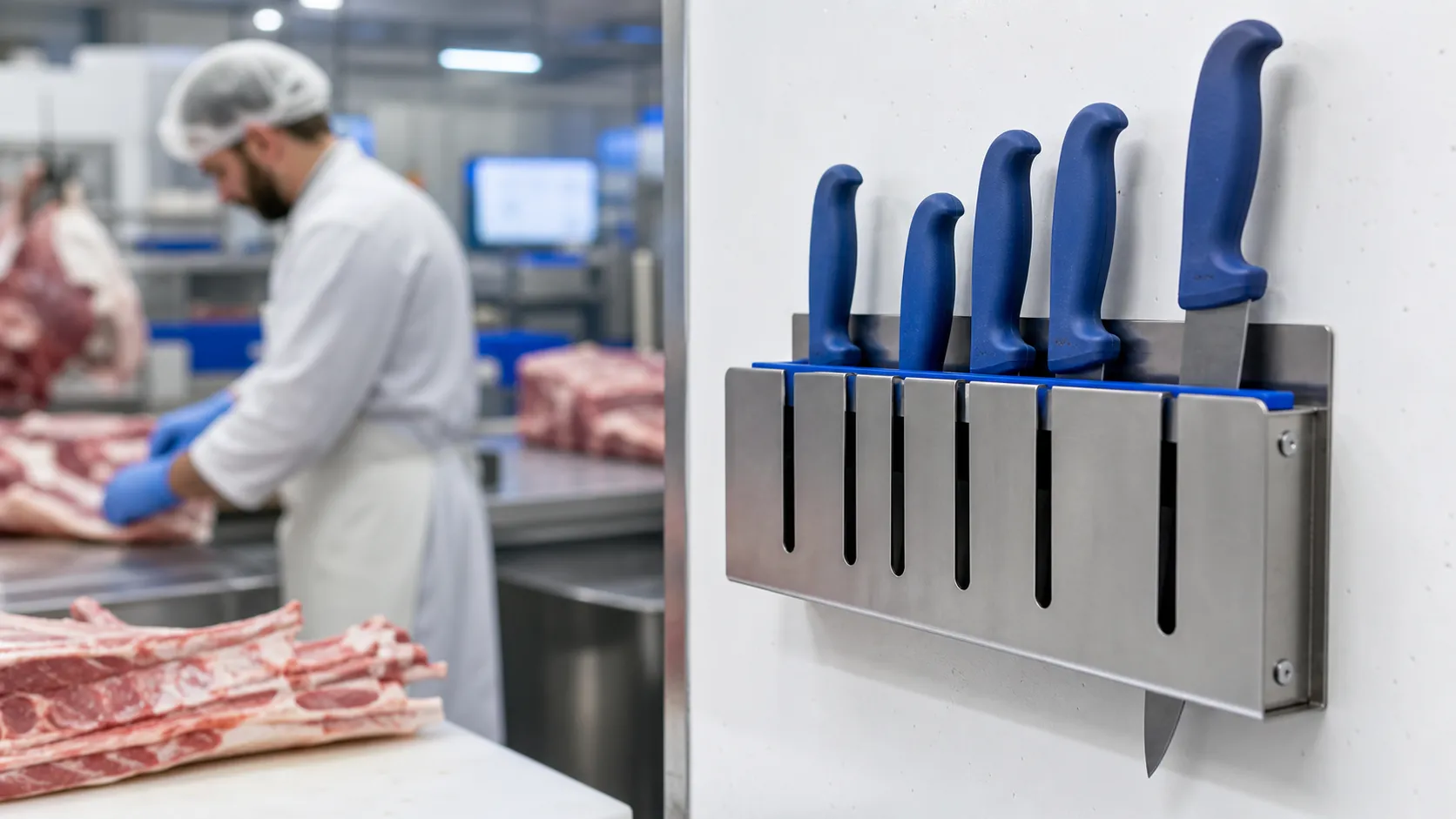
A hygienic knife holder is specialized tool storage equipment engineered specifically for the rigorous sanitation demands of meat processing environments. Unlike traditional racks, these industrial holders feature sanitary design principles that eliminate bacteria traps, resist aggressive chemical washdowns, and allow complete physical and thermal disinfection.
Core characteristics of professional hygienic holders:
Non-Porous Construction: Fabricated from high-grade, corrosion-resistant stainless steel.
Sanitary Design: Open-structure layouts that enable full visibility and fast drainage.
Sterilization Ready: Engineered to withstand hot water immersion and chemical sanitizers.
Why Sanitation is Critical in Meat Industry Tool Storage
Tool storage in meat processing plants is constantly exposed to moisture, animal fats, and protein residue. Standard or improperly designed racks quickly become hidden harborage points for dangerous bacteria, turning everyday tools into vectors for contamination.
Implementing certified sanitary storage systems protects your entire production line by ensuring:
Food Safety Compliance: Adherence to strict HACCP, USDA, and global safety standards.
Biofilm Elimination: Prevention of stubborn organic build-up on tool surfaces.
Product Integrity: Safeguarding raw meat products from spoilage and costly recalls.
Preventing Cross-Contamination and Pathogen Growth
Stopping cross-contamination requires continuous control over every piece of equipment that touches food. Hygienic knife holders prevent pathogen growth by incorporating self-draining geometry and seam-free welds that leave zero room for trapped moisture or debris.
By eliminating blind holes and tight crevices, these specialized holders ensure that sanitizing agents and high-temperature water reach every square millimeter of the unit. This design protects clean blades between shifts, breaking the chain of pathogen transfer and preserving the quality and shelf life of your processed meat products.
Criterion 1: Food-Grade Material Selection and Surface Finish
Material selection dictates whether a tool holder stands up to daily washdowns or becomes a hidden breeding ground for bacteria. When we build and evaluate equipment for meat handling, structural integrity and surface finish are non-negotiable.
Stainless Steel and Corrosion-Resistant Alloys
In heavy-duty processing environments, constant exposure to moisture, animal fats, and aggressive sanitizers will quickly destroy inferior metals. We insist on using high-performance stainless steel materials, specifically AISI 304 and 316L alloys, for all tool holders and storage racks.
- 304-Grade Stainless Steel: Excellent general-purpose resistance against water, mild acids, and mechanical wear.
- 316L-Grade Stainless Steel: High-molybdenum alloy tailored for extreme exposure to harsh chemical sanitizers and saline environments.
- Long-Term Durability: Eliminates rust spots and structural flaking that could contaminate meat products.
Non-Porous Surfaces and Smooth Weld Quality
Microscopic pits, rough welds, and porous surfaces trap organic debris, making effective tool sanitization nearly impossible. A smooth surfaces finish ensures that water and sanitizers reach every square millimeter of the unit.
- Seamless Welds: All frame joints are continuously welded, ground down, and polished to remove minimal crevices where bacteria hide.
- Controlled Surface Roughness: Metals are finished to strict industry benchmarks (Ra < 0.8 µm) to minimize organic material adhesion.
- Electropolished Finish: Creates a mirror-smooth surface layer that speeds up runoff during high-pressure washdowns.
Material Compliance with Food Contact Safety Standards
Every material integrated into a cleanroom or processing line must carry full food safety compliance. Using non-certified plastics or unrated alloys introduces chemical leaching hazards and leads to immediate audit failures.
Our material selection strategy aligns directly with global standards across the food processing industry, adhering strictly to FDA, EHEDG, and USDA requirements. This ensures every rack and holder remains inert, safe, and completely audit-ready.
Criterion 2: Hygienic Design and Easy-to-Clean Construction
When setting up tool storage in high-care meat processing environments, cleanability is non-negotiable. A truly hygienic knife holder relies on smart physical geometry to eliminate shelter points for bacteria and drastically cut down washdown times.
Open-Structure Design for Visual Inspection
Traditional enclosed racks create dark, hidden zones where meat debris and moisture accumulate unnoticed. An open-structure design fixes this problem at the source.
- Full Line-of-Sight: Sanitation crews can visually inspect every millimeter of the holder without disassembling it.
- Direct Chemical Access: High-pressure sprays and sanitizers reach all internal contact surfaces effortlessly.
- Rapid Drying: Open airflow prevents trapped humidity, halting bacterial multiplication right after sanitization.
Sloped Surfaces and Integrated Water Drainage
Standing water is a primary breeding ground for pathogens. We design equipment with intentional angles and built-in drainage paths so water never pools on structural elements.
- Self-Draining Geometry: All horizontal planes are replaced with sloped surfaces to force immediate liquid runoff.
- Targeted Drainage Paths: Runoff is directed away from knife handles and blades to preserve tool cleanliness.
To ensure these precise angles hold up under daily industrial use, our manufacturing process relies on strict quality inspection to verify that every channel and edge meets strict sanitary standards before reaching your processing line.
Elimination of Blind Holes and Contamination Crevices
Sharp corners, exposed threads, and blind screw holes act as microscopic safe harbors for bacteria like Listeria. Eliminating these crevices is crucial for complete food safety compliance.
| Risk Area | Standard Design Trap | Hygienic Design Solution |
|---|---|---|
| Corners & Joints | Sharp 90° angles that trap meat fibers | Smooth surfaces with continuous radiused internal corners |
| Fasteners | Exposed threads and blind bolt holes | Welded studs or hygienic, fully-sealed gasket hardware |
| Frame Welds | Spot welds with micro-gaps | Fully-penetrated, ground-smooth sanitary welds |
Criterion 3: Sterilization and Disinfection Compatibility
To maintain strict hygiene in meat processing, tool holders must withstand continuous, aggressive sanitization without deteriorating. We engineer our equipment to seamlessly handle thermal, chemical, and radiological disinfection methods.
Hot Water Sterilization Support (82°C)
In high-volume meat plant environments, standard hot water sterilization requires continuous immersion at 82°C (180°F) to eradicate pathogenic bacteria such as Salmonella and Listeria.
- Heat Tolerance: Holders built with low-grade plastics or soft seals degrade under heat, creating microbial harbors.
- Thermal Endurance: We utilize heavy-gauge stainless steel to ensure zero warping, weld failure, or structural breakdown during continuous high-temperature exposure.
Resistance to Harsh Chemical Sanitizers
Daily sanitation shifts rely on potent chemical solutions—including peracetic acid, chlorine compounds, and caustic foam agents—to dissolve fat residues and kill remaining microbes.
- Corrosion Resistance: High-grade alloys stop pitting and surface degradation caused by halogenated sanitizers.
- Long-Term Integrity: Equipment durability protects your investment across various high-rigor industrial processing sectors.
- Surface Protection: Eliminates micro-cavities where chemical residue and bacteria can settle.
Integration with UV Radiation Sterilization
Modern meat processing facilities increasingly use UV-C cabinet systems for continuous, dry knife sanitization during shifts.
- 360-Degree Exposure: Open-frame geometries allow ultraviolet rays to reach all blade surfaces without blocking light.
- UV Stability: Metal constructions withstand prolonged UV-C exposure without chalking, cracking, or releasing toxic particulates.
- Automated Compliance: Supports streamlined sanitation routines for verified food safety compliance.
Criterion 4: Ergonomics and Safe Tool Handling

Proper ergonomics in tool storage keeps operations running smoothly while protecting workers from preventable injuries. When evaluating 5 criteria for hygienic knife holders in meat processing, tool accessibility and user safety are just as critical as biological sanitation.
Easy Blade Insertion and Extraction
High-speed processing lines require operators to swap or store tools in seconds. We design tool storage solutions that allow smooth, effortless blade placement and retrieval without interrupting line velocity.
- Intuitive entry points: Wide opening slots guide the blade naturally without fumbling.
- Frictionless motion: Smooth interior channels allow instant extraction, keeping workflow bottlenecks to a minimum across the meat processing industry.
Secure Knife Retention and Edge Protection
A knife holder must grip blades firmly to prevent accidental drops on busy production floors. At the same time, it must safeguard delicate cutting edges from dulling against hard metal surfaces.
- Stable locking mechanisms: Uses non-porous mechanical or gravity retention to hold knives upright.
- Edge shields: Protects sharp tips and edges from contact damage, extending blade lifespan and reducing sharpening downtime.
- Versatile slot sizing: Accommodates various boning, trimming, and slicing blades securely in specialized knife holders.
Worker Safety and Hazard Prevention
Loose knives left on workstations represent a major safety hazard for processing crews. Integrating well-designed holders directly mitigates common plant floor risks:
| Safety Hazard | Ergonomic Solution | Operational Benefit |
|---|---|---|
| Exposed sharp blades | Fully enclosed guard housing | Prevents accidental cuts and slashes |
| Tool drops & slips | Positive locking slots | Keeps tools secure during equipment vibration |
| Awkward reach angles | Adjustable mounting positions | Reduces repetitive strain and operator fatigue |
By combining intuitive handling with robust edge protection, we ensure that worker safety and hygienic tool management go hand in hand.
Criterion 5: Regulatory Compliance and Sanitation Auditing
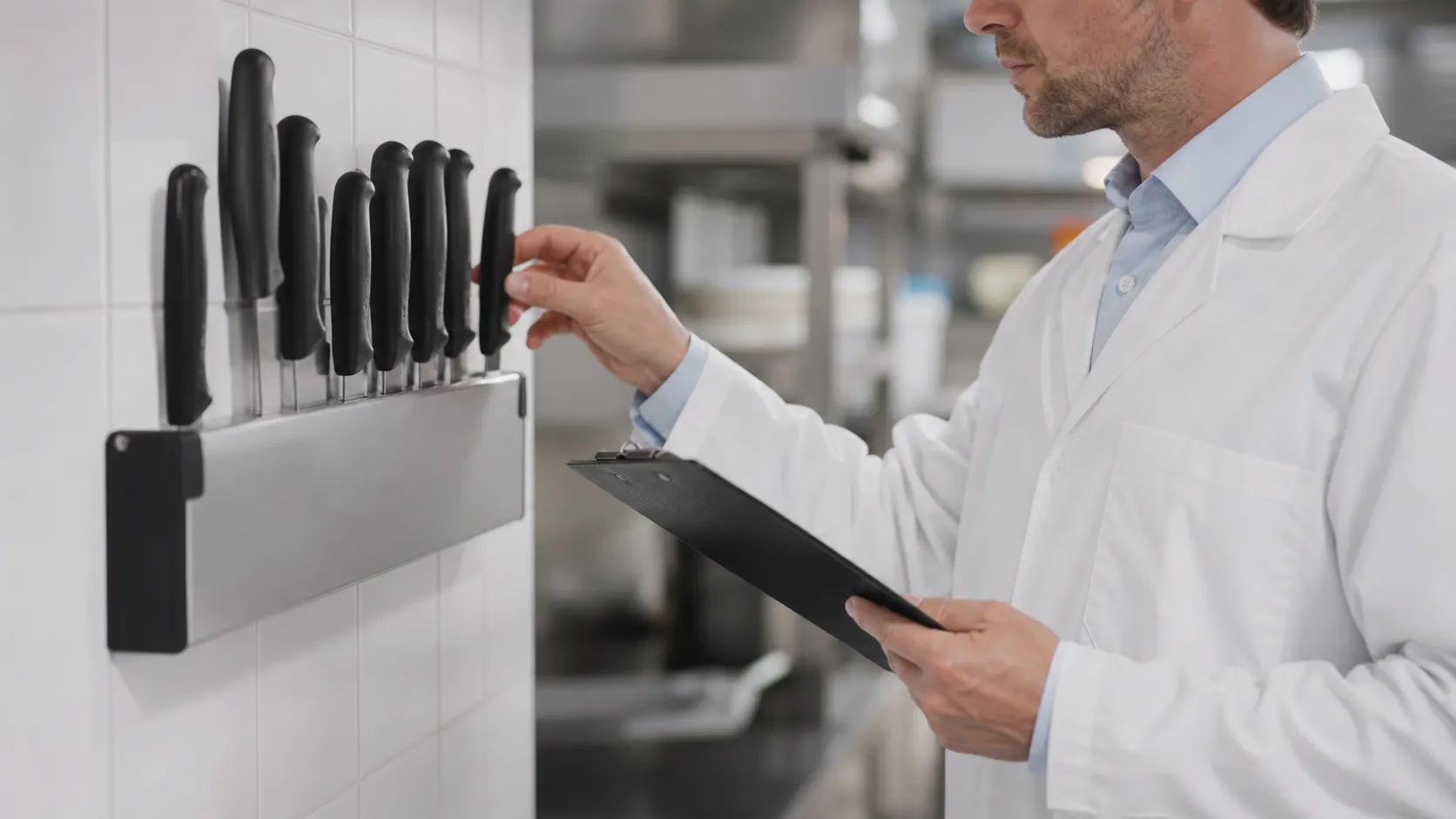
Regulatory compliance is non-negotiable when evaluating the 5 criteria for hygienic knife holders in meat processing facilities. Meeting international standards ensures your plant passes health inspections, protects consumer safety, and avoids costly operational shutdowns.
Adherence to Global Food Safety Regulations
Global meat processing plants operate under strict sanitary mandates to prevent foodborne illness outbreaks. We engineer our storage equipment to meet rigorous food contact safety standards, ensuring every material touching your cutting tools remains compliant. Integrating compliant tool storage into modern facilities across the food automation industry eliminates weak links in your sanitation workflow and reduces cross-contamination risks across the line.
Alignment with HACCP and USDA Guidelines
Our hygienic knife holder designs align directly with Hazard Analysis Critical Control Point (HACCP) principles and USDA directives:
- Hazard Elimination: Prevents harbor points where pathogens like Listeria or Salmonella thrive.
- Standardized Sanitation: Supports predictable, repeatable cleaning protocols for every shift.
- Food Safety Compliance: Meets stringent USDA meat inspection standards without requiring structural modifications.
Simplified Maintenance and Sanitation Audits
Passing sanitation audits shouldn't slow down production throughput. A well-designed knife holder provides quick visual verification, allowing quality assurance teams and inspectors to verify cleanliness instantly.
| Inspection Feature | Audit & Operational Benefit |
|---|---|
| Open-Sight Construction | Enables immediate visual checks without disassembling equipment |
| Smooth Surfaces | Prevents chemical film residue build-up during high-pressure washdowns |
| Ease of Maintenance | Minimizes labor hours required for daily sanitization and inspections |
Types of Hygienic Knife Holders and Sterilizers
Choosing the right storage and sanitization system depends on your plant layout, line speed, and sanitation workflow. In meat processing, we group the most reliable equipment into three core categories designed to maintain strict food safety compliance.
Hot Water Immersion Knife Sterilizers
Hot water immersion units remain the industry standard for immediate, high-temp sanitation directly on the processing floor.
- 82°C Continuous Flush: Keeps water at the precise temperature needed to destroy pathogens between cuts.
- Heavy-Duty Stainless Steel: Built with smooth surfaces and minimal crevices to prevent fat and protein buildup.
- Direct Overflow Design: Ensures contaminants continuously flush out rather than settling at the bottom.
We rely on these units for high-volume lines where workers need fast, effective hot water sterilization without stepping away from their stations.
UV Light Sanitizing Knife Cabinets
For dry tool storage between shifts or during extended downtime, UV-C light cabinets offer an exceptional sanitization method without chemical or moisture exposure.
- 360-Degree Radiation: Positions blades so UV rays hit every surface evenly.
- Enclosed Safety Lockouts: Shuts off UV lamps automatically when opened to protect workers.
- Zero Moisture Risk: Keeps high-carbon steel blades dry, preventing micro-corrosion and bacterial regrowth.
Wall-Mounted and Mobile Knife Rack Holders
Flexibility on the processing floor is essential for smooth operations. We utilize both stationary and mobile rack systems to keep blades organized and protected.
- Wall-Mounted Racks: Fixed securely at key work stations using heavy-duty mounting brackets, keeping sharp tools organized at ergonomic working heights.
- Mobile Knife Trolleys: Safely transport large batches of sanitized cutlery between sharpening rooms and production halls.
- Open-Structure Design: Features removable slotted inserts for ease of maintenance and quick visual inspection during sanitation audits.
Integrating these holders alongside reliable machine parts across your processing lines creates a clean, efficient workflow that actively prevents cross-contamination.
Maintenance Best Practices for Meat Plant Knife Holders
Keeping knife holders sterile in a high-throughput meat processing environment demands consistent upkeep. While proper design simplifies sanitation, rigorous daily routines are essential for long-term food safety compliance and preventing cross-contamination.
Daily Manual and Automated Cleaning Protocols
A reliable sanitation schedule balances thorough manual care with automated systems:
- Pre-Rinse: Flush away organic debris using warm water before applying chemicals.
- Detergent Wash: Apply food-safe alkaline cleaners to break down fats and proteins across all smooth surfaces.
- Sanitization: Run hot water sterilization (at least 82°C) or chemical knife sanitization to destroy persistent microorganisms.
- Air Drying: Allow complete drainage to ensure no standing water remains in areas with minimal crevices.
Quality Control in Knife and Holder Maintenance
Establishing clear quality control steps keeps storage equipment sanitary shift after shift:
- Visual Validation: Verify that every surface is free of film, grease, and mineral deposits before production starts.
- Swab Testing: Perform routine ATP or microbiological swab tests to confirm surface cleanliness.
- Equipment Alignment: Ensure your knife sterilizer and holding racks hold blades firmly without dulling edges or compromising safety.
Preventative Inspection for Wear and Contamination
Harsh sanitizers and heavy daily use eventually cause material fatigue. Regular structural inspections prevent compliance failures:
- Detect Surface Defects: Inspect stainless steel frames for pitted welds, scratches, or micro-cracks where bacteria can harbor.
- Inspect Fasteners: Check mounting brackets and drainage outlets to ensure structural stability.
- Timely Component Replacement: Replace degraded hardware immediately with certified wear parts to eliminate sanitation risks and avoid unexpected plant downtime.