Overview
Understanding DFM-Optimized CNC Machined Plates
ZSCNC supplies custom CNC machined base plates, mounting plates, indexing beds and side plates for packaging equipment. We review approved drawings for material, tool access, datums, flatness and hole positions before quotation. For repeat production, specify sample quantity, quantity per release and estimated annual demand.
What is DFM in CNC Plate Milling?
DFM reviews how a plate can be machined and inspected while preserving its approved function. Tool access, internal radii, pocket depth, workholding and tolerance allocation can affect batch cost. Any design change requires customer approval; the approved drawing remains the manufacturing basis.
The Role of Precision CNC Plates in Packaging Machinery
High-speed packaging lines require absolute rigidity and precise alignment to maintain continuous operation. Custom precision machined plates serve crucial roles across the system:
- Structural Integrity: Supporting drive shafts, servomotors, and linear rails under heavy, continuous cyclic loads.
- Accurate Registration: Dowel fits and mounting patterns are defined relative to functional datums and verified to the approved drawing.
- Vibration Absorption: Plate stiffness, stock condition and mounting affect vibration; the equipment designer validates dynamic behavior.
Unoptimized CAD vs. DFM-Ready Plate Designs
| Design Feature | Unoptimized CAD Design | DFM-Optimized Plate Design | Manufacturing Impact |
|---|---|---|---|
| Internal Corners | Sharp 90° square pocket corners | Radii sized to standard end mill cutters | Can simplify milling where the mating design permits radii |
| Pocket Depth | Deep pockets with slender walls | Balanced depth-to-width ratios with rigid walls | Helps manage tool reach, stiffness and distortion risk |
| Tolerances | Universal tight tolerances (+/- 0.005 mm) | Selective tight tolerances on critical bores only | Targets finishing effort at functionally necessary features |
| Setup Operations | Features on 5+ sides requiring multiple setups | Features consolidated for single-setup top machining | Can reduce setups; datum transfer still needs control |
Major Cost Drivers in Packaging Machine Plate Machining
Unplanned machining costs for CNC packaging machine plates usually stem from design choices that ignore practical mill constraints. Identifying where machine hours and tool wear accumulate lets us eliminate waste before raw material hits the vise.
Excess Raw Material Removal
- Stock Sizing: Specifying non-standard plate thicknesses forces us to fly-cut entire faces down to size, increasing cycle times and generating excess scrap.
- High Removal Ratios: Milling massive deep pockets out of solid block stock drastically reduces material removal efficiency compared to starting with optimized near-net plate dimensions.
Deep Pockets and Tight Corner Radii
- Tool Deflection: Deep cavities require review of cutter reach, rigidity, material and finish; a fixed depth-to-diameter ratio is not a universal machining limit.
- Small Internal Corners: Sharp inside corners prevent larger, rigid roughing end mills from clearing material quickly, forcing time-consuming finishing passes with tiny cutters.
Over-Engineered Specs and Complex Setups
Unnecessary design complexity drives up machine setup time and labor costs on custom packaging components.
| Machining Cost Driver | Production Impact | DFM Optimization Strategy |
|---|---|---|
| Tight Tolerances | Requires extra finishing passes and slower cutting feeds | Apply tight tolerances only to critical bearing locations; keep non-critical plate features at standard machining tolerances |
| Custom Threads | Demands specialized tooling and custom thread milling routines | Standardize callouts to standard thread sizes and off-the-shelf fasteners |
| Multi-Axis Setups | Part re-orientations increase labor hours and tolerance stacking risks | Design flat base plates for single-setup clamping or streamlined CNC milling setups with reviewed workholding and datum transfer |
Addressing these core cost drivers during early component design keeps unit costs low while ensuring high-precision fit and function for custom packaging mounts and brackets.
DFM Design Guidelines for Precision CNC Plates
Applying smart Design for Manufacturability (DFM) rules turns complex CAD models into cost-effective DFM-optimized CNC machined plates for packaging machines. We focus on critical geometric tweaks that slash cycle times and extend tool life without compromising structural performance.
Standardizing Internal Corner Radii
Rotating milling cutters leave internal corner radii. Agree radii or reliefs that fit the mating component and permit cutter access. The appropriate geometry depends on pocket depth, tool size and function; no single radius multiplier is a universal requirement.
Optimizing Wall Thickness and Pocket Ratios
Wall stiffness and cutter reach depend on material, supported length, pocket geometry, workholding and tolerance. Highlight thin sections and deep pockets for feasibility review. Numerical thickness or depth rules are design-review starting points, not guaranteed machining limits.
Quick Reference DFM Guidelines for Packaging Components
| Plate feature | Review before batch quotation |
|---|---|
| Internal corners | Required mating clearance, permitted radii and cutter access. |
| Walls and pockets | Stiffness, tool reach, support and distortion risk. |
| Threaded holes | Standard, size, useful engagement, blind-hole depth and inspection. |
| Datums and setups | Functional reference faces, clamping surfaces and datum transfer. |
Streamlining Threads and Single-Setup Clamping
Re-clamping parts across multiple angles increases labor costs and introduces stacking tolerances. Designing packaging machine components for a single setup preserves tight geometric relationships across critical mounting points.
- Standardized Callouts: Use standard thread callouts where suitable; specify useful engagement, runout clearance and blind-hole depth according to the joint design.
- Unified Counterbores: Keep counterbore sizes uniform across the plate so the machine can run a single tool path without unnecessary tool changes.
- Single-Pass Fixturing: Keep key mounting pockets, dowel alignment holes, and reference edges on the main face. Designing components like precision locator plates for packaging machine assemblies with dedicated fixturing tabs allows fast, accurate alignment during high-volume batch CNC machining.
Material Selection for Packaging Machinery Plates
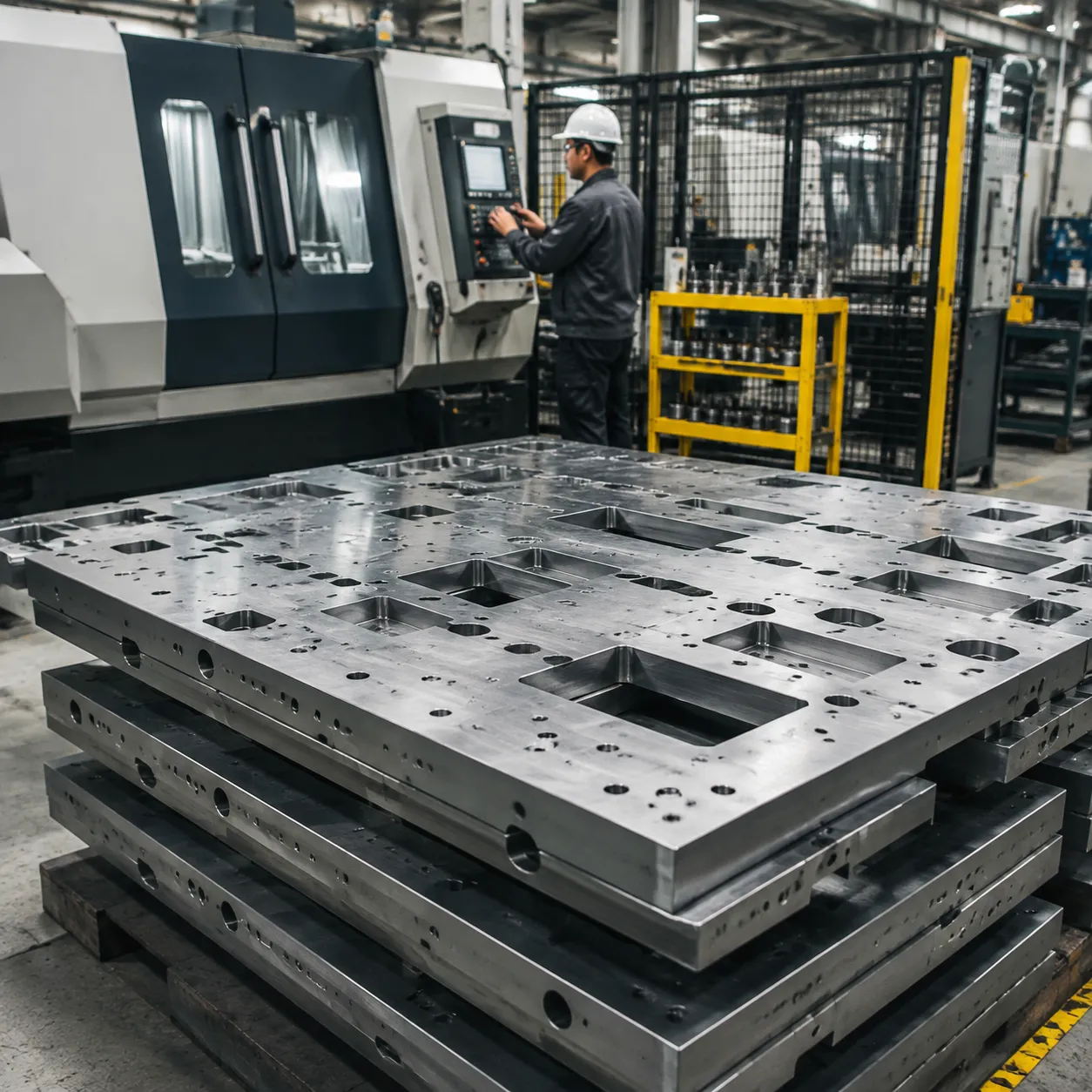
Choosing the right alloy for DFM-optimized CNC machined plates for packaging machines balances high-speed cycle rates, thermal performance, corrosion resistance, and overall manufacturing cost.
Aluminum Alloys for Lightweight Speed and Thermal Control
- 6061-T6 Aluminum: Offers outstanding machinability, light weight, and excellent thermal conductivity. It is our top choice for general aluminum machine plates, heat-sealing mounting bars, and high-speed reciprocating components.
- 7075-T6 Aluminum: Delivers strength comparable to structural steel with a fraction of the weight. Ideal for high-stress packaging machine components that endure continuous dynamic loads.
Stainless Steel for Washdown and Sanitary Environments
Specify 304 or 316L by the applicable grade and stock requirements. Cleaning chemistry, temperature, chloride exposure and product contact must be reviewed for the intended use. Neither alloy is a universal corrosion or food-contact approval.
Carbon and Tool Steels for Heavy Structural Plates
Specify the steel grade, stock condition, hardness and any heat-treatment requirements. Feasibility, finishing allowance, distortion control and secondary-process access are confirmed from the drawing before acceptance.
Surface Treatments and Corrosion Resistance
| Finish Type | Compatible Materials | Ideal Packaging Application | Main Engineering Benefit |
|---|---|---|---|
| Type II & III Anodizing | Aluminum Alloys | Conveyor guide plates & frames | Specify coating type, thickness, masking and final dimensions |
| Electropolishing | 304 / 316L Stainless Steel | Sanitary food-contact plates | Surface-texture requirements and application validation must be agreed |
| Electroless Nickel Plating | Carbon & Tool Steel | Drive housings & structural beds | Confirm coating specification, process access and acceptance |
Matching the raw material and surface treatment early in the design stage ensures lower manufacturing costs and reliable production through our one-stop CNC sourcing for packaging machinery.
Applications for DFM-Optimized CNC Machined Plates in Packaging Machines
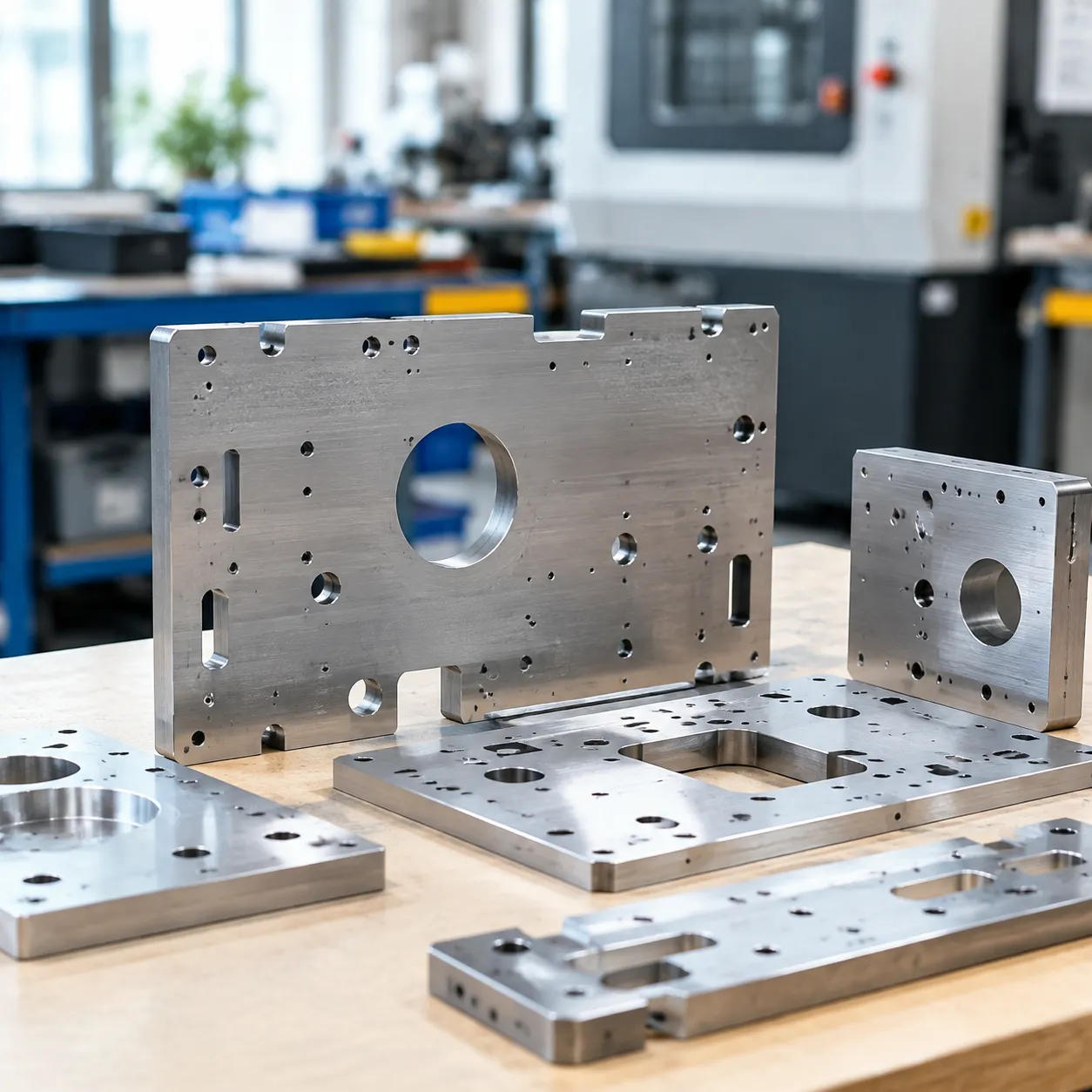
Packaging plates may support mechanisms, provide mounting references or form part of a transfer or sealing module. Functional loads, rigidity and machine performance remain the responsibility of the approved equipment design.
VFFS Machinery Structural Plates
For VFFS plates, define mounting datums, bearing or guide locations, plate thickness and any mass-reduction pockets. Agree the critical inspection features and check the finished plate in the customer assembly before sample approval.
Robotic End Effectors and Vacuum Manifold Plates
For end-of-arm tooling plates, provide the approved interfaces, payload-related design requirements and any passage or sealing features. Define leak-test or assembly-test requirements separately; machining geometry alone does not establish a sealed vacuum circuit.
Conveyor Indexing Beds and Heat-Sealing Bar Mounting Plates
Specify functional flatness, guide locations and thermal interfaces for the plate. Where it mates with sealing jaws or heat plates, supply the relevant interface drawing and final finishing condition. Agree how the plate is supported during inspection.
Frequently Asked Questions About DFM CNC Packaging Plates
How much can DFM optimization reduce packaging plate manufacturing costs?
Savings depend on the original design, material removal, setups, tolerances, quantity and inspection. Compare the approved original and proposed geometry at the same quantity and scope. ZSCNC does not promise a fixed saving percentage; each quotation confirms the reviewed manufacturing route.
What aluminum grade works best for food contact packaging machine plates?
There is no universally best aluminum grade for food contact. Grade, coating, product contact, cleaning conditions and required compliance evidence must be assessed for the application. Related 6061-T6 packaging parts and hard-anodized aluminum parts are drawing-based options, not automatic food-contact approvals.
Why are sharp internal square pockets expensive to CNC mill?
A rotating cutter cannot create a perfectly sharp internal corner by ordinary pocket milling. A permitted radius, corner relief or revised assembly detail may simplify manufacture. If sharp internal geometry is essential, confirm the necessary process route before quotation; ZSCNC has no in-house EDM or wire cutting.
Can DFM tweaks be made to existing packaging machinery CAD files?
We can review the supplied model and propose changes to radii, pockets, threads or workholding features. The customer must approve the revised drawing and verify its effect on fit, strength and function before production. No CAD or drawing change is made implicitly.
Related Sources
Our Wuxi machining base focuses on CNC milling and turning. We have no in-house 5-axis machining, EDM or wire cutting. Feasibility, inspection scope, required material documents and delivery schedule are confirmed for each order.
Material and Flatness Requirements for Packaging Plates
Specify the aluminum grade, temper, plate thickness, datum scheme, flatness and mounting-hole positions. 6061, 6082 or 7075 must follow the approved drawing; stock availability and required material documents are confirmed before order acceptance. For repeat orders, confirm the approved stock grade, finishing condition and revision.
Batch Orders and First-Article Approval for Packaging Plates
What should an OEM include in a plate batch RFQ?
Provide the 2D drawing and matching model, revision, material grade and temper, final thickness, flatness support condition, mounting datums and finish. List sample quantity, quantity per release, estimated annual demand, delivery destination and requested dates for each part number.
How are repeat batches controlled after DFM changes?
Approve the revised drawing before machining and agree the first-article features, finishing condition and report scope. After customer assembly approval, reference that revision on repeat orders and flag changes to mating hardware. For paired side plates, identify left and right part numbers and whether quantities mean pieces or sets.
Upload packaging plate drawings for a batch quotation. Include your part-number and quantity list. The form accepts PDF, STEP and DWG files up to 5 MB per file; email info@zscncpack.com for larger files or other formats. Price and delivery follow the confirmed scope.