
Understanding Filling Nozzle Tolerance
What Is Filling Nozzle Tolerance?
Filling nozzle tolerance refers to the allowable limit of variation in the physical dimensions of a dispensing nozzle, including the inner nozzle diameter, concentricity, and orifice length. In fluid dispensing systems, this parameter directly governs how predictably liquids, gels, or pastes pass through the nozzle. Maintaining strict dimensional boundaries during production guarantees consistent fluid dynamics across every unit manufactured.
Accuracy, Precision, and Tolerance in Nozzle Manufacturing
In precision manufacturing, three distinct metrics dictate dispensing performance:
- Accuracy: How close the actual physical dimensions or dispense volumes match the specified target design.
- Precision: The repeatability of fluid delivery across millions of continuous production cycles.
- Tolerance: The defined manufacturing deviation permitted during tight tolerance machining.
| Metric | Definition | Direct Impact on Dispensing |
|---|---|---|
| Accuracy | Target alignment | Eliminates systematic overfilling or underfilling |
| Precision | Repeatability | Guarantees identical cycle-to-cycle delivery |
| Tolerance | Engineered boundary | Controls physical dimensional accuracy and clearance gap |
Standard Tolerances vs. Tight Tolerances
Selecting the appropriate tolerance level balances fluid delivery performance against manufacturing complexity.
- Standard Tolerances (±0.02 mm to ±0.05 mm): Ideal for general macro-filling applications, such as beverages, household cleaners, and bulk industrial chemicals, where minor volumetric variations are acceptable.
- Tight Tolerances (±0.005 mm): Engineered for micro-dosing and high-precision applications where exact assembly clearance, stable fluid velocity, and absolute volumetric repeatability are essential to eliminate waste and prevent defect rates.
Why Nozzle Tolerance Is Critical in Fluid Dispensing
In automated filling operations, the nozzle is the final control point for your liquid product. When you are running high-speed operations or dispensing expensive formulas, filling nozzle tolerance dictates whether your line runs smoothly or bleeds profit through product giveaway and unscheduled stops.
Ensuring Consistent Volumetric Dosing
Fluid behavior inside the nozzle depends heavily on precise internal geometry. Even microscopic variations in the internal bore disrupt flow dynamics and fluid pressure:
- Bore Consistency: A variation of just a few microns alters the cross-sectional area, creating uneven flow rates across multi-head fill lines.
- Targeted Repeatability: High dimensional accuracy ensures every single cycle dispenses the exact target volume without constant operator recalibration.
- Uniform Pressure Drop: Equalizing internal flow resistance keeps multi-channel dosing completely balanced from the first container to the last.
Preventing Overfilling and Material Waste
Product giveaway is a hidden cost center. When nozzle dimensions vary, operators often set baseline fill volumes higher than necessary just to ensure no bottle falls below the legal minimum limit.
Rigid, precise mounting setups—like those built with custom anodized mounts and brackets for OEM packaging—keep nozzles perfectly aligned. Combining rigid positioning with tight nozzle internal dimensions allows you to hit target weights precisely, saving thousands of dollars in wasted fluid over a single production run.
Minimizing Dripping, Leaks, and Downtime
Improper tolerances inside the fluid path cause poor surface tension control at the tip, leading to post-dosing drips, stringing, and seal failure.
| Dispensing Challenge | Root Cause | Precision Machining Solution |
|---|---|---|
| Dripping & Tailing | Incorrect tip geometry or improper clearance gap | Sharp, precise fluid cutoffs with smooth internal bores |
| Seal Leaks | Loose assembly clearance on mating components | Tight-tolerance valve seats and smooth micro-finishes |
| Frequent Cleaning Downtime | Residual fluid buildup on the outer nozzle face | Anti-drip land designs with exact wall thicknesses |
By keeping internal passages smooth and tight—much like how robust 316L valve manifolds for beverage lines prevent leaks in sanitary transfer systems—you maintain a clean cutoff, prevent container contamination, and keep your machines running without constant wipe-downs.
Factors That Affect Filling Nozzle Tolerances
Achieving and maintaining an ultra-tight filling nozzle tolerance requires control over every stage of design, machining, and operation. Several critical factors determine whether a nozzle can consistently perform at a ±0.005 mm precision level.
Machining Methods and Manufacturing Precision
The path to micro-precision starts on the factory floor. Standard production techniques often fall short when crafting tight orifice dimensions and ultra-smooth internal finishes.
- Advanced Machining: Reaching a ±0.005 mm tolerance relies on precision Swiss turning, micro-EDM (Electrical Discharge Machining), and ultra-precise CNC milling.
- Surface Integrity: High-precision manufacturing eliminates internal micro-burrs and surface defects that cause fluid turbulence or uneven flow streams.
- Internal Geometries: Strict process controls keep the internal nozzle diameter and clearance gap exact across entire production batches.
When we produce precision-engineered filling machine components, rigorous quality control ensures that every part matches critical dimensional specifications.
Material Selection and Thermal Expansion
Material behavior under heat and mechanical stress directly affects long-term dimensional stability. A nozzle machined perfectly at room temperature can lose its tolerances if thermal expansion alters its internal dimensions during operation.
- Thermal Expansion Control: Materials with low coefficients of thermal expansion—such as 316L stainless steel, tungsten carbide, or ceramics—prevent dimensional drift.
- Sterilization Tolerance: Low-expansion materials withstand high-temperature Clean-In-Place (CIP) and Steam-In-Place (SIP) cycles without warping.
- Wear Resistance: Hardened materials resist abrasive wear, preserving the original orifice geometry across millions of dispensing cycles.
Choosing the right industrial material selection guarantees that your filling nozzle maintains its structural integrity and tight tolerances over time.
Fluid Properties, Viscosity, and Operating Pressure
The physical characteristics of the liquid being dispensed dictate how sensitive your process is to minor tolerance variations.
- High-Viscosity Fluids: Thicker liquids require elevated line pressures, which exaggerate any internal machining flaws or diameter variations.
- Pressure Drop Consistency: Precise bore diameters keep line pressure stable, eliminating unexpected flow surges or volumetric drops.
- Shear-Sensitive Products: Smooth, high-accuracy internal channels reduce shear stress, protecting delicate biological fluids, emulsions, and chemical formulations.
When Is a ±0.005 mm Tolerance Needed?
While standard tolerances work fine for bulk liquids, an ultra-tight filling nozzle tolerance of ±0.005 mm becomes mandatory when tiny fluid variations cause massive financial, safety, or operational issues. We see this level of precision manufacturing specified across several critical industries where every drop counts.
Pharmaceutical and Medical Micro-Dosing
In pharmaceutical filling, dosage accuracy is non-negotiable. Filling vials, syringes, or ampoules with active ingredients or vaccines requires exact micro-dosing.
- Zero Margin for Error: A microscopic variation in nozzle diameter directly changes liquid velocity and volume.
- Regulatory Compliance: Maintaining ±0.005 mm dimensional accuracy ensures every dose meets strict FDA and global safety standards without costly batch rejections.
Semiconductor and Electronics Encapsulation
Dispensing adhesives, conductive pastes, and underfill encapsulants onto microchips and circuit boards leaves no room for sloppy flow.
- Tight Assembly Clearances: Modern electronics feature microscopic clearance gaps that demand pinpoint fluid placement.
- Defect Prevention: Precise nozzle geometry prevents liquid bridging, short circuits, and air entrapment during high-density component assembly.
High-Speed Automated Packaging Lines
When operating automated fill lines at thousands of units per hour, minor hydraulic inconsistencies multiply rapidly.
- Downtime Minimization: In the high-demand packaging industry, uniform nozzle dimensions keep fluid streams straight and predictable.
- Clean Cuts: Ultra-tight tolerances stop stringing and dripping between fills, keeping seals clean and conveyor lines running continuously.
High-Value Chemical and Cosmetic Dispensing
Dispensing premium items like luxury perfumes, concentrated serums, or rare chemical reagents makes material yield a primary business priority.
- Cost Control: Overfilling by even a fraction of a drop drains profitability on high-margin products.
- Repeatable Flow Rates: Using high-precision nozzles created through reliable sourcing for packaging machinery components ensures strict volumetric control, preserving profits across millions of fill cycles.
Benefits of High-Precision ±0.005 mm Filling Nozzles
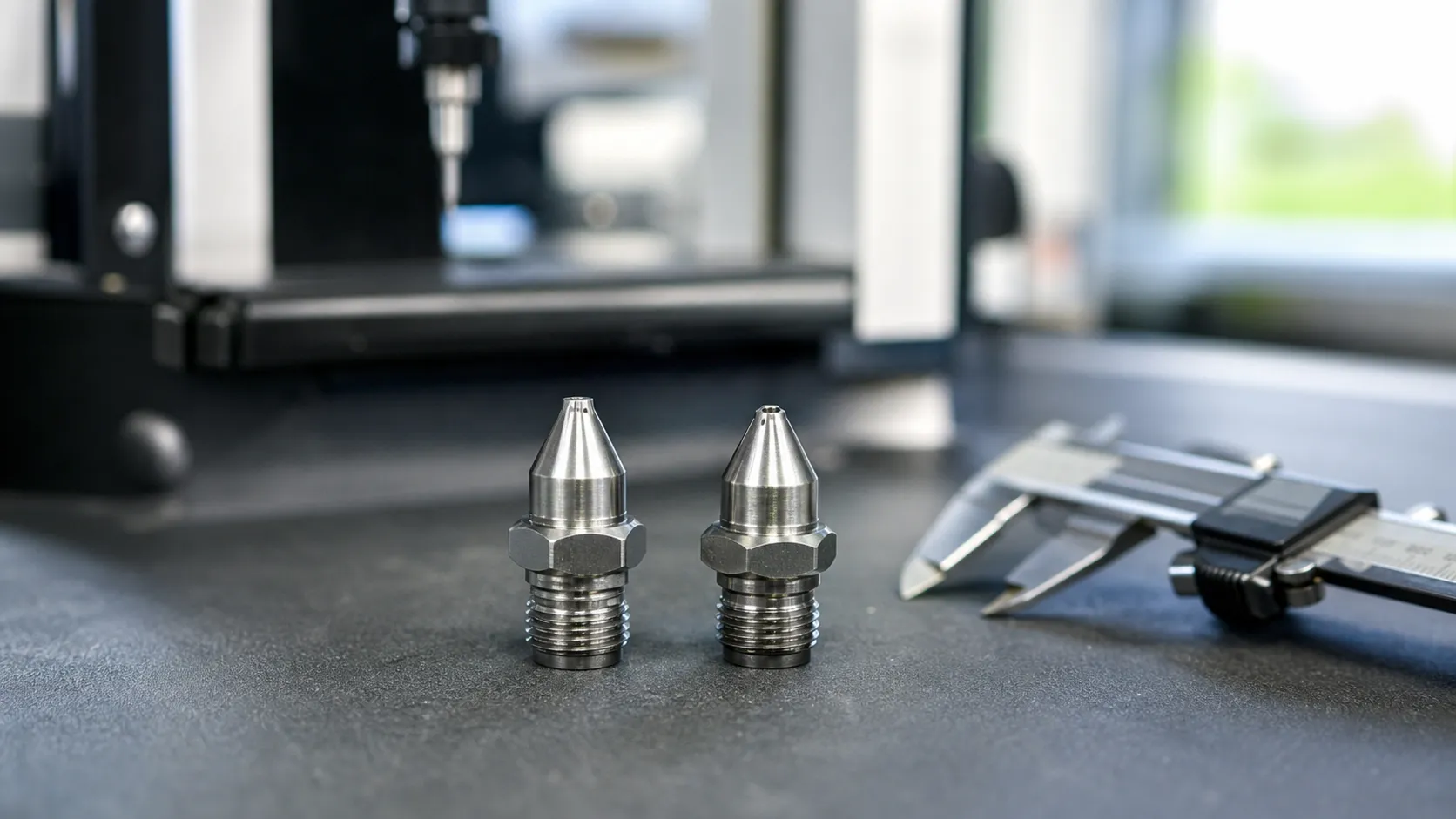
Holding a filling nozzle tolerance down to ±0.005 mm isn't just a manufacturing feat—it directly elevates dispensing performance, product quality, and system lifespan. In high-speed and ultra-precise filling operations, this level of precision transforms line efficiency.
Superior Flow Rate Stability
When every nozzle orifice maintains an exact nozzle diameter, fluid dynamic variations disappear across multi-head filling systems. I see client lines achieve unmatched repeatability once they lock in this level of dimensional accuracy.
| Feature | Standard Tolerances (±0.05 mm) | Precision Tolerances (±0.005 mm) |
|---|---|---|
| Flow Rate Drift | Variable across heads | Near-zero variation |
| Volumetric Yield | Higher margin of error | Maximum raw material yield |
| Pressure Balance | Requires frequent adjustment | Self-balanced fluid lines |
Elimination of Turbulence and Air Bubble Entrapment
Irregular internal geometries or slight shifts in the clearance gap create micro-turbulence inside the fluid path. Precision manufacturing guarantees ultra-smooth bore finishes that keep flow laminar.
- Laminar Flow Control: Prevents liquid shearing during high-velocity dispensing cycles.
- Zero Bubble Entrapment: Eliminates air pocket formation in sensitive pharmaceuticals and optical adhesives.
- Drip-Free Cut-Off: Delivers clean fluid snapping without stringing or tailing.
Enhanced Wear Resistance and Component Longevity
Excessive friction and flow turbulence wear down internal surfaces unevenly. By combining tight tolerance machining with premium alloys, we craft high-performance wear parts built to withstand continuous abrasive slurries without losing calibration.
- Extended Operating Life: Minimizes bore degradation under continuous pressure.
- Lower Downtime: Decreases nozzle replacement frequency on automated packaging lines.
- Consistent Batch Quality: Maintains tight dosing limits over millions of cycles.
How to Select and Maintain High-Tolerance Filling Nozzles
Assessing Dispensing Requirements vs. Machining Costs
When designing custom fluid handling components, balancing performance with budget is critical. Specifying a tight filling nozzle tolerance like ±0.005 mm when standard tolerances work only increases production cost without adding real value.
- Standard Fluid Volumes: Moderate tolerances keep costs down while meeting yield goals.
- Micro-Dosing & High-Value Media: Demands tight tolerance machining to prevent expensive fluid giveaway and guarantee precise volumetric delivery.
- Production Speed: High-velocity automated lines require exact dimensional accuracy to prevent pressure drops and jetting issues.
Choosing Wear-Resistant Materials and Coatings
A nozzle only holds its tight tolerance if the material withstands constant flow, abrasive particulates, and harsh washdowns. The right material choice ensures the internal nozzle diameter stays constant over millions of cycles.
- Stainless Steel: Excellent for harsh chemicals and high-volume packaging. Utilizing precision-machined stainless steel ensures structural rigidity and long-term dimensional stability under pressure.
- PEEK & Engineering Polymers: Perfect for sensitive pharmaceuticals requiring low friction and bio-compatibility. Components made from PEEK hold a tight clearance gap while resisting aggressive solvents.
- Surface Coatings: DLC (Diamond-Like Carbon) or TiN coatings reduce friction and prolong tool life when dispensing abrasive slurries.
Inspection, Calibration, and Cleaning Best Practices
Keeping filling nozzles operating at peak precision manufacturing standards requires strict quality control protocols. Tiny deposits or minor wear alter flow dynamics fast.
| Action | Core Objective | Recommended Tools / Methods |
|---|---|---|
| Inspection | Verify internal diameter wear and assembly clearance | Optical comparator, go-no-go gauge |
| Calibration | Confirm exact flow rate and shot-size repeatability | Micro-gram analytical scales |
| Cleaning | Clear fluid build-up without scratching precision inner bore | Ultrasonic cleaning baths, soft non-metallic swabs |