Overview of Stainless Steel Auger Screws in Beverage Processing
Stainless steel auger screws are critical components in modern automated beverage production. Designed to convey raw fruit solids, concentrates, and additives, these screw feeders maintain continuous material transfer while adhering to strict sanitary standards across processing facilities globally.
The Role of Auger Screws in Acidic Beverage Lines
In acidic beverage manufacturing, auger screws perform essential conveying and dosing functions. They move wet, fibrous, or abrasive materials—such as citrus pulp, berry purees, and powdered acidulants—through the processing system.
- Precise Dosing: Delivers controlled feed rates for consistent flavor and acidity profiles.
- Hygienic Transport: Encloses fruit solids and concentrates to eliminate product exposure and cross-contamination.
- Continuous Operation: Prevents material buildup and bridging during high-volume fruit slurry conveying.
Why Material Selection Matters for Acidic Applications
Operating in low-pH environments creates extreme chemical demand on processing equipment. Organic acids such as citric, tartaric, and malic acids—combined with abrasive fruit seeds or fiber—can rapidly degrade substandard metals.
Selecting the wrong steel alloy leads to localized corrosion, surface pitting, product contamination, and costly operational downtime. Choosing the optimal material ensures prolonged service life, uncompromised product purity, and regulatory compliance.
Understanding 304 and 316L Food-Grade Stainless Steel
While both alloys qualify as food-grade stainless steel, their chemical formulations serve distinct operational needs:
- 304 Stainless Steel: The standard food-industry alloy containing 18% chromium and 8% nickel. It provides solid corrosion resistance for non-acidic or mildly acidic handling under moderate temperatures.
- 316L Stainless Steel: An advanced low-carbon alloy enhanced with 2% to 3% molybdenum. It offers superior resistance against severe organic acids, chloride pitting, and harsh Clean-In-Place (CIP) chemicals.
Chemical Composition: 304 vs 316L Stainless Steel
At the core of the debate between 304 and 316L for acidic beverage auger screws is their chemical breakdown. While both belong to the austenitic family, subtle alloy additions drastically change how they perform under acidic and high-stress conditions. Choosing the correct food grade stainless steel comes down to understanding these specific elemental differences.
Molybdenum Content and Acid Corrosion Resistance
The single biggest differentiator between these two alloys is molybdenum. Standard 304 stainless steel contains zero molybdenum, whereas 316L incorporates between 2.0% and 3.0% of this critical element.
- Enhanced Chloride Resistance: Molybdenum significantly improves resistance to aggressive chloride ions and organic acids found in citrus, berry, and carbonated drink processing.
- Pitting Corrosion Protection: In low pH environments, 304 can suffer localized pitting corrosion. The molybdenum in 316L creates a more resilient passive oxide layer that self-heals in demanding beverage lines.
| Element / Property | 304 Stainless Steel | 316L Stainless Steel |
|---|---|---|
| Chromium | 18.0% - 20.0% | 16.0% - 18.0% |
| Nickel | 8.0% - 10.5% | 10.0% - 14.0% |
| Molybdenum | 0.0% | 2.0% - 3.0% |
| Carbon (Max) | 0.08% | 0.03% |
Carbon Content: The Advantage of Low-Carbon "L" Grades
The "L" designation in 316L stands for low carbon. While standard 304 can have up to 0.08% carbon, 316L caps carbon content at a maximum of 0.03%.
When fabricating a continuous screw feeder, welding flighting to the central pipe generates intense heat. High carbon levels cause chromium carbides to form at the weld boundaries, depleting chromium and leading to weld decay (intergranular corrosion). By utilizing low-carbon 316L, we eliminate carbide precipitation during welding, ensuring your auger flights maintain full corrosion resistance at every weld seam without requiring post-weld heat treatment.
Mechanical Strength and Wear Resistance
Acidic beverage augers handle both corrosive exposure and continuous mechanical friction. Comparing their structural capabilities reveals similar strength profiles, but distinct wear characteristics:
- Tensile Strength: Both 304 and 316L offer excellent ultimate tensile strength (typically around 485 to 620 MPa), providing the structural rigidity needed to convey heavy liquid-solid slurries without flexing.
- Yield Strength: Their yield strength is comparable (around 170 to 290 MPa), meaning both resist permanent deformation under normal operational torque.
- Abrasive Wear: Standard 304 is slightly harder on the Rockwell scale, but 316L maintains superior structural integrity over time because acid-induced micro-corrosion does not weaken its surface matrix, preventing premature wear on the auger flights.
Corrosion Resistance in Acidic Beverage Environments
Resistance to Organic Acids (Citric, Tartaric, and Malic Acids)
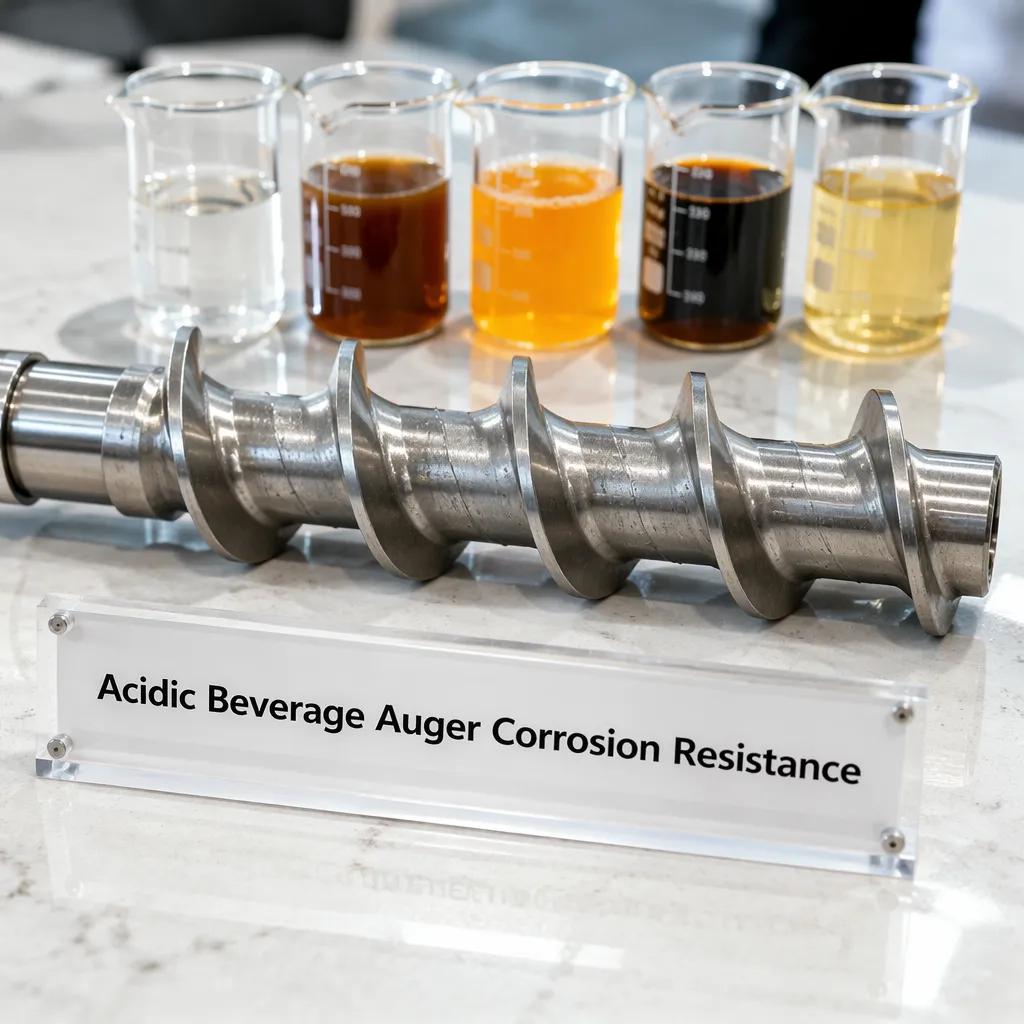
Acidic beverage processing demands equipment that withstands continuous exposure to low-pH liquids. Auger screws used in fruit juice, concentrate, wine, and soft drink production regularly contact concentrated organic acids, including citric, tartaric, and malic acids.
While standard 304 stainless steel handles mild solutions, elevated acidic concentrations rapidly attack its passive surface. In our experience across the beverage processing industry, selecting 316L stainless steel is crucial for maintaining long-term chemical stability. The molybdenum added to 316L shields auger flights against aggressive organic acid degradation, preventing alloy leaching and preserving product purity.
Pitting and Crevice Corrosion in Low pH Conditions
Low pH environments (pH 2.0 to 4.0) paired with trace chlorides create severe risks for mechanical components:
- Pitting Corrosion: Tiny pinhole punctures penetrate standard 304 surfaces, creating hidden spots where acid accumulates and eats deeper into the component.
- Crevice Corrosion: Acidic liquids pool in tight spaces, such as flight welds, shaft keyways, and mounting flanges, accelerating localized structural decay.
When evaluating 316L vs 304 for acidic beverage auger screws, 316L provides vastly superior chloride resistance. This prevents microscopic pitting and structural crevice failure, keeping the screw shaft smooth, clean, and structurally sound under severe operating conditions.
Tolerance to CIP (Clean-In-Place) Chemicals and Sanitizers
Daily sanitation can be even more aggressive on equipment than the beverages being processed. Standard Clean-In-Place (CIP) procedures utilize hot caustic washes (sodium hydroxide) followed by strong acid sanitizers, such as peracetic acid or nitric acid formulations.
- 304 Stainless Steel: Repeated thermal shocks and chemical exposure gradually strip the protective oxide layer off 304, leading to surface etching and micro-abrasions that trap bacteria.
- 316L Stainless Steel: Easily handles harsh chemical sanitation in a demanding CIP environment without surface degradation or chemical pitting.
Upgrading to 316L ensures your conveying screws endure relentless daily CIP routines while maintaining strict hygiene standards over an extended service life.
- Performance Factors for Acidic Beverage Auger Screws
Selecting the right alloy goes beyond chemical resistance—it directly impacts mechanical reliability, hygienic compliance, and daily line throughput. In high-volume packaging systems, auger screws experience continuous friction alongside aggressive chemical exposure.
- Sanitation and Surface Finish Options
When moving low-pH liquids, fruit purees, or carbonated bases, the surface roughness of your auger screw dictates cleaning efficiency. Microscopic surface defects act as harbors where acidic residue collects, causing localized pitting corrosion and bacterial contamination.
- Standard Mechanical Polish (304): Typically finished to Ra 0.8 µm. While adequate for neutral dry goods, acidic media eventually attack microscopic surface ridges.
- Electropolished Surface (316L): Applying specialized surface finishing techniques achieves ultra-smooth surfaces down to Ra 0.4 µm or better. Electropolishing strips free iron from the surface, leaving a chromium-rich layer that prevents batch cross-contamination.
- Hygienic Flight Design: We manufacture custom 316L auger screws for beverage processing featuring continuous flight welds polished smooth, preventing crevice corrosion in automated CIP environments.
- Handling Abrasion and Mechanical Wear During Conveying
Conveying particulate-heavy beverages—such as citrus pulps, seeds, or frozen concentrates—introduces combined erosion-corrosion wear. Corrosion strips the protective passive film from the metal surface, allowing abrasive solid particles to scour away the exposed material beneath.
| Performance Metric | 304 Stainless Steel | 316L Stainless Steel |
|---|---|---|
| Yield Strength | ~205 MPa | ~220 MPa |
| Brinell Hardness | ~123 HB | ~146 HB |
| Acid-Erosion Resistance | Moderate (accelerates in low pH) | High (molybdenum strengthens passive film) |
| Galling Tendency | Moderate under load | Low when properly polished |
The higher structural density and molybdenum addition in 316L give it a clear edge in resisting synergistic wear from combined mechanical abrasion and acid contact.
- Temperature and Pressure Tolerances in Continuous Operation
Hot-fill operations operating between 85°C and 95°C, along with high-pressure CIP steam cycles, push conveyor components to their thermal limits.
- Thermal Stability: While both alloys exhibit similar thermal expansion rates, 316L maintains superior creep strength and resistance to stress corrosion cracking at elevated processing temperatures.
- Torque Endurance: Viscous, highly acidic fruit concentrates place heavy rotational torque on the screw feeder shaft. Grade 316L handles fatigue loads more effectively without flight deflection.
- Thermal Shock Resistance: Rapid transitions between hot sanitizing washes and cold product feeds can stress weld joints. The low carbon content in 316L prevents intergranular cracking across thermal cycles, keeping the equipment running without unexpected downtime.
- Cost vs. Value: 304 vs 316L Auger Screws
When evaluating materials for acidic beverage auger screws, looking only at purchase price is a common mistake. Balancing upfront raw material cost against long-term maintenance and risk exposure reveals the true return on investment for your production line.
Initial Material and Component Cost Comparison
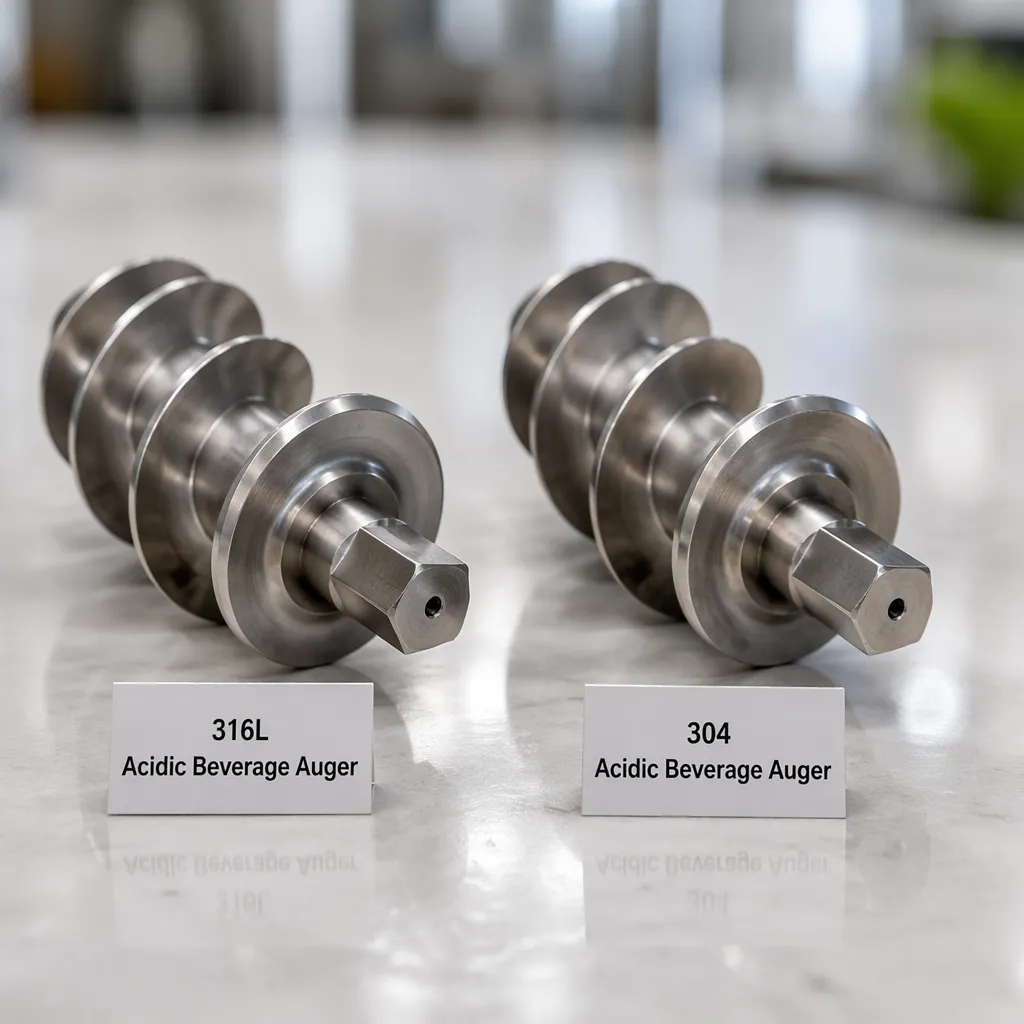
Standard 304 stainless steel is generally 20% to 30% less expensive upfront than 316L. This price gap stems primarily from the 2% to 3% molybdenum added to 316L for alloy enhancement.
For basic dry conveying, 304 delivers solid value. However, in acidic beverage processing, that lower price tag can be deceiving if the material breaks down under continuous chemical exposure.
| Cost & Value Factor | 304 Stainless Steel | 316L Stainless Steel |
|---|---|---|
| Initial Material Cost | Baseline (20–30% Lower) | Moderate Premium |
| Alloy Enhancement | 18% Cr / 8% Ni | 16% Cr / 10% Ni / 2–3% Mo |
| Acidic Service Life | Reduced (Risk of Pitting) | Extended (High Durability) |
| Overall ROI in Low pH | Low | High |
Long-Term Maintenance and Service Life Expectancy
In low-pH environments, a 304 screw feeder slowly develops surface roughening and pitting corrosion. This micro-damage creates harborage points for bacteria and requires frequent polishing or total replacement.
Conversely, 316L withstands aggressive acids and harsh caustic cycles in the CIP environment with minimal wear. Over a multi-year production cycle, 316L auger screws significantly reduce maintenance labor and replacement frequency. For maximum reliability across your plant, pairing these components with a high-purity beverage valve manifold 316L for sanitary processing ensures consistent corrosion defense throughout your whole liquid transfer system.
Risk Mitigation for Equipment Failure and Downtime
An auger failure during peak production costs far more than the initial material price difference. Upgrading to 316L food grade stainless steel serves as direct insurance against operational disruption:
- Eliminates Contamination: Prevents microscopic rust or metal flake detachment into product streams.
- Avoids Unscheduled Downtime: Stops premature mechanical failure and emergency teardowns during active bottling runs.
- Protects Weld Integrity: Low carbon "L" grade prevents intergranular corrosion along heavy auger flight welds.
Which Grade Should You Choose for Your Acidic Beverage Auger Screw?
Selecting between 304 and 316L stainless steel for an acidic beverage auger screw comes down to your liquid's pH, operating temperatures, and cleaning chemicals. Making the right call upfront prevents premature surface pitting, batch contamination, and costly line shutdowns.
When 304 Stainless Steel May Be Sufficient
Standard 304 food grade stainless steel works well for mild, non-aggressive handling where corrosion risk is minimal. It provides reliable structural strength at a lower upfront material cost.
- Acidity Levels: Products with a mild pH (above 4.5).
- Product Exposure: Dry powder feeds, gentle fruit pulps, or short contact times.
- Cleaning Regimes: Standard washdowns without heavy chlorinated sanitizers or aggressive acid flushes.
- Budget Limits: Projects with tight capital expenditure where mechanical abrasion is a higher priority than chemical resistance.
When 316L Stainless Steel Is Mandatory
When handling high-acid beverages, 316L stainless steel is non-negotiable. Its molybdenum addition provides essential chloride resistance, preventing severe pitting corrosion and localized material breakdown in aggressive environments.
- High Acidity: pH levels below 4.0 (citrus juice concentrates, tart apple bases, soft drink syrups).
- Harsh CIP Environments: Continuous exposure to hot nitric acid flushes, caustic soda, or active chlorine sanitizers during Clean-In-Place cycles.
- Extended Contact: Continuous liquid contact in high-speed, automated screw feeder lines.
In severe acidic beverage processing lines, stepping up to 316L eliminates equipment failure risks. We saw this clear advantage in our beverage valve manifold 316L case study, where low-carbon 316L successfully eliminated corrosion and extended component service life under heavy sanitizer flushes.
Key Selection Criteria for Processing Equipment
Use this quick selection matrix when specifying your auger screw feeder components:
| Decision Factor | 304 Stainless Steel | 316L Stainless Steel |
|---|---|---|
| pH Threshold | Ideal for pH > 4.5 | Essential for pH < 4.0 |
| Chloride Resistance | Low to Moderate | High (2-3% Molybdenum) |
| Pitting Corrosion Risk | High in acidic/salty conditions | Very Low |
| CIP Environment Tolerance | Mild sanitizers only | Resists hot caustic & acid washes |
| Initial Investment | Lower upfront cost | 20%–30% material premium |
| Long-Term TCO | Higher risk of premature replacement | Lowest total cost of ownership |
Evaluating your exact chemical exposure ensures your auger screw maintains sanitary surface standards, satisfies food safety compliance, and delivers uninterrupted operating efficiency.
Explore our full range of custom 316L augers designed specifically for these harsh environments.