Overview
What Are POM Bottle Neck Guides for Filling Lines?
Definition and Role in Bottling Conveyor Systems
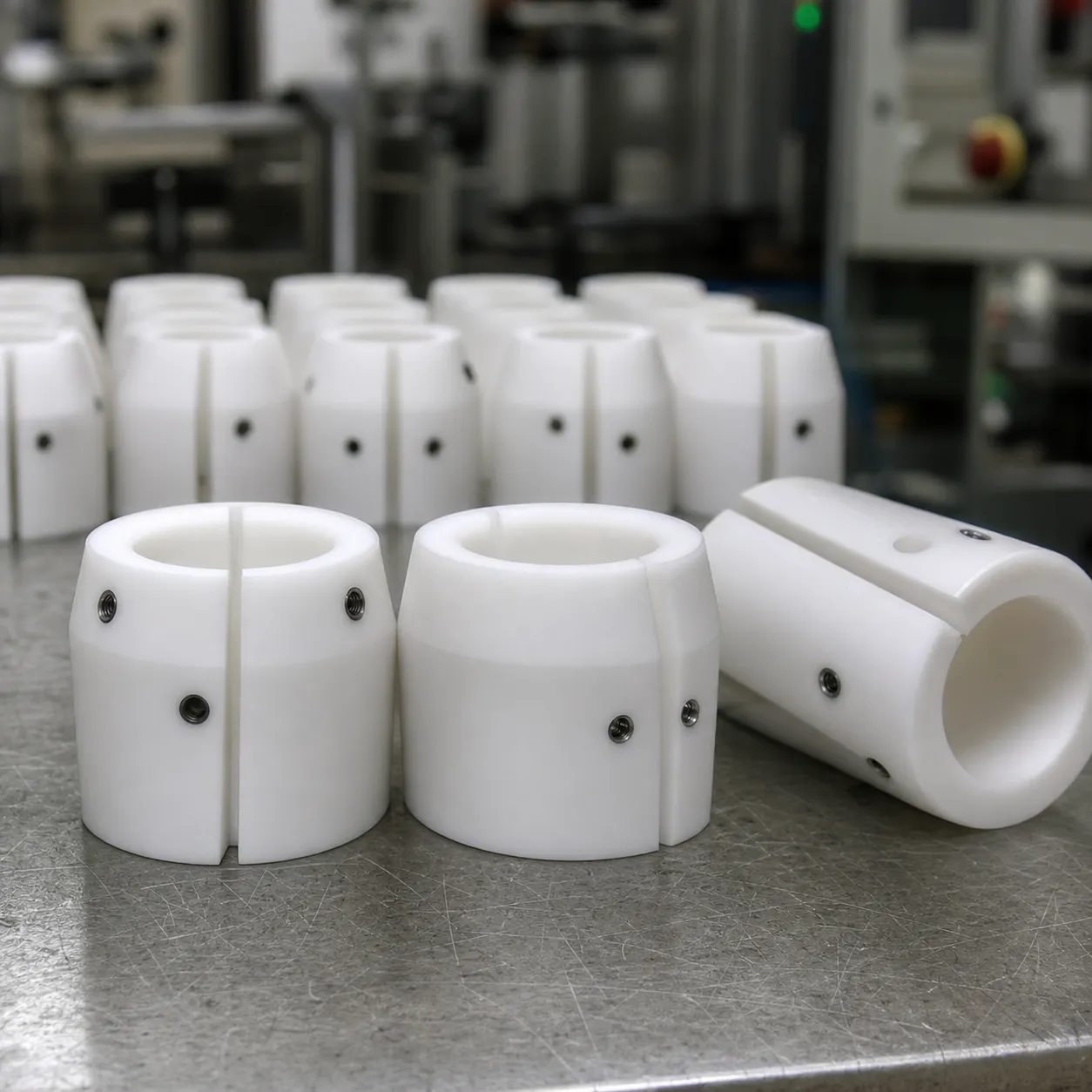
POM bottle neck guides are precision-machined components that support and control containers by their neck as they move through bottling conveyor systems. Installed along transfer sections, filling equipment, and related packaging machinery, they help maintain a stable container path between operating stations.
These guides are commonly produced to match the bottle profile, neck finish, conveyor layout, and equipment configuration. Custom CNC machining allows the guide geometry to follow specific OEM or replacement-part requirements.
Why Polyoxymethylene (POM) Is Preferred for Guide Components
Polyoxymethylene, also known as POM or polyacetal, is well suited to guide applications because it combines:
- Low-friction movement for smooth container handling
- Wear resistance for repeated contact during production
- Stable dimensional performance for accurate bottle control
- Machinability for custom neck profiles, pockets, and mounting features
For food, beverage, and liquid-processing equipment, POM parts can also be supplied with material traceability and applicable food-contact compliance documentation. The selected material grade should match the operating and regulatory requirements of the application.
How Neck Guides Ensure Smooth Operation on Filling Lines
Bottle neck guides help keep containers correctly positioned as they pass through filling, transfer, and capping sections. Consistent guidance supports accurate alignment with machine components and helps reduce unstable movement, contact damage, and interruptions caused by poor tracking.
For OEM machinery and packaging line integration, CNC-machined guides can be produced from CAD files, physical samples, or dimensioned photos. DFM review, first-article inspection, and CMM dimensional verification help confirm that the finished component fits the intended filling-line assembly.
Key Benefits of Using POM Material for Bottle Neck Guides
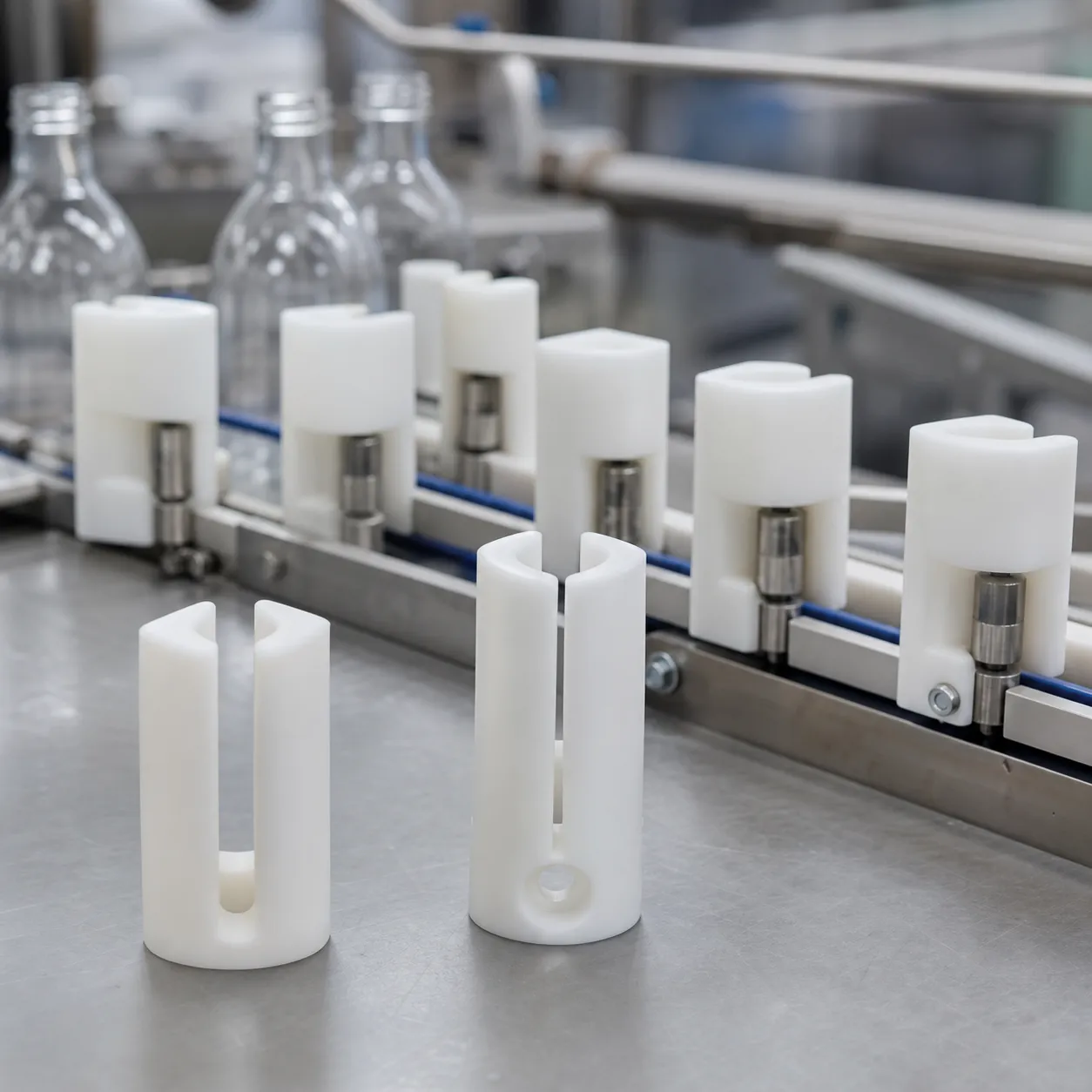
POM bottle neck guides for filling lines provide a practical balance of low friction, wear resistance, dimensional accuracy, and cleanability. These properties support stable bottle movement across conveyors, filling stations, and capping machine lines.
High Wear Resistance and Low Coefficient of Friction
POM, also known as polyacetal, supports smooth container transfer with limited sliding resistance. Its wear-resistant surface is suitable for bottle handling components that operate continuously in packaging automation systems.
Key benefits include:
- Smooth movement along guide rails and contact surfaces
- Reduced friction during bottle transfer
- Reliable performance in high-use bottling equipment
- Lower risk of premature guide surface wear
For a material comparison, our guide to UHMW-PE, POM, and PEEK for food conveyors explains the main differences between these engineering plastics.
Precision Alignment and Prevention of Line Jams
Accurate neck guidance helps maintain container orientation as bottles move through the line. CNC-machined POM guides can be produced to the required bottle profile and mounting dimensions, supporting consistent alignment at transfer points and filling stations.
| Alignment benefit | Production value |
|---|---|
| Stable bottle positioning | Supports consistent nozzle and closure alignment |
| Accurate guide geometry | Helps reduce unwanted bottle movement |
| Consistent dimensions | Supports repeatable replacement part fit |
| Smooth transitions | Helps limit transfer interruptions |
ZSCNC provides precision CNC machining with dimensional control down to ±0.002 mm, subject to the part design and inspection requirements.
Chemical Resistance and Hygienic Compliance
POM components are suitable for wet bottling environments and can withstand continuous moisture and aggressive clean-in-place chemicals. For food, beverage, and dairy equipment, we support material traceability with mill sheets and food-contact compliance certifications.
Sanitary design also matters. Smooth, burr-free surfaces help reduce crevices where residue could collect. Dimensional inspection, IQC/OQC controls, and material documentation support reliable quality verification for OEM and replacement components.
Noise Reduction and Protection Against Bottle Scuffing
Low-friction POM contact helps bottles move smoothly through guide sections without unnecessary rubbing. This can reduce surface scuffing during filling, transfer, and capping operations.
A well-fitted neck guide should provide:
- Controlled contact with the bottle neck
- Smooth passage through conveyor curves and transfers
- Reduced risk of visible bottle marks
- Consistent support without excessive pressure
Proper machining and alignment remain important. Even a wear-resistant material can cause bottle damage if the guide profile, spacing, or mounting position does not match the container.
Common Types and Custom Designs of POM Neck Guides
Adjustable Neck Guide Rails for Variable Container Sizes
I use custom-machined POM guide rails to support stable bottle movement across different container formats. Adjustable mounting points help operators set the rail position to match bottle dimensions and line layouts. For broader conveyor guidance options, see our food-grade UHMW-PE guide rails and wear strips.
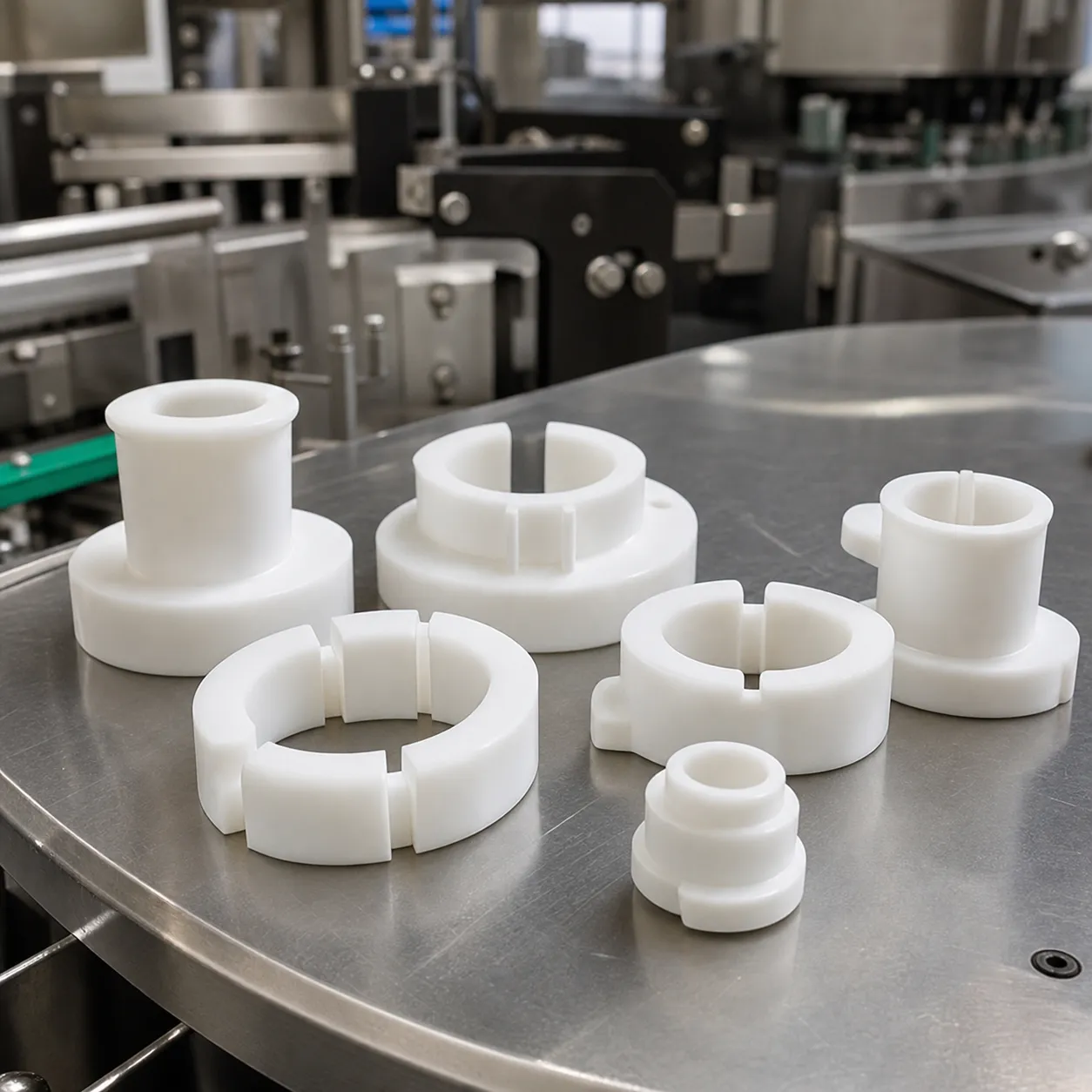
Custom Machined POM Starwheels and Infeed Guides
Custom POM starwheels and infeed guides can be produced from CAD drawings, physical samples, or dimensioned photos. CNC milling and 5-axis machining support accurate pockets, profiles, and mounting features for bottle transfer and container orientation.
Neck-Hanging Guides for High-Speed PET Lines
Neck-hanging guides control PET bottles by the neck during conveyor transfer and filling-line handling. We can review the bottle profile, guide path, and mounting arrangement through a DFM process before first-article production.
Applications Across Bottling and Packaging Industries
Beverage and Edible Oil Filling Lines
We supply custom-machined POM bottle neck guides for filling lines used in beverage, liquid food, and edible oil packaging equipment. These guides support stable bottle transfer between conveyors, filling stations, and capping machine lines while helping reduce friction and surface scuffing. They can be engineered for rotary or linear equipment based on the container profile and line layout. Our beverage processing industry solutions cover precision components for demanding bottling environments.
Pharmaceutical and Health Product Packaging
POM neck guides support controlled container movement in pharmaceutical and health product packaging automation. Their low-friction surface helps maintain consistent container orientation during conveying, filling, and transfer operations. For applications with strict hygiene requirements, we provide material traceability and dimensional inspection to support OEM quality documentation.
Cosmetics, Household, and Chemical Product Bottling
In cosmetics, household, and chemical product bottling, neck guides help maintain alignment through filling and packaging stations. We machine each component to match the bottle neck, conveyor arrangement, and required mounting geometry. Our packaging industry components are produced with CNC milling, turning, or 5-axis machining for both replacement parts and custom equipment builds.
How to Select the Right POM Bottle Neck Guides
Evaluating Container Dimensions and Neck Finish
We match each POM bottle neck guide to the container’s neck diameter, profile, height, and neck finish. Accurate dimensions help maintain stable bottle control through filling, capping, and transfer points. For a reliable fit, we review STEP, DWG, IGES, or PDF files, along with physical samples or dimensioned photos.
Conveyor Speed and Production Capacity Considerations
The guide geometry should suit the conveyor layout, transfer points, and operating speed. Correct alignment helps reduce bottle movement, contact marks, and unplanned line interruptions. We support custom components for bottling conveyor systems and can review the complete application during the DFM process. Our CNC-machined conveyor components are produced for packaging and processing equipment requirements.
Custom Engineering vs. Standard OEM Replacement Parts
Standard OEM replacement parts can be suitable when the original dimensions and mounting points remain unchanged. Custom engineering is a better fit when the line uses a different container format, modified neck finish, or non-standard mounting arrangement.
We provide DFM feedback, first-article prototypes, and production support for custom POM Bottle Neck Guides for Filling Lines. Dimensional inspection with CMM equipment and material traceability help confirm that the finished parts meet the approved design.
Maintenance and Care for Long-Lasting POM Bottling Components
Inspection Routines for Mechanical Wear and Alignment
Regular checks help keep POM bottle neck guides for filling lines stable and accurate. I recommend inspecting:
- Guide surfaces for grooves, deformation, cracks, or excessive wear
- Mounting points, fasteners, and adjustment features for looseness
- Alignment rails for position changes or uneven bottle movement
- Contact areas for bottle scuffing, vibration, or repeated line jams
For critical OEM components, dimensional inspection can confirm that the guide remains within the required design specification.
Cleaning and Sanitization Best Practices
Clean POM neck guides according to the filling line’s sanitation procedure and the material supplier’s recommendations. Remove product residue from contact surfaces, rinse thoroughly, and allow the parts to dry before restarting the line.
Avoid practices that can damage the machined surface or create burrs. Where food-contact use applies, maintain material traceability and use components with the required compliance documentation.
Signs It Is Time to Replace Bottle Neck Guides
Replace a POM bottle neck guide when wear begins to affect container control or line performance. Common signs include:
- Persistent bottle scuffing or unstable neck guidance
- Visible cracks, deformation, deep grooves, or damaged edges
- Repeated jams after alignment adjustments
- Loose mounting areas that cannot hold the correct position
- Measured dimensions falling outside the approved drawing requirements
Replacing worn guides early helps protect downstream equipment and supports consistent filling and packaging operation.